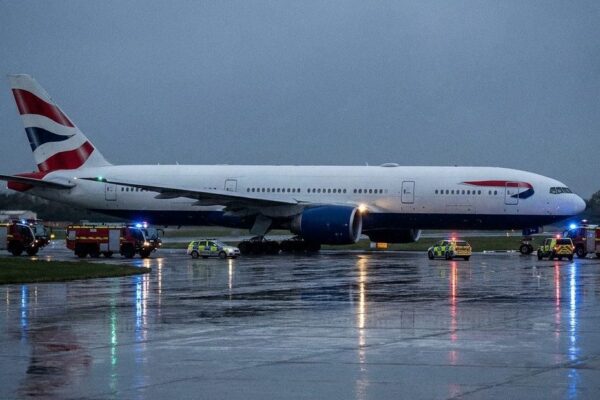

U.S. and European aviation regulators have proposed CFM56-7B fan blade inspections after a fan blade separated on a Boeing 737-800 and sent debris through the fuselage. The proposed airworthiness directive from the Federal Aviation Administration, published Oct. 27 in the Federal Register, would cover all CFM International Model CFM56-7B engines.
The European Union Aviation Safety Agency issued a parallel proposed airworthiness directive, PAD 26-130, on Oct. 26. Neither document names an operator or flight. The FAA notice describes the prompting event as involving a 737-800 with CFM56-7B26/3 engines, and the details match the July 10 Malta Air event documented in a preliminary report by the National Transportation Safety Board.
FlightGlobal reported the proposals in connection with the Malta Air 737-800.
What the FAA’s CFM56-7B fan blade inspections would require
According to the FAA, the proposed AD “was prompted by an event involving a CFM Model CFM56-7B26/3 engine where a fan blade separated and resulted in an engine in-flight shutdown (IFSD) with debris penetrating the fuselage, which caused a loss of pressurization and prompted an emergency descent.”
The rule would require a visual inspection of the fan blades under CFM Service Bulletin CFM56-7B S/B 72-1119, dated Sept. 8, 2026. Inspectors would look for findings considered not serviceable: “cracks, tears, tip curls, local distortion on leading edge.”
Installed engines would have to be inspected within 400 flight cycles or 90 days after the AD takes effect, whichever comes first.
A blade that fails would have to be replaced before further flight, and the adjacent clockwise blade would also be inspected and replaced if it fails. Results with unserviceable findings would go to CFM within 30 days.
The FAA estimates the proposal would affect 3,450 engines on U.S.-registered airplanes. At one work-hour and $85 per engine, inspections would cost U.S. operators $293,250 in total. Replacing a blade is estimated at $51,485.
The agency calls the proposal interim action. “The inspection reports that are required by this AD will enable the manufacturer to obtain better insight into the nature, cause, and extent of the fan blade failure, and eventually allow the manufacturer to develop final action to address the unsafe condition,” the FAA said.
EASA’s parallel proposal and a shortened comment period
EASA’s proposal covers CFM56-7B engines installed on Boeing 737-600, -700, -800, -900 and -900ER airplanes, among others. Its consultation closes Nov. 23.
“The released fan blade was initially contained by the engine case, but there was subsequent uncontained forward release of debris. Preliminary investigation determined that the event was due to a fracture in the blade, which had initiated from the fan blade dovetail,” EASA said.
The agency warned that the condition “could lead to fan blade failure, possibly resulting in uncontained forward release of debris.” It would also require a one-time visual inspection of each fan blade within 400 flight cycles or 90 days.
The FAA set a 30-day comment period instead of the standard 45 days, with comments due Nov. 27. The agency said the shorter window aligns its action with EASA’s and reflects “the recent in-service engine event.”
The Malta Air event in the NTSB preliminary report
On July 10, Malta Air, doing business as Ryanair flight 1879, suffered a No. 2 engine fan-blade-out failure while climbing out of Thessaloniki, Greece, bound for Memmingen, Germany. Fragments breached the fuselage, the cabin depressurized and the crew returned to Thessaloniki.
One of the 155 people aboard was seriously injured, as detailed in earlier coverage of the failure over Greece.
The NTSB found the No. 10 fan blade fractured through the dovetail in the blade root, with about 37% of the fracture surface showing features consistent with high amplitude fatigue. The blades had passed an ultrasonic inspection 253 cycles before the flight with no findings, as reported in August.
“Determination of any relevant similarities or details between this accident and previous events remains under investigation,” the NTSB said. Its report is preliminary and subject to change.
Leading-edge deformation and bird remains under scrutiny
The NTSB reported rounded deformation on the leading edges of blades Nos. 8, 9, 12 and 21. Bird remains, including feathers, were recovered from the engine and sent with blade samples to the Smithsonian Institution Feather Identification Lab.
Four suspected bird strikes to that engine were reported in the 12 months before the accident. Follow-up maintenance found no damage.
No cause has been determined, and the manufacturer’s root-cause investigation is ongoing. However, the FAA said “preliminary investigation indicates deformation to the fan blades induced a localized vibratory response in the failed blade.”
For maintenance crews, that preliminary finding puts the focus on blade shape. The proposed visual check targets tip curls and local distortion on the leading edge, the kinds of deformation investigators are now examining.
Subscribe to FODNews for continuing coverage of FOD incidents and prevention worldwide.
Sources
- Federal Register — “Airworthiness Directives; CFM International, S.A. Engines” (Oct. 27, 2026)
- European Union Aviation Safety Agency — “PAD 26-130: Engine – Fan Blades – Inspection” (Oct. 26, 2026)
- National Transportation Safety Board — “Aviation Investigation Preliminary Report DCA26FA274”
- FlightGlobal — “Forward debris release after 737 engine blade fracture spurs CFM56 inspection directive” (Oct. 26, 2026)