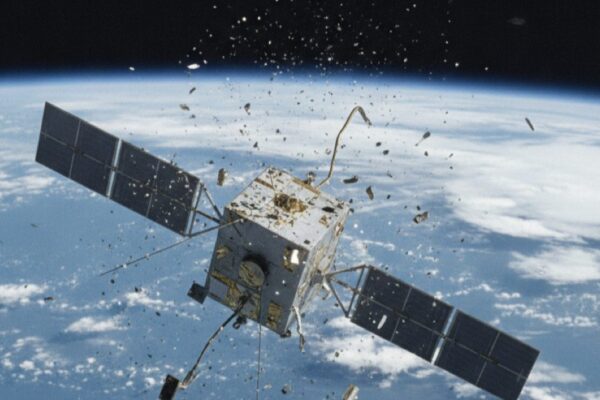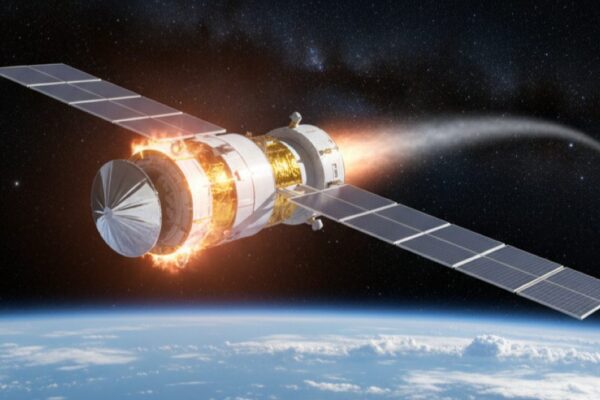

More than 300 rockets lifted off in 2025. They carried over 4,000 new payloads into orbit — an average of roughly ten spacecraft launched every day. On the other side of the ledger, just over three intact satellites and rocket bodies fell back into the atmosphere on an average day. That gap is why orbital debris risk in low Earth orbit just got measurably worse. Not gradually, either. The European Space Agency‘s newly released 2026 Space Environment Report puts the decline at an entire order of magnitude in a single year.
ESA’s Space Debris Office has published the annual report since 2017. Its purpose is to track whether international debris-mitigation efforts are keeping pace with the growth of space activity. The 2026 edition covers data through the end of 2025, and it’s the bluntest version yet. Growth is outrunning cleanup. In short, prevention alone is no longer enough.
A Widening Gap Between Launches and Reentries
The headline numbers describe an orbital environment expanding faster than it can be managed. Large satellite constellations and rideshare missions mean more spacecraft are deployed per launch than ever. Single-payload missions are becoming rare. Satellites are also no longer staying put in established orbital bands. ESA flagged a new trend: constellations shifting altitude significantly from year to year. That complicates the tracking and coordination work needed to avoid collisions.
Not enough satellites are leaving congested orbits once they reach the end of their operational lives, the report found. That lag is a primary driver of rising collision risk. ESA also reported a growing number of tracked objects that can’t yet be linked to a specific satellite, rocket, or fragmentation event. Detection technology, in other words, is outpacing the ability to identify what’s actually up there.
Health Index Jumps From 4 to 50
To make the trend legible in a single figure, ESA uses what it calls the Space Environment Health Index. The benchmark was set in 2014 against a reference scenario built on strong debris-mitigation compliance. Anything above that baseline represents added strain on the orbital environment beyond what’s considered sustainable.
In the 2026 report, that index climbed from roughly 4 to roughly 50 in a single year. The long-term effect of 2025’s space activity is now an order of magnitude further from sustainable than it was in 2024. ESA’s forward projections tell a similar story. The agency shortened its forecasting horizon from 200 years to 100 years, aiming for firmer, more grounded data. Even so, the expected number of future objects and collisions in low Earth orbit still came in sharply higher than last year’s outlook.
The Kessler Syndrome Risk Is Becoming Visible Sooner
ESA’s report frames the core danger differently than raw launch counts might suggest. The real threat is a self-reinforcing cycle: collisions generate fragments, and those fragments go on to cause further collisions. That phenomenon is known as Kessler syndrome. It means the debris population can keep growing even if launch activity stopped entirely, because fragmentation events already in motion generate debris faster than it can naturally reenter the atmosphere.
FODNews has tracked several individual incidents that fit squarely inside this trend line. A Chinese Yaogan-50 (02) reconnaissance satellite broke apart in orbit this year, scattering more than 43 tracked fragments. A Long March 6C upper stage fragmented into hundreds of pieces after reaching orbit. Each event reads as an isolated incident on its own. ESA’s report is the data confirming they’re part of a broader, accelerating pattern instead.
A New Metric: Risk on the Ground
For the first time, the 2026 report includes a dedicated measure of on-ground casualty risk from debris that survives atmospheric reentry. ESA is careful to note the absolute probability remains low next to everyday risks people accept without a second thought. But the trend is climbing, driven by the same combination of more launches, more satellites, and more reentries described elsewhere in the report.
ESA points to two mitigations. The first is shifting more reentries from uncontrolled to controlled trajectories. The second is wider use of “design-for-demise” spacecraft engineering, which aims to have satellites burn up as completely as possible rather than shedding surviving debris toward the surface. The report notes that controlled rocket-body reentries have now outnumbered uncontrolled ones for a second consecutive year. That’s modest progress, even as the broader debris trendline worsens.
Disposal Targets Are Tightening
One bright spot sits inside an otherwise grim assessment. Still, operators are increasingly disposing of spacecraft faster. The report tracks a shift in low Earth orbit disposal guidance, moving from the long-standing 25-year post-mission benchmark toward a much tighter 5-year target. The goal is to push dead satellites and rocket stages out of congested altitudes sooner, rather than letting them linger for decades as tracking-and-collision liabilities.
Faster disposal alone isn’t solving the underlying math, though. FODNews reported on that same gap last year with the Pentagon’s active debris removal push. As of that reporting, no robotic servicer had ever successfully captured an uncontrolled satellite, despite the technology being treated as essential to any real fix. ESA’s own answer is the Zero Debris Approach: a target to sharply limit new debris from all of the agency’s missions by 2030. That effort is backed by the multinational Zero Debris Charter, which ESA helped establish in 2023, and by demonstration missions like ClearSpace-1, designed to prove active debris removal can work at all.
Why This Orbital Debris Risk Matters Beyond One Report
Individual breakup and near-miss stories tend to read as discrete events with discrete causes. A Chinese rocket stage fragments. A falling-debris warning goes out to ships and aircraft. A satellite passes uncomfortably close to another spacecraft. ESA’s annual report is the mechanism that ties them together into a single trendline. This year’s trendline is the worst one the agency has published: an order-of-magnitude jump in a single year, arriving despite genuine progress on faster disposal and more controlled reentries.
ESA’s own conclusion is unambiguous. Preventing new debris remains necessary, but it’s no longer sufficient on its own. Active removal of objects already in orbit is now treated as a requirement, not an aspiration, if the agency’s stated 2030 target is going to mean anything.
Sources
- European Space Agency: ESA Space Environment Report 2026
- ESA Space Debris Office: Space Environment Report 2026 (full PDF)
- Space & Defense: ESA report warns growing satellite traffic is worsening orbital debris risks
- Innovation News Network: ESA Space Environment Report warns space debris threat is accelerating
Want more coverage like this? Subscribe to FODNews for ongoing tracking of orbital debris events and FOD incidents worldwide.