
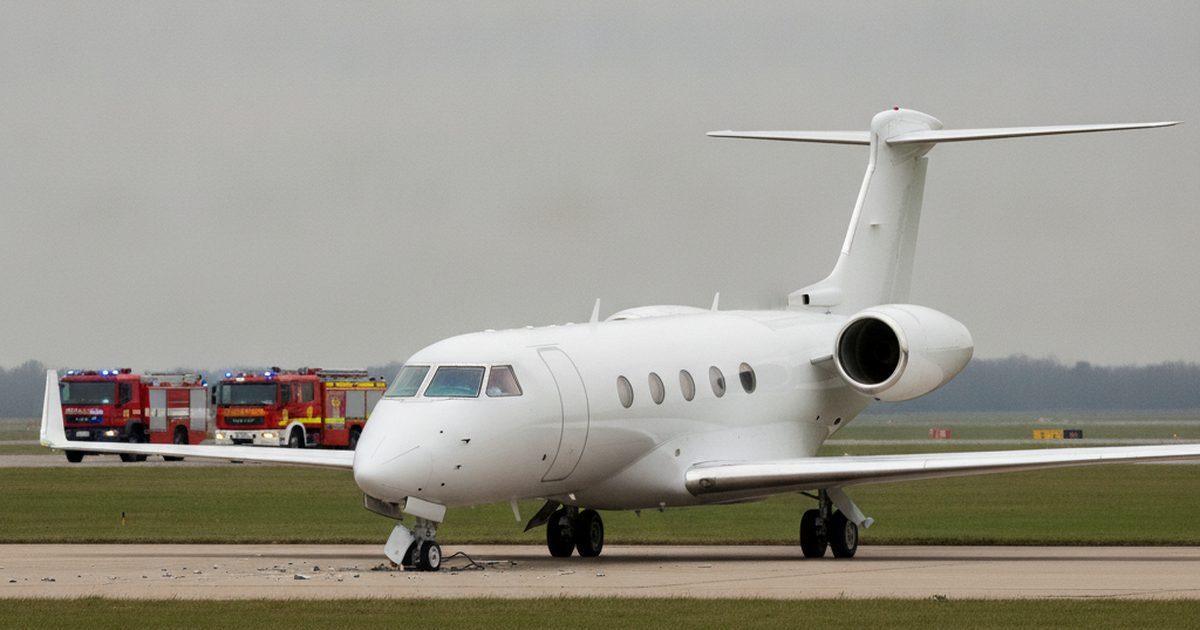
A missing secondary safety pin let a Gulfstream nose gear pip pin walk out of position on landing. The gear itself separated on the runway at Spirit of St. Louis Airport. A National Transportation Safety Board preliminary report, released Sept. 14, lays out how it happened.
The Part 135 on-demand charter, N406JS, was carrying three crew and seven passengers. The flight had departed Eagle County Regional Airport in Colorado on Aug. 14, 2026. None of the 10 people aboard suffered injuries. However, the accident left a debris trail across Runway 8R and the surrounding grass at Spirit of St. Louis Airport (KSUS) in Chesterfield, Missouri. The NTSB still hasn’t located one missing gear component.
What Went Wrong With the Gulfstream Nose Gear Pip Pin
According to the NTSB, ground crew at Eagle County couldn’t seat the nose landing gear’s pip pin during the preflight inspection. The pip pin is the removable pin that connects the upper torque link, or scissor link, to the nose-wheel-steering actuator. The pilot installed the pip pin himself. However, he forgot the secondary safety pin that’s designed to keep it locked in place.
Before departure, the crew got a “STEER BY WIRE FAIL” cockpit alert. They ran the checklist, and the warning cleared. On approach into KSUS, after the gear came down, the identical warning reappeared. This time it didn’t clear. When the nose wheel touched Runway 8R, it developed a shimmy. The nose landing gear separated from the airframe, and the left main gear collapsed. Consequently, the aircraft veered left into the grass and came to rest upright.
What’s Missing From the Runway
Investigators recovered the pip pin itself from the runway and grass, still holding three of its four ball locks. They never located the fourth ball lock or the gear’s entire upper scissor link. Crews also recovered the safety pin intact, still clipped to its lanyard and sitting in the open position — exactly where it would sit if no one had ever engaged it. Additionally, the NTSB pulled the cockpit voice and flight data recorders and sent them to its Vehicle Recorders Laboratory in Washington, D.C. The agency has retained the wreckage while the investigation continues under case number CEN26LA290.
A Familiar Failure Mode
This isn’t the first time a Gulfstream IV’s nose-gear pip pin has ended up as runway debris. A nearly identical accident occurred at Fort Lauderdale Executive Airport on Aug. 21, 2021 (NTSB case ERA21LA336). Ground crew towing a different G-IV couldn’t get the pip pin’s locking balls to release normally. They reinstalled it anyway and left its safety pin hanging unsecured on its lanyard without telling the flight crew. During the takeoff roll, the pip pin worked its way out and the nose gear developed a violent shimmy. The crew’s rejected takeoff still ended with the gear separating and the airplane veering off the runway, damaging a wing. All 14 aboard escaped injury. The NTSB’s probable-cause finding in that case blamed the flight crew for not catching the missing safety pin during preflight — the same last line of defense that didn’t hold at KSUS five years later.
Two accidents, two airports, one recurring gap: a two-step securing procedure on a common bizjet gear design. This procedure has a documented history of the second step getting skipped under time or communication pressure. Consequently, the NTSB’s continued teardown of the recovered St. Louis wreckage should help determine why the gear failed. Investigators are still examining whether the pin separation alone explains the collapse, or whether the still-missing ball lock and scissor link point to other mechanical factors.
Sources
- AIN Online — “Forgotten Safety Pin Preceded Gulfstream IV Excursion” (Sept. 14, 2026)
- avi-go.com — “Forgotten Safety Pin on Nose Gear Preceded Gulfstream IV Runway Excursion at KSUS” (Sept. 14, 2026)
- National Transportation Safety Board. Preliminary Report, accident CEN26LA290. data.ntsb.gov
- National Transportation Safety Board. Aviation Investigation Final Report, accident ERA21LA336, Fort Lauderdale Executive Airport (Aug. 21, 2021).
- FODNews — Lufthansa 787-9 Nose Gear Collapse at Frankfurt: BFU Points to Tool-Control Failure
Stay informed — subscribe to FODNews for daily coverage of FOD incidents and prevention worldwide.