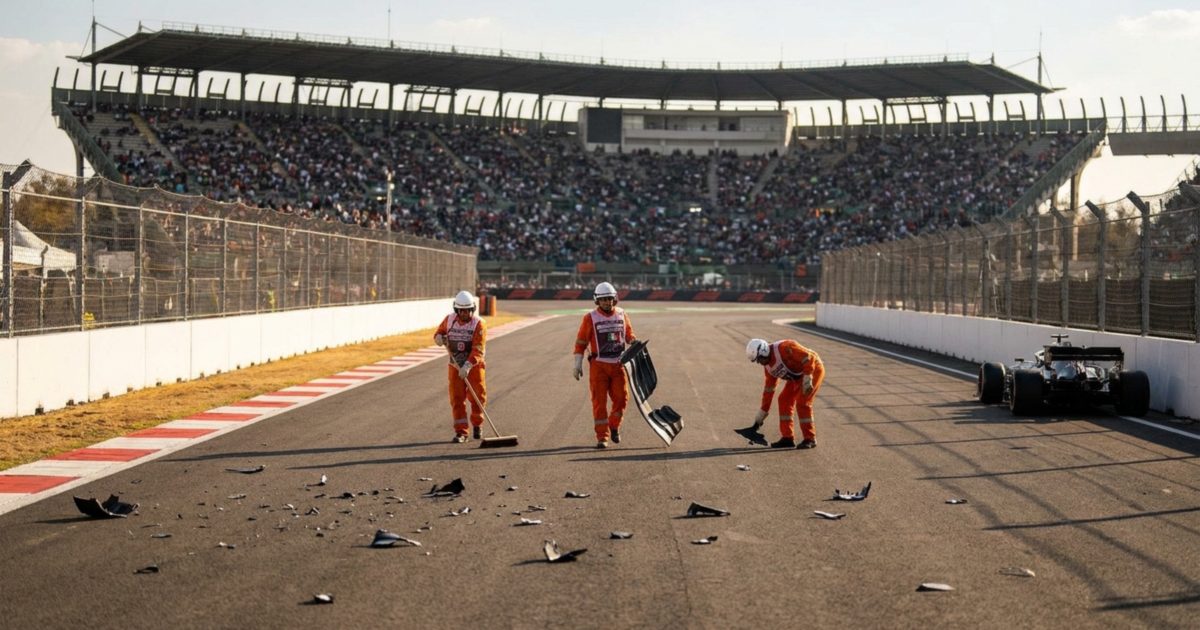
MEXICO CITY — Second practice for the Mexico City Grand Prix was stopped with a red flag on Oct. 30 so debris could be recovered after Max Verstappen and Liam Lawson tangled in the stadium section, Formula 1 reported.
The FIA stewards reviewed video and data, spoke to both drivers and gave each a one-place grid drop and a penalty point. According to the stewards, “Both drivers admitted the moves were unnecessary and ‘clumsy’.”
Racing Bulls team boss Alan Permane said much the same: “I think one word, just ‘unnecessary’ in a practice session; completely unnecessary, and I say that to both of them.”
What happened in the stadium section
Neither driver had run in first practice, because rookies Ayumu Iwasa and Nikola Tsolov drove their cars. That meant second practice, known as FP2, was their first time on track at Autódromo Hermanos Rodríguez that weekend.
The Red Bull driver passed Lawson going into Turn 12. Lawson then tried to retake the position at the next left-hander through the stadium section.
Verstappen bounced over the curb on the exit and rejoined alongside Lawson, “causing damage to the Red Bull’s floor and Racing Bulls’ front wing,” Formula 1 reported. Like the rest of an F1 car’s bodywork, those parts are made of carbon fiber.
“A red flag was thrown to recover the debris, and both drivers picked up their practice programmes – Verstappen finishing P5 and Lawson P9,” Formula 1 reported.
Stewards escalate from a warning to grid penalties
According to the stewards, neither car was on a flying lap. “On the approach to Turn 12, Car 3 [Verstappen] was on a preparation lap and Car 30 [Lawson] was on a cool down lap preparing for another push lap,” they wrote.
They also pointed to a warning issued earlier that day. “The drivers of both cars behaved in a manner that was considered unacceptable by the stewards particularly in view of the warning that had been given at the Team Managers meeting earlier this day,” the decision said.
“Noting that there had been similar incidents this year of actions between drivers in Free Practice,” the stewards imposed grid penalties rather than a formal warning.
Verstappen had criticized Lawson for “not very smart behaviour,” Formula 1 reported. Permane didn’t take sides: “Mine is it’s just not needed, and they can both do better.”
Race day brings two more stoppages
Wreckage stopped the race on Nov. 1 as well. “Valtteri Bottas crashed his Cadillac at Turn 1 on Lap 44 after an apparent suspension failure at high speed. The Safety Car was then sent out before the race was stopped on the following lap to allow the car to be removed and the barriers repaired,” Formula 1 reported.
McLaren wrote that “Valtteri Bottas was pitched into the barriers at Turn 1 after a car failure.” Bottas got out of the car unaided, and Cadillac later confirmed he had been released after precautionary medical checks, Grandprix.com reported.
On Lap 59, Arvid Lindblad of Racing Bulls and Oscar Piastri of McLaren made contact at the first chicane while fighting for seventh. Piastri’s front tire touched Lindblad’s left rear, “sending the latter skidding into the barriers,” according to Formula 1.
McLaren described the contact as “resulting in floor damage for Oscar, debris on track, and a second Safety Car.” Lindblad radioed that he was okay, and marshals cleared his car.
After the race, the stewards gave Piastri a 10-second penalty for causing the collision. “The Stewards determined that the collision could have been avoided if the driver of Car 81 had moved further to the left after turn 1, even if this involved leaving the track prior to turn 2,” they wrote. Piastri lost his seventh-place finish and his points.
Verstappen won the race, and Kimi Antonelli finished third to clinch the 2026 world championship, becoming the youngest champion in Formula 1 history at 20.
What the Mexico City Grand Prix debris and red flag show
There were no points on offer in the practice clash, yet a damaged floor and front wing still left debris on the racing line, and every car had to stop until it was recovered.
The same pattern repeated on race day. Once parts or wreckage were on the track, the race was neutralized or stopped until marshals cleared it. That holds for any place where machines share space: a minor bump can leave fragments in the path of whoever comes next, and work has to pause until someone picks them up.
That morning’s warning didn’t prevent the contact, so the stewards escalated from talk to penalties. Debris has stopped sessions before this season: barrier debris triggered three red flags at Madrid’s F1 debut, and Verstappen’s own crash at Zandvoort in August scattered debris and brought out a red flag.
Subscribe to FODNews for continuing coverage of FOD incidents and prevention worldwide.
Sources
- Formula 1 — “Max Verstappen and Liam Lawson get grid penalties after ‘clumsy’ Mexico City practice clash” (Oct. 30, 2026)
- Formula 1 — “2026 Mexico City Grand Prix: Race red flagged after Bottas crashes out” (Nov. 1, 2026)
- Formula 1 — “Piastri loses P7 after being handed post-race penalty at Mexico City GP” (Nov. 1, 2026)
- McLaren — “2026 Mexico City Grand Prix – Race Report” (Nov. 1, 2026)
- Grandprix.com — “Race Notes – Verstappen wins as Antonelli becomes world champion” (Nov. 1, 2026)