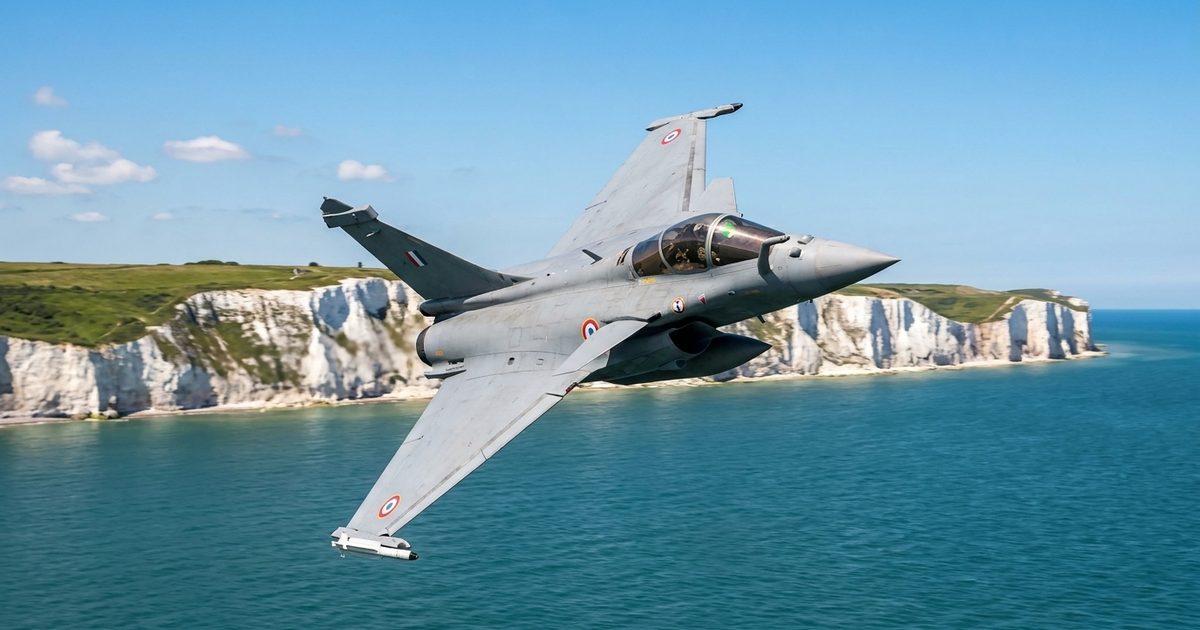
A Rafale bird strike over the English Channel forced a French Navy fighter jet into an emergency diversion to Exeter Airport in Devon, UK, on Tuesday. Even a modern twin-engine combat aircraft has no margin for error when a single bird finds its way into an intake.
The Rafale Marine is assigned to Landivisiau Naval Air Base (BAN) in Brittany. It was flying a joint training exercise with British armed forces at the time. The jet struck a bird over the Channel and began experiencing trouble in one of its two engines. The pilot then diverted to Exeter, the nearest suitable airfield identified at the time of the collision. It landed safely a few minutes later.
Rafale Bird Strike Triggers a Precautionary Response, Then Stand-Down
Exeter Airport said a precautionary emergency response met the jet, involving both airport resources and external agencies. All of those resources stood down once the aircraft was safely on the ground. No injuries were reported. Residents across the city said they heard the fighter overhead as it approached the airfield.
“A French Navy Rafale fighter jet requested to land on Tuesday afternoon after reporting an issue with one of its two engines while over the English Channel,” an Exeter Airport spokesperson said, according to the Mirror. “It was met by a precautionary emergency response including our own resources and external agencies, which all stood down when the aircraft landed safely without incident. The aircraft is awaiting inspection by engineers.”
Why a Bird Strike Grounds Even a Twin-Engine Fighter
The Rafale is designed with two engines specifically to tolerate the loss of one. However, French military procedure treats any bird strike as a landing emergency, regardless of redundancy. Ingestion can damage compressor blades or disrupt airflow. It can also trigger vibration that risks further engine failure if the aircraft keeps flying.
A French military spokesperson laid out that procedure directly: “On Tuesday, September 22, during a joint training exercise with the British armed forces, a Rafale Marine fighter jet from the Landivisiau Naval Air Base (BAN) was involved in a bird strike. In such cases, the procedure dictates that the aircraft must land as quickly as possible to ensure the safety of the pilot and the aircraft. The diversion airfield — the closest at the time of the collision — identified upstream was Exeter, in the United Kingdom. The Rafale Marine landed there a few minutes later.”
That single-bird vulnerability is a recurring theme in FODNews’s bird-strike coverage. For instance, a Texas Air National Guard F-16 was destroyed after a suspected bird strike that knocked out its engine over Michigan earlier this month. Overall, the pattern is a stark reminder that ingestion risk doesn’t discriminate by airframe or engine count.
Cross-Border Inspection Logistics
With the Rafale grounded on foreign soil, Landivisiau dispatched its base protection team to the UK. The team provides round-the-clock surveillance of the aircraft. A team of technicians then flew to Exeter the following morning to assess the jet’s structural integrity. The jet cannot fly back to Landivisiau until it clears that inspection. The technical investigation into the extent of the engine damage is ongoing. Officials have not announced a timeline for the aircraft’s return.
The episode illustrates the logistical tail that follows a single bird strike on a military asset operating abroad. It involves a security detail, an inspection team, and a diplomatically routine but operationally significant foreign-soil grounding. All of it was triggered by one bird over open water.
No Damage Reported at Exeter
Exeter Airport, a regional civilian field, does not typically host military fast-jet traffic. Even so, its diversion procedures for precautionary emergencies handled the arrival without disruption to the airport itself. The airport has not reported any impact to its own operations or infrastructure from the incident.
Subscribe to FODNews for ongoing coverage of bird-strike and engine-ingestion incidents across civil and military aviation.