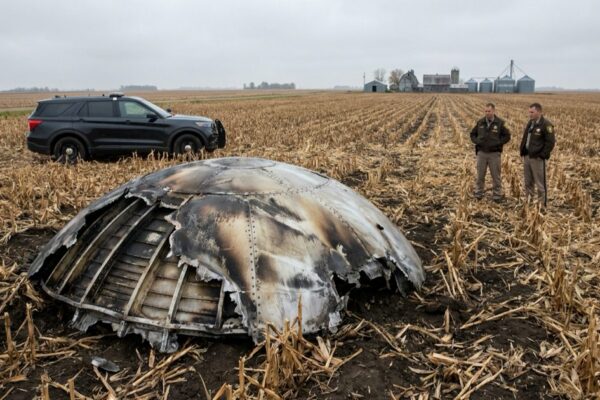

SAMPIT, Indonesia — A large, scorched metal fragment found on a palm oil plantation in Central Kalimantan is likely Zhuque-2E debris from a Chinese commercial rocket, according to Indonesia’s National Research and Innovation Agency, BRIN. A plantation worker found the object on Monday morning, Oct. 19, five days after a separate piece of suspected Zhuque-2E hardware was reported in a Minnesota cornfield.
The identification is not confirmed. BRIN astrophysicist Thomas Djamaluddin said orbital data indicate the object was likely part of the rocket. However, he said a physical examination is still needed to verify that the components and materials match the rocket’s specifications. Separately, airport head Abdul Haris told Kompas he could not yet confirm the objects were Chinese rocket fragments. Their origin and type would be known only after a study by competent parties, he said.
The Zhuque-2E is a methalox launch vehicle built by Chinese company LandSpace. LandSpace did not respond to a request for comment on the Borneo debris, according to a report republished by DNYUZ. AFP said it could not immediately reach the China National Space Administration.
What fell near Sampit
The fragment came down on a plantation near Sampit in East Kotawaringin District, about 3 km from the PT Agro Bukit housing complex, according to the Jakarta Post, which carried an AFP report. “It was just there. At first, I thought it might have been aircraft debris,” plantation worker Wardi Tamroni, 51, told AFP. “Fortunately, all the workers had already gone home, so no one was left in the plantation.”
Local police chief I Kadek Dwi Yoga Sidhimantra described “a fairly large aluminum plate measuring up to 9 meters with an irregular shape and visible burn marks.” AFP described the pieces as roughly car-sized.
On Tuesday, Oct. 20, a second piece turned up about 1 km from the first. “Its material also appears to be an aluminum alloy, but we will need to verify this,” civil aviation spokesman Zachrudien said. He added that there was no loss of life or property damage and no radiation or toxicity risk. The pieces were being examined at a nearby military airbase. Kompas reported that airport staff documented three suspect objects, while AFP reported two.
How BRIN linked the Zhuque-2E debris to an Oct. 14 launch
BRIN ties the fragment to a Zhuque-2E that lifted off Oct. 14 from the Dongfeng commercial space zone in northwest China carrying 10 satellites, according to Xinhua. The flight was designated Y4.
According to BRIN, the rocket’s remnant reentered on Sunday, Oct. 18, at about 5:36 p.m. local time, passing north to south over Kalimantan near Sampit. Residents reported hearing a rumbling sound at around the same time. “The alignment between the trajectory timing and residents’ reports strongly suggests that the object found in Sampit was part of the ZhuQue-2E rocket debris,” Djamaluddin said, as quoted by ANTARA. He explained that a rocket’s spent stages can stay in orbit for a while after a mission until atmospheric drag pulls them down.
Indonesian outlet Detik reported that the national transport safety committee, KNKT, noted the code “2ZQE31-20-15” on the fragment. Detik said the code resembles the rocket’s name, and that the debris was moved to Iskandar air base at Pangkalan Bun. FODNews could not independently verify the marking.
Two finds, two different flights
The Borneo fragment comes from a different flight than the object found in a Minnesota cornfield. That object was reported to the Stevens County Sheriff’s Office on Oct. 14. According to Ars Technica, a Zhuque-2E launched 10 satellites on Sept. 15, then reignited and deorbited itself, reentering about 75 to 80 minutes into the flight without completing an orbit. The Scott Township object measured about 11 feet across, matching the 3.35-meter diameter of the Zhuque-2E upper stage. LandSpace had not publicly acknowledged it, and Ars said the fall over land was “perhaps the result of a botched deorbit burn.”
The Borneo case differs. Under BRIN’s account, the rocket body stayed in orbit for roughly four days after the Oct. 14 launch before reentering. The two finds came days apart, while the flights were about a month apart. In June, a Zhuque-2E second stage that reached orbit on June 9 broke apart in low Earth orbit, and LeoLabs’ Darren McKnight estimated it produced 100 to 150 pieces.
Uncontrolled reentries as a ground FOD hazard
A spent stage left in orbit comes down wherever drag takes it, and nobody controls where the surviving metal lands. In Sampit, that was a working plantation. The finder told AFP the workers had already gone home for the day, and officials reported no injuries or property damage, but the fragments still became foreign object debris on open ground.
The ESA Space Debris Office has flagged the trend. “Although the re-entry risks are still relatively small, they have grown considerably from 2019 to 2024, mainly due to increased space activities,” it said in a report last year. FODNews has also tracked the agency’s newer 2026 space environment report, which found debris risk worsening. For Sampit, BRIN says physical examination is still needed, so the origin remains a strong suspicion rather than a confirmed match.
Subscribe to FODNews for continuing coverage of FOD incidents and prevention worldwide.
Sources
- BRIN — “Benda misterius jatuh di Sampit, BRIN ungkap jejak roket China Zhuque-2E” (Oct. 2026, in Indonesian)
- ANTARA — “BRIN traces Sampit space object to China’s satellite-launch rocket” (Oct. 21, 2026)
- Xinhua — “China’s Zhuque-2E rocket launches 10 satellites into space” (Oct. 14, 2026)
- Jakarta Post (AFP) — “Indonesia probes crash of suspected Chinese rocket fragment” (Oct. 20, 2026)
- Detik — “Logam Besar di Kebun Sawit Kotim Kalteng Ternyata Puing Roket Milik China” (Oct. 19, 2026, in Indonesian)
- Kompas — “Benda Asing Diduga Sampah Antariksa Jatuh di Kebun Sawit Kotim, Akan Dilaporkan ke KNKT” (Oct. 22, 2026, in Indonesian)
- DNYUZ — “Space Debris Found Twice Within Days Amid ‘Growing Casualty Risk’” (Oct. 22, 2026)
- Ars Technica — “A Chinese rocket deorbited over Minnesota and left this in a farmer’s cornfield” (Oct. 19, 2026)