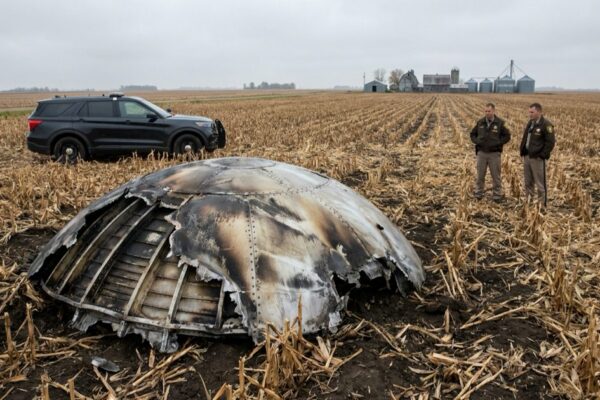

For the first time, scientists have completed a direct space debris pollution measurement. It tracks the chemical contamination generated when hardware burns up in Earth’s upper atmosphere. That event occurs more than three times a day, every day, around the globe.
The findings, published in Communications Earth & Environment — part of the Nature research portfolio — represent a milestone. Specifically, they reveal what happens when the growing inventory of orbital foreign object debris (FOD) comes back down. Until now, scientists had only modeled and estimated the atmospheric impact of reentering hardware. No study had directly observed it from a specific, identified object.
A Rocket Falls. Scientists Were Watching.
On the night of February 19–20, 2025, a SpaceX Falcon 9 upper stage made an uncontrolled reentry over Europe. It had failed its planned deorbit burn. The stage had launched 22 Starlink satellites. It shed debris across a wide swath of airspace, with fragments ultimately landing in Poland.
Roughly 100 km above Kühlungsborn, Germany, something unusual lit up on a lidar screen.
Researchers at the Leibniz Institute of Atmospheric Physics (IAP) were operating a high-sensitivity resonance fluorescence lidar. That ground-based laser system is capable of detecting trace elements at extreme altitude. When the Falcon 9 reentered, the instrument recorded a sharp spike in lithium vapor in the lower thermosphere. The timing matched the reentry event precisely.
“This is the first time a specific reentry event has been causally linked to measured upper-atmospheric pollution.” The study was led by Dr. Robin Wing and Dr. Michael Gerding of IAP.
Why Lithium? Why Does It Matter?
Lithium is nearly absent from Earth’s upper atmosphere under normal conditions. Natural meteor ablation contributes only about 80 grams of lithium globally per day — a trace so small it barely registers. A single Falcon 9 upper stage, by contrast, carries an estimated 30 kilograms of lithium. It is locked in batteries and aluminum-lithium structural alloys.
That contrast made lithium an ideal tracer. By tuning the lidar to lithium’s precise optical wavelength, the IAP team could detect the atom’s fingerprint at altitudes around 90–100 km. The sensitivity was extraordinary. The instrument recorded approximately a tenfold increase in lithium density at around 96 km altitude. That is exactly where modeling predicted the Falcon 9’s hull would begin melting.
Subsequently, back-trajectory modeling using European Centre for Medium-Range Weather Forecasts (ECMWF) atmospheric data traced the plume’s movement through the upper atmosphere. It confirmed a match with the Falcon 9 reentry path. The chain of evidence was tight enough to publish.
The Scale of the Reentry Problem
The broader context underscores why this measurement matters. According to the European Space Agency’s 2025 Space Environment Report, more than 39,000 objects are now catalogued in orbit. The breakdown: nearly 14,000 payloads, roughly 2,000 rocket bodies, and more than 23,000 debris fragments. Intact satellites or rocket bodies reenter Earth’s atmosphere at an average rate of more than three times per day.
Until the IAP study, the atmospheric chemistry of those reentries was largely theoretical. Researchers knew metals were being vaporized at altitude. They could not directly measure, event by event, what was going up in smoke — or precisely where.
As FODNews has previously reported, experts have long warned of a growing and underestimated risk from uncontrolled debris reentries. Those risks extend to aircraft and to populations on the ground. This new research, moreover, adds a chemical dimension to that threat.
What the Data Reveals — and What Comes Next
The February 2025 measurement was, in a sense, serendipitous. The IAP’s lidar system happened to be operational and pointed in the right direction at the right time. The researchers acknowledge that many reentries go unobserved, or occur over ocean or uninstrumented regions.
To address that gap, the IAP has been developing a next-generation multi-element lidar. It can simultaneously measure lithium as a space debris tracer and sodium as a meteor ablation tracer. Other metals in its detection range include copper, titanium, silicon, gold, and silver. The goal is a systematic baseline: how much of the material raining down from orbit is natural, and how much is human-made?
The answer has direct implications for atmospheric chemistry, satellite constellation policy, and debris mitigation frameworks. Lithium, for example, has known chemical reactivity at high altitudes. Furthermore, the cumulative effect of repeated mass-reentry events on upper-atmospheric composition remains an open scientific question.
ESA’s own research roadmap reflects the urgency. The agency is conducting targeted reentry observation campaigns with its retiring Cluster satellites in 2026. Additionally, its forthcoming Draco mission — scheduled for launch in 2027 — will carry more than 200 sensors and four cameras. It will document the reentry process from inside a reentering spacecraft for the first time.
Implications for Debris Governance
Policy has historically focused on the collision risk posed by debris in orbit. That includes the potential for cascading fragmentation events known as Kessler Syndrome. The IAP study, however, opens a second front: what happens downstream, when debris comes down.
ESA’s 2025 report found that only 40–70% of LEO payloads comply with the established 25-year post-mission disposal guideline. Compliance with the tighter five-year standard introduced in 2023 drops further, to just 20–55%. For rocket bodies specifically, controlled reentries have improved — rising from 10% to over 65% of disposals in the past decade. Consequently, 2024 marked the first year controlled reentries exceeded uncontrolled ones.
However, progress on controlled disposal does nothing to address the chemical footprint of objects allowed to reenter freely. That includes those that fail their deorbit burns — as the February 2025 Falcon 9 did.
Direct measurement is now possible. The science has caught up to the scale of the problem. Whether policy does the same remains to be seen.
Subscribe to FODNews for ongoing coverage of orbital debris, aviation FOD incidents, and airspace safety developments worldwide.
– Wing, R. & Gerding, M. et al. (2025). “Measurement of a lithium plume from the uncontrolled re-entry of a Falcon 9 rocket.” Communications Earth & Environment (Nature Portfolio).
– Universe Today. (2025). “Scientists Publish the First Direct Measurement of Space Debris Pollution.” universetoday.com
– European Space Agency. (2025). ESA Space Environment Report 2025. esa.int
– Leibniz Institute of Atmospheric Physics (IAP), Kühlungsborn. iap-kborn.de
– FODNews. (2024). “UK Experts Warn Space Junk Debris Reentry Strike Is Inevitable.” fodnews.com