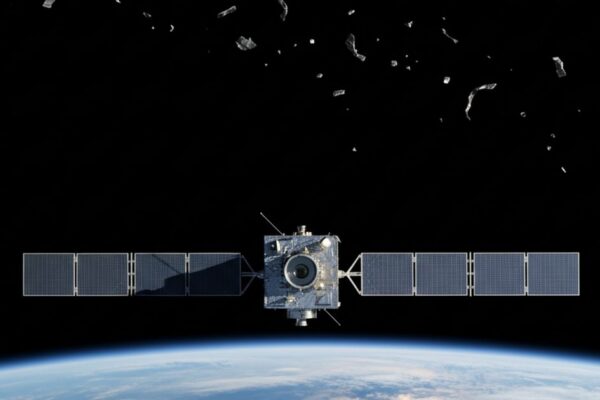
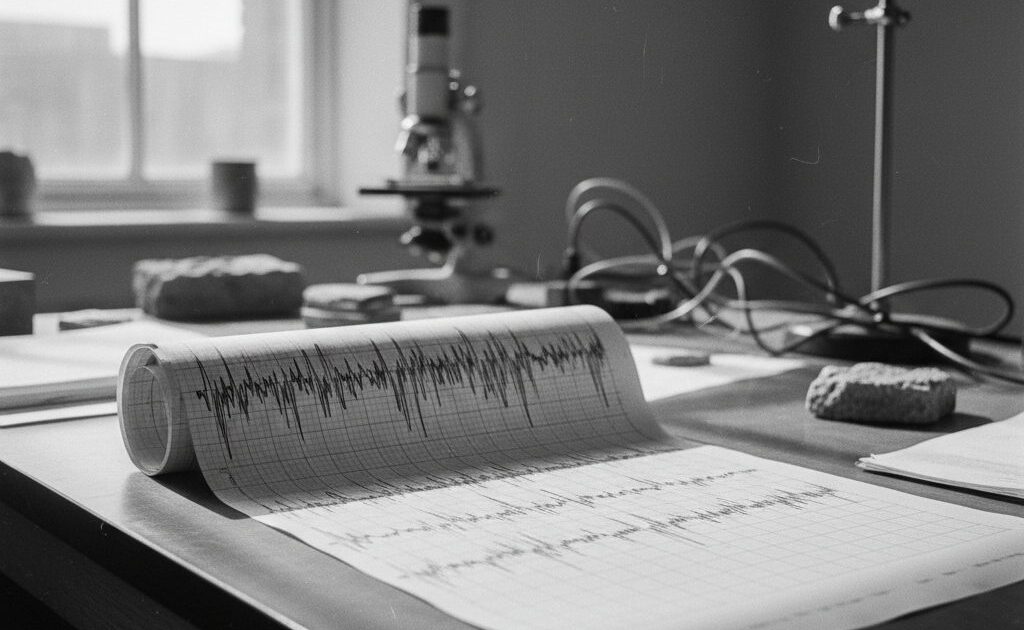
When Chinese space hardware screamed back through Earth’s atmosphere in April 2024, it left more than a light show in the Southern California sky. It left seismic signals — shockwaves strong enough to register on earthquake sensors across two states. The event marks a breakthrough moment for space debris seismic detection, and the findings could permanently expand how the world tracks falling orbital hardware.
That discovery, published in Science in January 2026, points toward a new era in debris monitoring — one that uses the global earthquake-detection network to track falling space objects with a precision that orbital radar alone cannot match.
A New Kind of Ground Truth
The study — authored by geophysicists Benjamin A. Fernando and Constantinos Charalambous — analyzed the April 2, 2024, reentry of China’s Shenzhou-15 orbital module, a roughly 1-meter-wide object weighing more than 1.5 tons that re-entered uncontrolled after completing its mission.
As the module plunged through the upper atmosphere at Mach 25 to 30 — roughly eight times faster than the world’s fastest jet — it generated powerful sonic boom shockwaves. Those pressure waves propagated downward and coupled with the ground, registering as seismic signals across approximately 127 monitoring stations in Nevada and Southern California.
Fernando and Charalambous developed what they call a “minimum-gradient fit” seismic inversion — a method that reconstructs a debris object’s full reentry behavior from the arrival times and amplitudes of those signals. From seismometer data alone, their approach recovered the trajectory, speed, altitude, descent angle, approximate size, and fragmentation pattern of the descending hardware.
Where the Predictions Failed
The implications for space situational awareness are significant. The U.S. Space Command had predicted the Shenzhou-15 module’s reentry path based on orbital tracking data. The seismic reconstruction placed the actual track roughly 25 miles south of that prediction — a meaningful discrepancy for anyone on the ground trying to assess risk in real time.
Traditional orbital tracking is highly accurate while objects remain in space. But once debris enters the upper atmosphere, atmospheric drag, object tumbling, and aerodynamic forces introduce compounding uncertainties. Radar and optical systems struggle to maintain contact during this critical phase.
Seismometers, it turns out, don’t have that problem. They simply listen for what arrives at the ground.
The researchers found they could reduce the time required to determine a debris fallout corridor from days to approximately 100 seconds after reentry — a timeline that could meaningfully help emergency responders and hazmat teams in cases involving toxic or radioactive materials surviving reentry.
Cascading Breakup Dynamics
The seismic data also revealed something unexpected about how the Shenzhou-15 module came apart. Rather than a single catastrophic breakup, the records showed cascading, multiplicative fragmentation — pieces breaking off and then themselves fragmenting at successive altitudes. This mirrors the kind of disintegration chain previously documented only in meteoroid impacts.
That distinction matters. The fragment size distribution and terminal velocity of debris reaching the ground depend heavily on when and how objects break apart. Knowing the fragmentation sequence improves predictions of where surviving pieces actually land — and how fast.
Repurposing the Earthquake Grid
Perhaps the most practical finding: the method requires no new infrastructure. Fernando and Charalambous used open-source data from seismic networks built and maintained for earthquake monitoring. Those networks already cover much of the geologically active world with dense arrays of sensitive sensors.
The researchers say deploying automated algorithms to screen continuous seismic data for debris-characteristic sonic boom signatures could convert the existing earthquake monitoring grid into a planetary-scale debris detection layer — with minimal modification to the underlying hardware.
They frame the approach as complementary to, not a replacement for, radar and optical tracking. It provides independent measurement of what actually happens during the in-atmosphere phase, when other systems lose fidelity.
A Growing Problem
The timing of this research is not coincidental. The European Space Agency’s 2025 Space Environment Report documented approximately 40,000 tracked objects in orbit — up from roughly 35,000 the previous year — with total reentries of large intact objects continuing to rise as low Earth orbit becomes increasingly congested.
Elevated solar activity near the current solar cycle peak is accelerating orbital decay rates, pushing more objects toward reentry on compressed timelines. As FODNews has previously reported, British researchers have concluded that debris strikes on populated areas are not a matter of if, but when — a risk that grows with every uncontrolled reentry.
For most reentries, most debris burns up completely. But some hardware — fuel tanks, engine bells, structural frames built to survive launch loads — arrives at the surface intact. Knowing where those pieces fall, and having 100 seconds rather than several days to narrow the search, is not a trivial improvement.
What Comes Next
Fernando and Charalambous flag two priorities for operationalizing their method: automated machine learning systems capable of flagging potential debris events in continuous seismic streams, and clear operational frameworks for who receives the resulting alerts and how those alerts feed into civil protection systems.
The first piece is largely a software engineering challenge on an existing infrastructure base. The second is a policy and coordination question involving national space agencies, emergency management bodies, and international monitoring organizations.
Neither is simple. But the underlying physics is now proven. The ground shakes when space junk comes home — and scientists are learning to listen.
Subscribe to FODNews for independent coverage of FOD incidents and prevention worldwide.
– Fernando, B.A. & Charalambous, C. (2026). “Reentry and disintegration dynamics of space debris tracked using seismic waves.” Science. DOI: 10.1126/science.adz4676
– European Space Agency. (2025). ESA Space Environment Report 2025. ESA Space Safety Programme.
– FODNews. “UK Scientists: Space Junk Debris Reentry Strike Is Inevitable.” FODNews.com.