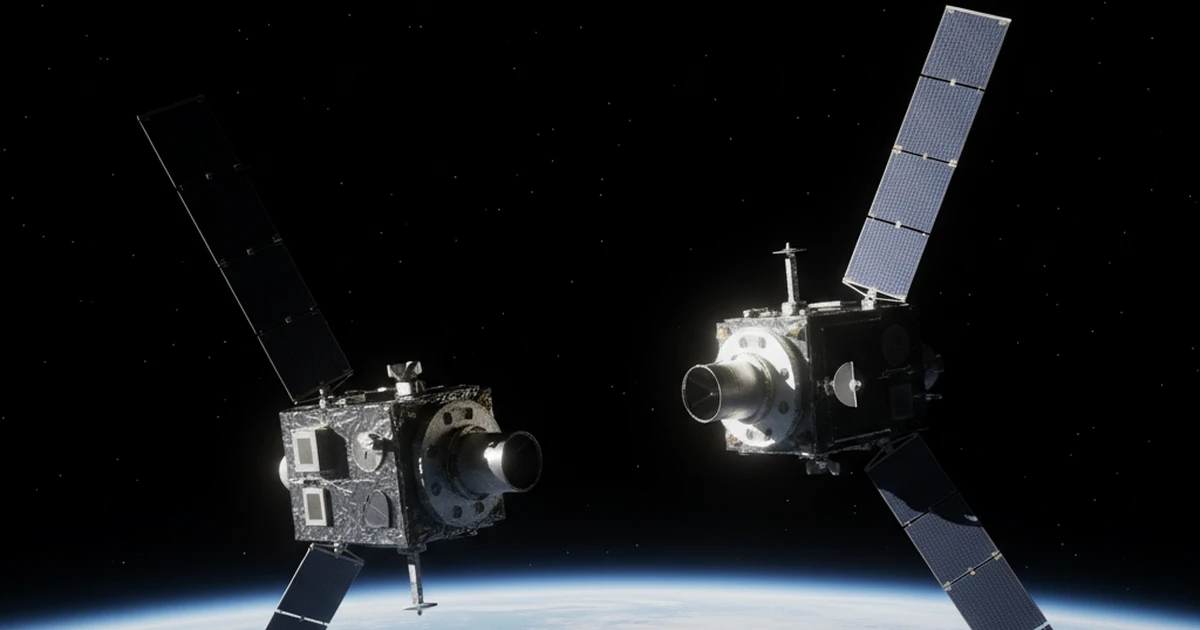
On April 28, 2026, two Russian military satellites closed to within approximately 3 meters of each other in low Earth orbit. The Russian proximity operation unfolded at 585 km altitude—one of the most commercially congested orbital shells on record. Using radar tracking data from LeoLabs, COMSPOC characterized the event as a deliberate rendezvous and proximity operation (RPO), not an accidental conjunction. If confirmed at the reported separation distance, the encounter ranks among the closest uncrewed satellite approaches ever recorded in free flight.
The Russian Proximity Operation
The satellites involved are Kosmos 2581, 2582, and 2583—an unacknowledged Russian military constellation executing coordinated formation maneuvers since at least late 2025. A fourth object, a subsatellite released earlier by Kosmos 2583 and tracked as “Object F,” also participated in the broader sequence.
According to COMSPOC’s analysis, Kosmos 2583 executed multiple “fine maneuvers” to hold an extremely tight formation with Kosmos 2581. The spacecraft achieved a closest approach of roughly 3 meters with near-zero relative velocity. Kosmos 2582 trailed the formation at under 100 km. Object F passed within approximately 10 km of Kosmos 2581 during the same sequence, apparently without maneuvering.
Space.com cited COMSPOC’s assessment directly: “Whatever Russia is testing, it’s sophisticated.” Russia has not publicly disclosed the mission’s purpose. The maneuvers are consistent with an on-orbit inspection or precision rendezvous demonstration, analysts assess, though intent remains unconfirmed.
What 3 Meters Actually Means
At 585 km altitude, both spacecraft travel at approximately 7.6 km per second—roughly 17,000 mph relative to Earth. Sustaining 3 meters of separation between two independently maneuvering satellites at those velocities demands autonomous or ground-directed GNC systems accurate to centimeter-scale.
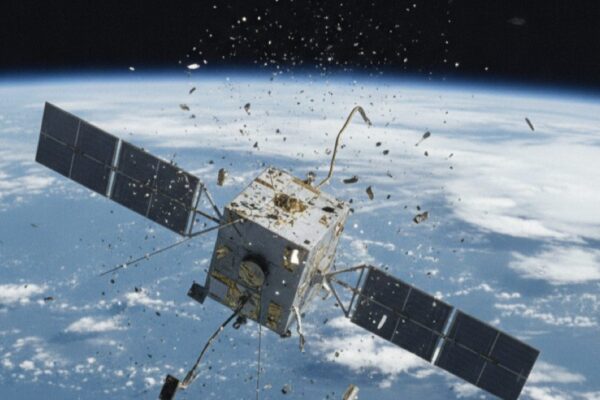
Three meters is also well inside what engineers describe as the credible “error budget” for most orbital maneuvering systems. A single uncorrected thruster pulse, a navigation lag, or a GPS ephemeris error could close that gap to zero. At conjunction speeds, even a minor collision between two objects of this mass class would generate hundreds to thousands of debris fragments.
The 585 km shell is not an empty test range. It is densely occupied by Starlink and other commercial broadband satellites, hosting thousands of active spacecraft. That makes it one of the highest economic-value altitude bands per orbital degree—with debris decay timelines measured in decades, not months.
A Policy Vacuum
No binding international rules currently govern how close a state actor may approach another nation’s satellite—or a commercial operator’s spacecraft—without prior notification or consent. The Outer Space Treaty of 1967 establishes that space activities must avoid “harmful interference.” It contains no proximity threshold, no notification requirement, and no enforcement mechanism for RPO at the meter scale.
COMSPOC’s analysis of the Kosmos maneuvers, cross-referenced with LeoLabs tracking data, adds to a growing record. Commercial SSA companies are now documenting state-actor RPO in real time—filling a transparency function no intergovernmental body currently performs. The Secure World Foundation and CSIS’s Aerospace Security Project have both called for confidence-building measures (CBMs) around proximity operations. These include advance notification requirements and agreed definitions of unsafe approach behavior in occupied orbital shells. Neither framework is binding, and neither is under active negotiation.
The gap is structural. Commercial operators in the same 585 km band must file conjunction analysis and maneuver coordination with the FCC and coordinate with the U.S. Space Force’s 18th Space Defense Squadron. No equivalent obligation, however, applies to military spacecraft conducting unannounced proximity operations nearby.
Cumulative Risk
The April 28 approach does not occur in isolation. FODNews has tracked a steady accumulation of conjunction risk in commercial LEO shells over the past several months. From Starlink’s nine-conjunction week in March, to ESA’s 2026 environment report projecting escalating collision probability in high-density bands, to TIME’s CRASH Clock analysis—each event has added to the documented risk in the 585 km band. A deliberate proximity operation by unacknowledged military spacecraft adds a variable that passive conjunction-avoidance models are not designed to account for.
What distinguishes the Kosmos maneuvers from prior FODNews coverage is intent. Accidental conjunctions are managed through maneuver coordination and probability thresholds. A proximity operation, by definition, is the opposite of accidental. It is operational. And the policy architecture that might govern that distinction—what notifications are required, what distances are acceptable, who adjudicates a complaint—does not yet exist.
Subscribe to FODNews for continued coverage of LEO debris risk and space traffic policy.
Sources
- ‘Whatever Russia is testing, it’s sophisticated’ — Space.com
- LeoLabs — commercial radar tracking data underlying COMSPOC analysis
- Two Russian satellites came as close as 10 feet and went back — India Today
- Cosmos Satellites Close Approach — The Daily Galaxy
- Strategic Reforms for U.S. Dominance in Low Earth Orbit — CSIS