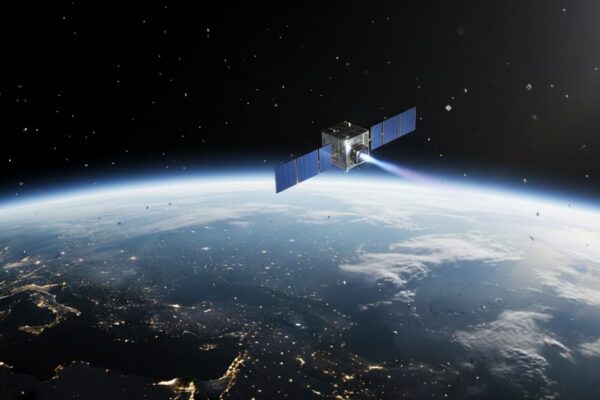
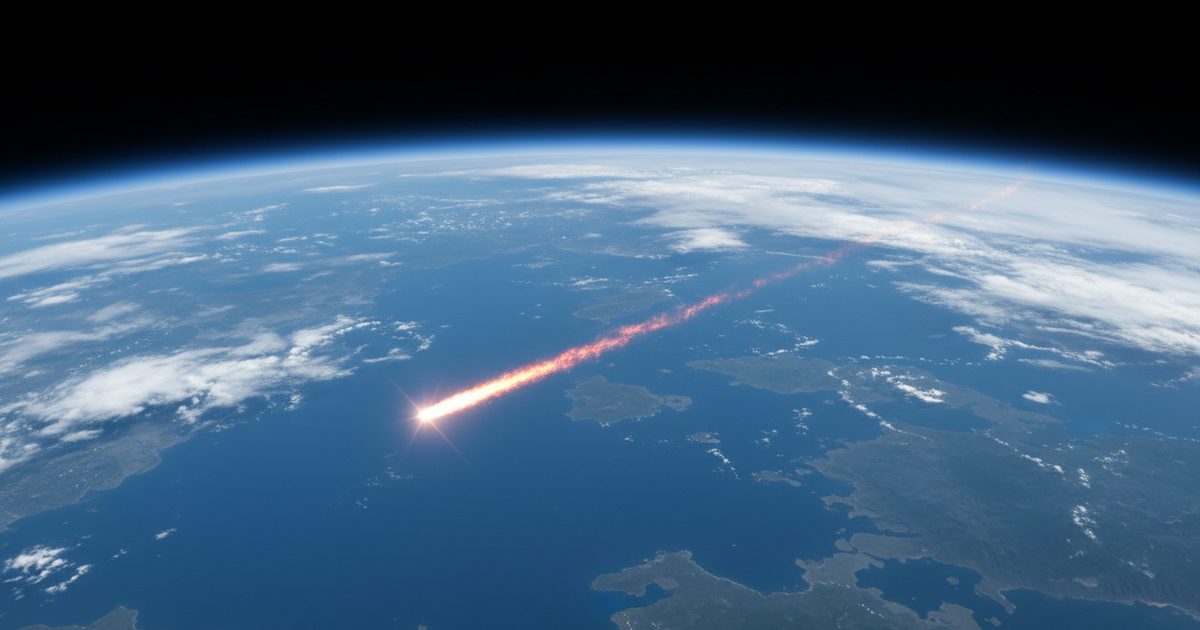
Each time a Starlink satellite reenters Earth’s atmosphere, it doesn’t just disappear in a streak of light. It leaves something behind: roughly 30 kilograms of aluminum oxide nanoparticles suspended in the upper atmosphere, invisible, chemically reactive, and slow to settle.
SpaceX deorbited approximately 120 Starlink satellites in January 2025 alone, according to satellite tracker Jonathan McDowell of the Harvard Center for Astrophysics — a pace of four to five per day. That rate has continued into 2026 as SpaceX systematically retires first-generation hardware to make way for upgraded satellites. By mid-April 2026, tracking data suggested several hundred Starlink satellites had already reentered year-to-date. At 30 kilograms of aluminum oxide per reentry, the atmospheric deposit accumulates fast.
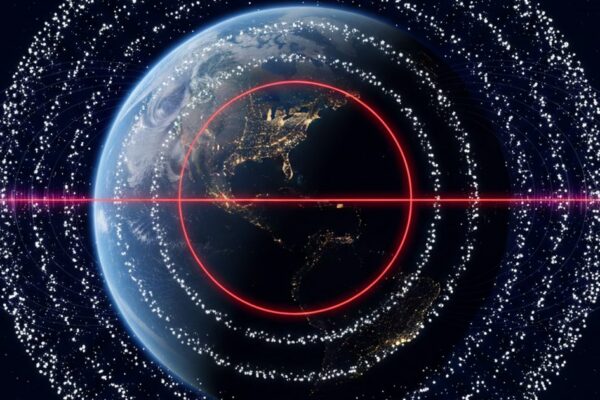
A landmark 2024 study published in Geophysical Research Letters by researchers at the University of Southern California puts the numbers in stark relief. In 2022, reentering satellites released 17 metric tonnes of aluminum oxide nanoparticles into the upper atmosphere. At full megaconstellation deployment — Starlink alone has approval for up to 42,000 satellites — that figure is projected to reach 360 metric tonnes per year, an increase of 646% above natural atmospheric aluminum oxide levels from cosmic dust.
From Mesosphere to Stratosphere — A Slow-Motion Contamination
The physics of reentry places most satellite ablation in the mesosphere, between 50 and 85 kilometres altitude. This is well above the stratosphere, where roughly 90% of Earth’s ozone resides. But upper-atmosphere particles don’t stay where they form.
Research indicates that aluminum oxide nanoparticles, once formed in the mesosphere, descend gradually through global atmospheric circulation — reaching stratospheric altitudes within one to three years and persisting there for years to decades. The Ferreira et al. study notes that because the particles are not consumed in chemical reactions, they accumulate over time as a function of ongoing reentry activity. Space agencies are only now beginning to instrument reentry events directly; ESA’s DRACO mission will be the first deliberately destructive reentry designed to capture data on what actually happens to a satellite as it burns up.
The empirical confirmation came in a 2023 study published in the Proceedings of the National Academy of Sciences by a NOAA-led team. Using a high-altitude research aircraft equipped with a particle mass spectrometer, the researchers detected more than 20 metals — including aluminum, copper, lithium, and lead — in individual stratospheric sulfuric acid aerosol particles. They found that approximately 10% of sulfuric acid particles larger than 120 nanometres already contain spacecraft-derived metals. For several elements including aluminum, the flux from reentry now exceeds natural cosmic dust influx.
“The influence of this level of metallic content on the properties of stratospheric aerosol is unknown,” the NOAA team wrote — a careful phrasing that carries significant weight.
Aluminum Oxide and the Ozone Connection
Aluminum oxide doesn’t react directly with ozone. The concern is subtler and, in some ways, harder to regulate.
Al₂O₃ nanoparticles act as heterogeneous catalysts — providing reactive surfaces that convert chlorine from relatively inert reservoir forms (such as hydrogen chloride and chlorine nitrate) into reactive chlorine species that then destroy ozone catalytically. Critically, the aluminum oxide particles are not consumed in the process. Each particle can participate in these reactions repeatedly for years as it drifts through the ozone layer.
The Ferreira et al. 2024 study is the first to quantify this potential at megaconstellation scale. The 646% increase in atmospheric aluminum oxide projected at full deployment represents an unprecedented new input into stratospheric chemistry — one that was not anticipated when the Montreal Protocol was designed to protect the ozone layer.
“Only in recent years have people started to think this might become a problem,” said Joseph Wang, a professor of astronautical engineering at USC and corresponding author of the 2024 study. “We were one of the first teams to look at what the implication of these facts might be.”
A Debris Conversation That’s Missing the Point
For years, orbital debris policy has focused on trackable objects: defunct satellites, spent rocket stages, fragmentation clouds from collisions. The conventional threat model is physical — a piece of metal moving at 7 kilometres per second, capable of destroying a functioning satellite or, in worst-case scenarios, threatening a crewed vehicle.
That model largely ignores what happens when satellites successfully reenter as designed. The traditional debris story — like the Starlink fragmentation cloud that formed at 560 kilometres earlier this year — captures attention because it produces trackable objects with potential collision risk. The chemical residue from a successful reentry produces no such trackable object, and so receives no comparable scrutiny.
Boley and Byers flagged this gap as early as 2021 in a Scientific Reports paper examining the full risk profile of satellite megaconstellations. Their analysis identified atmospheric chemistry impacts from reentry as an underappreciated threat alongside collision risk and astronomical light pollution. The paper warned that planned constellations could fundamentally alter the composition of Earth’s upper atmosphere in ways that no current regulatory framework was designed to address.
Five years later, the NOAA measurements and USC modeling have given that warning empirical and quantitative weight. The particles are already there. They are already accumulating. And the reentry rate is accelerating, not slowing.
The debris conversation — at the UN Committee on the Peaceful Uses of Outer Space, at the ITU, at national space agencies — has made significant strides on collision risk. It has barely started on chemistry.
The invisible objects falling from orbit may turn out to matter more than the visible ones.
Subscribe to FODNews for independent reporting on foreign object debris in aviation, space, and beyond.
Sources
- Ferreira, J.P., Huang, Z., Nomura, K., & Wang, J. (2024). Potential ozone depletion from satellite demise during atmospheric reentry in the era of mega-constellations. Geophysical Research Letters, 51, e2024GL109280. [Peer-reviewed, AGU]
- Murphy, D.M., et al. (2023). Metals from spacecraft reentry in stratospheric aerosol particles. Proceedings of the National Academy of Sciences, 120(43), e2313374120. [Peer-reviewed, NOAA-led]
- Boley, A.C., & Byers, M. (2021). Satellite mega-constellations create risks in Low Earth Orbit, the atmosphere and on Earth. Scientific Reports, 11, 10642. [Peer-reviewed, Nature Portfolio]
- AGU Press Release (June 12, 2024). Satellite “megaconstellations” may jeopardize recovery of ozone hole. American Geophysical Union.
- McDowell, J. / Watchers.news (February 2025). Starlink satellites reentering Earth’s atmosphere in increasing numbers. [Citing Harvard CfA satellite tracker data]
More Space & LEO coverage on FODNews.