Kreios Space’s Plasma-Breathing Satellite Could Slash LEO Debris by Self-Deorbiting
A Spanish startup says it has cracked one of orbital mechanics’ most persistent problems: how to keep a satellite flying through the upper fringes of Earth’s atmosphere without burning through fuel — and how to make sure it doesn’t stick around as debris when it’s done.
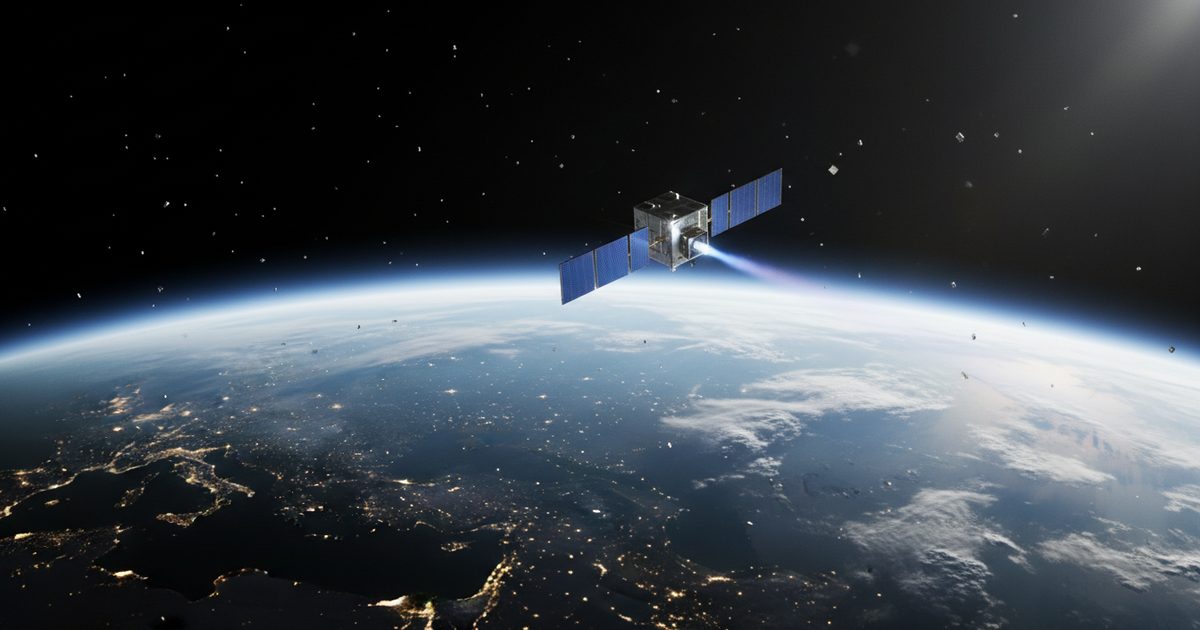
Kreios Space, founded in 2021 by six aerospace engineering graduates from the Polytechnic University of Catalonia, has developed what it calls an Air-Breathing Electric Propulsion (ABEP) engine. The system captures residual air molecules at altitudes between 150 and 400 kilometers — a zone known as Very Low Earth Orbit, or VLEO — compresses them by up to 100 times, ionizes them into plasma using a Helicon Plasma Thruster, and expels them as propellant. The entire process is powered by solar panels. No fuel tanks required.
The company presented its technology in an April 2026 Euronews segment, drawing renewed attention to an approach that directly addresses the growing crisis of orbital congestion.
The Debris Problem in Numbers
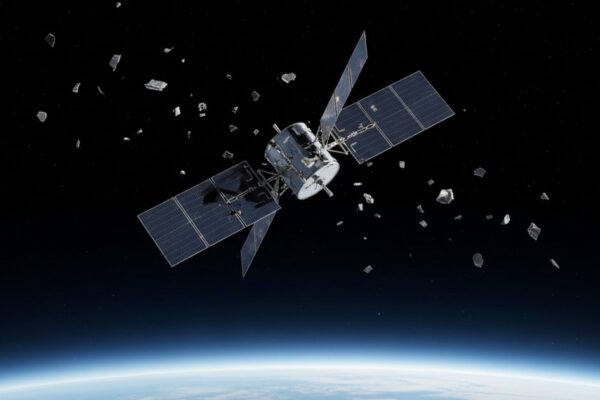
Low Earth orbit is increasingly cluttered. According to the European Space Agency’s 2025 Space Environment Report, surveillance networks now track roughly 40,000 objects in orbit. An estimated 1.2 million debris fragments larger than one centimeter are believed to exist — too small to track but large enough to be lethal to operational spacecraft. LEO holds more than 83 percent of all catalogued objects.
The core problem is persistence. Satellites placed above 600 kilometers can drift for decades or centuries before atmospheric drag pulls them down. At those altitudes, a dead satellite becomes a long-lived hazard — a potential trigger for the kind of cascade collision scenario researchers call the Kessler syndrome, where one breakup produces a chain reaction that renders an orbital band unusable.
Kreios founder Francisco Boira framed it plainly in the Euronews interview: “VLEO orbits are not currently used because at these distances there is a lot of aerodynamic drag. To counteract it, huge amounts of fuel are needed, enough to give the satellite an autonomy of days and make it entirely unfeasible.”
Turning Drag Into Propulsion
The ABEP engine flips that constraint. Rather than fighting atmospheric drag with stored propellant, it harvests the atmosphere itself — turning the very force that makes VLEO hostile into a continuous fuel source.
The result, Kreios says, is a satellite capable of maintaining stable orbit for more than a decade without onboard propellant. And when a mission ends — or if propulsion fails — the satellite simply stops fighting drag and descends naturally, burning up in the atmosphere within days rather than lingering for generations.
That passive disposal mechanism is significant. Under current ESA and Inter-Agency Space Debris Coordination Committee (IADC) guidelines, operators are expected to deorbit LEO satellites within five years of end-of-mission. Compliance remains uneven across the industry. A VLEO architecture, by design, makes compliance automatic.
NATO Investment and First Launch
In September 2025, Kreios closed an €8 million seed round led by the NATO Innovation Fund — a €1 billion private equity vehicle backed by 24 NATO member states. JOIN Capital, Grow Venture Partners, Xesgalicia, and Tasivia Global also participated. Combined with an earlier €2.3 million raise in 2024, total investment now exceeds €10 million.
The NATO Innovation Fund cited strategic autonomy concerns in its rationale. VLEO constellations could provide high-resolution Earth observation and direct-to-device communications at latencies of two to eight milliseconds — a fraction of the 50-millisecond lag typical of conventional LEO systems — without dependency on ground-based infrastructure.
Kreios completed certification and ground testing of the ABEP engine in 2026. Funding from the NATO round will support the launch of two test satellites, including the first in-orbit demonstration of the system. The company is based in Vigo, Galicia, and is preparing new facilities in the nearby municipality of Nigrán that will house a clean room and vacuum test chamber.
Uncrowded by Design
One byproduct of VLEO operations that the company highlights: the orbital band is currently empty. There are no legacy debris fields below 500 kilometers of the scale found at 550 to 600 kilometers, where years of launches have concentrated risk. A satellite constellation operating at 200 to 400 kilometers would start fresh — and clean up after itself.
That combination — no inherited debris, automatic end-of-life disposal, and sustainable propulsion — represents a fundamentally different architecture than the constellations now being built at higher altitudes.
Whether VLEO scales commercially will depend on solving the coverage math: the closer to Earth, the more satellites are needed to maintain global visibility. Launch logistics also add cost; SpaceX currently offers a minimum release altitude of 500 kilometers, requiring a VLEO-bound satellite to descend on its own after deployment.
But if Kreios’ in-orbit demonstration succeeds, it could offer a template for sustainable satellite deployment at a moment when the alternative — an ever-denser shell of debris in the most commercially valuable orbital bands — grows more consequential with each launch.
Subscribe to FODNews for ongoing coverage of orbital debris, aviation safety, and the technologies shaping both.