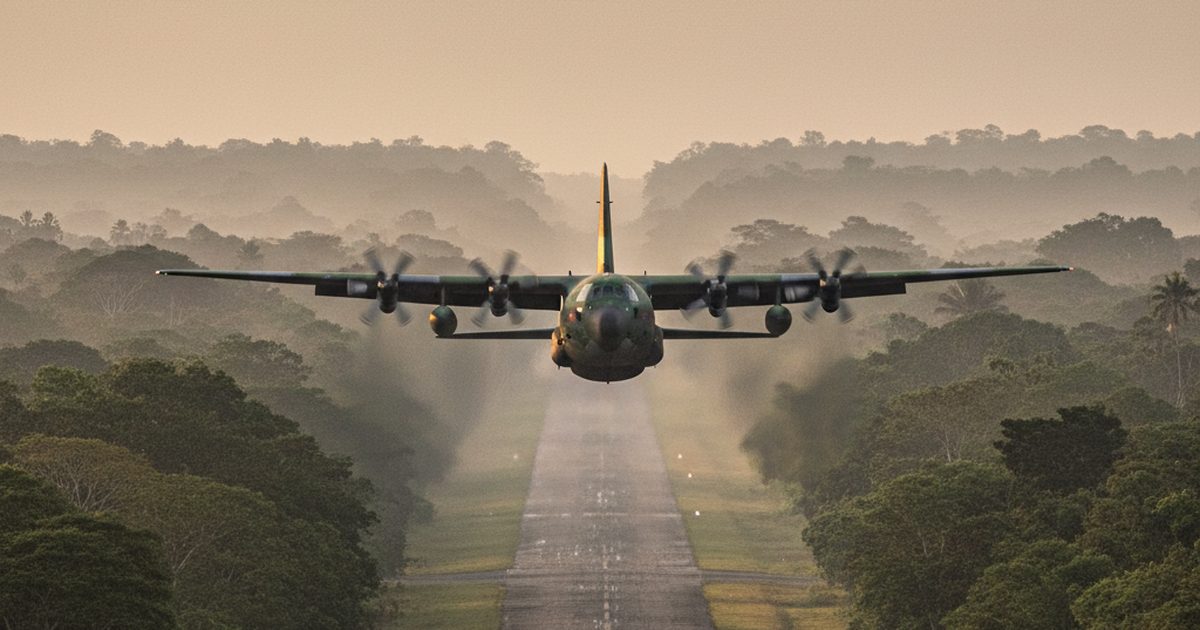
Colombian military investigators this week recommended halting fixed-wing departures from runway 30 at Puerto Leguízamo’s Caucaya airport. The trees off the runway end must come down first. Preliminary findings show a Lockheed Martin C-130H struck three of those trees seconds after lift-off on March 23. Plant material then entered both left-hand engines before the aircraft crashed.
The accident killed 69 of the 126 occupants aboard FAC 1016. The Hercules transport, operated by the Colombian Aerospace Force (Fuerza Aérea Colombiana), had departed Caucaya bound for Tres de Mayo airport in Puerto Asís. It carried personnel and cargo from infantry battalion BISOL 49.
According to the inquiry summary reported by FlightGlobal, the C-130 collided with three trees roughly four seconds after lifting off from the 1,199-meter runway. First, the fuselage and inboard right-hand engine struck the initial tree. Then the left-hand propellers and fuselage clipped a second and third.
Engines Ingested Plant Material After Tree Strikes
Flight-data recorder information showed a loss of power in both left-hand engines. Investigators called the inboard powerplant’s drop “significant.” The inquiry states: “According to the analysis of the [wreckage] there is evidence of ingestion of plant material in [these engines].”
The damage degraded the left wing’s aerodynamic performance and the crew’s control of the aircraft. The C-130 banked 29 degrees left and lost altitude. The pilot reduced power on the right-hand engines to try to recover. However, the aircraft struck the ground 2,080 meters past the runway end after 36 seconds airborne. Investigators found no conclusive evidence that the emergency engine shutdown procedure was executed.
Cockpit-voice recorder data indicated an estimated takeoff weight of 133,000 pounds (60,300 kg), below the C-130H’s 139,000-pound maximum. The aircraft departed in a standard configuration. Technical logs showed no operational restrictions, and weather was stable. The airplane was airworthy, loaded within limits, and bound for what should have been a routine takeoff. What it was not bound for was a runway environment that met international obstacle-clearance standards.
The Colombian C-130 Caucaya Crash as an Obstacle-Environment FOD Story
For runway-safety practitioners, Caucaya is a textbook example of how the airfield environment itself can produce foreign object damage. The trees were not debris on the runway. They were the debris source — vegetation that became plant material inside two engines the instant the propellers chopped through it.
The International Civil Aviation Organization addresses exactly this risk through obstacle limitation surfaces. These are the imaginary planes around an aerodrome inside which obstacles must be controlled or removed. ICAO Annex 14 directs operators to identify, monitor and eliminate objects that penetrate these surfaces. The standard places particular focus on the takeoff climb surface beyond the runway end. The investigators recommended removing all trees that present obstacles at either end of runway 30. That recommendation is effectively a finding that the airfield fell short of those principles when FAC 1016 took off.
Where Sweeping Ends and Airfield Management Begins
Most FOD prevention conversations focus on the paved surface — sweeping aprons and runways, walking pavement, monitoring construction debris and tire shedding. That work matters, and lapses in it have real consequences.
But Caucaya is a reminder that airfield FOD prevention does not stop at the runway edge. When a tree at the runway end becomes the foreign object that takes down a 60-tonne transport, pavement sweeping alone cannot address the hazard. Engine-ingestion risk scales directly with what airports allow to grow, perch, or accumulate near the flight path. The same failure mode shows up wherever environmental hazards reach the takeoff envelope. The capybara perimeter breach at Guyana’s Ogle Airport and the AirAsia engine strike in Chennai illustrate the same pattern.
The Human Toll and What Comes Next
Sixty-three of the 115 passengers and six of the 11 crew died in the impact. Many of the dead were Colombian Army soldiers returning from a counter-narcotics mission in the Amazon. The defense ministry blamed post-impact explosions on ammunition the troops had been carrying, not hostile action.
FAC 1016 was one of six C-130Hs in Colombian service before the accident. The inquiry’s findings remain preliminary. A full report will examine two questions. First, could the crew have completed the emergency engine shutdown in 36 airborne seconds? Second, had earlier obstacle surveys flagged the trees? Until those trees come down, runway 30 is closed to fixed-wing departures.
The lesson is written into the recommendation itself. The runway is not just the pavement. It is the entire envelope the airplane has to fly through to leave the ground safely. What grows in that envelope can kill.
Subscribe to FODNews for ongoing coverage of FOD incidents and runway-safety investigations.