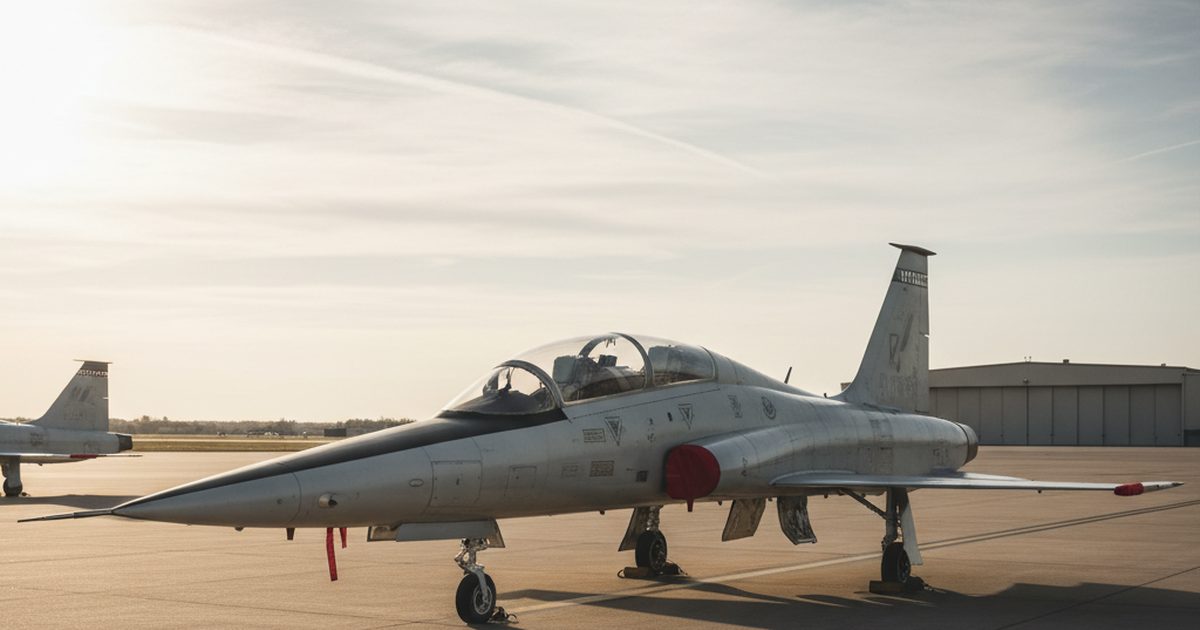
The U.S. Air Force ordered a T-38 Talon fleet grounding on May 19, 2026. The decision came one week after a T-38C trainer from Columbus Air Force Base, Mississippi, crashed in rural Lamar County, Alabama. Both pilots safely ejected before the aircraft went down. Neither was injured.
The Air Force described the stand-down as taken “out of an abundance of caution.” The operational pause affects T-38 operations at four major commands: Air Education and Training Command, Air Combat Command, Air Force Materiel Command, and Air Force Global Strike Command. No other aircraft types are affected.
The two-person crew was on a routine training mission on May 12. According to the 14th Flying Training Wing at Columbus AFB, they determined they had to eject. The aircraft crashed near the Mississippi-Alabama border. The cause of the mishap has not been publicly released, and investigators have not commented on causal factors.
A 65-Year Training Fleet at a Crossroads
The T-38 Talon has served as the Air Force’s primary advanced jet trainer since the 1960s. The aircraft first flew in 1959 and is widely recognized as the world’s first supersonic jet trainer. More than 70,000 pilots have trained on the platform over its operational lifetime, according to the Air Force.
Approximately 475 T-38s remain in service today, the majority of them T-38C variants. But the fleet’s age is showing. According to Air & Space Forces Magazine, mission-capable rates for the T-38C fell to 55.3 percent in fiscal year 2024. That reflects a growing maintenance burden on one of the military’s oldest active airframes.
Relief is coming, but not immediately. The Air Force approved the T-7A Red Hawk for full-rate production in early May 2026. The new trainer is expected to begin replacing AETC’s T-38 fleet in 2027. Until then, the Talon remains the backbone of advanced jet training for fighter and bomber pilot pipelines.
Investigation Underway, No Findings Released
A Safety Investigation Board was convened following the May 12 crash, as is standard procedure after Class A mishaps. The board is gathering evidence from the accident site and assessing whether safety issues exist across the fleet.
The Air Force has not set a timeline for ending the pause. The duration remains undetermined, pending engineering analysis. That work includes developing a specific inspection process to clear individual aircraft for return to flight. Inspections were expected to begin as early as the week of the May 19 announcement. Once an aircraft completes the inspection — and any required maintenance — it may resume flying operations.
No causal factors have been publicly released. The Safety Investigation Board has not announced findings. The Air Force said it is committed to “the continued safety of Air Force personnel and equipment involved in flying T-38 operations while the investigation progresses.”
Stand-Downs and the FOD Inspection Protocol
Fleet-wide operational pauses of this kind do more than halt flights while investigators work. They also create conditions for systematic physical inspection of every affected aircraft. That process routinely includes FOD checks of airframes, engine intakes, and cockpits.
The Air Force put it plainly: the goal is “development of an inspection process to clear aircraft for a safe return to flight.” Once established, that process will require maintainers to verify each T-38 is clear of anomalies — structural, mechanical, or debris-related — before it returns to the training pipeline. Fleet-wide stand-downs are, among other things, a structured opportunity to find what routine pre-flight checks may have missed.
That context is why this story matters to FODNews readers. A stand-down affecting 475 aircraft across four major commands ranks among the most comprehensive flightline FOD assessments the Air Force can execute.
What Comes Next
In the interim, affected aircrews are maximizing simulator training to maintain proficiency and currency requirements, the Air Force said. The T-38’s last fleet-wide ground stop came in July 2022. At that time, faulty ejection seat parts prompted a partial grounding alongside some F-35As and T-6 Texans.
How quickly the current pause resolves will depend on how rapidly engineering teams can develop and validate the inspection criteria. Individual aircraft are expected to return to flight on a rolling basis rather than all at once. The Safety Investigation Board’s timeline for releasing any findings has not been announced.
Stay informed — subscribe to FODNews for daily coverage of FOD incidents and prevention worldwide.
Sources
- U.S. Air Force. T-38 Talon operational pause statement (May 19, 2026).
- Air & Space Forces Magazine — “Air Force Pauses All T-38 Trainer Flights, a Week After Alabama Crash” (May 2026).
- Stars & Stripes — “Air Force orders operational pause for all T-38 Talon aircraft” (May 20, 2026).
- Stars & Stripes — “Pilots eject safely after mishap in T-38 Talon II aircraft” (May 12, 2026).
- Breaking Defense — “Air Force grounds T-38 fleet after Mississippi mishap” (May 2026).