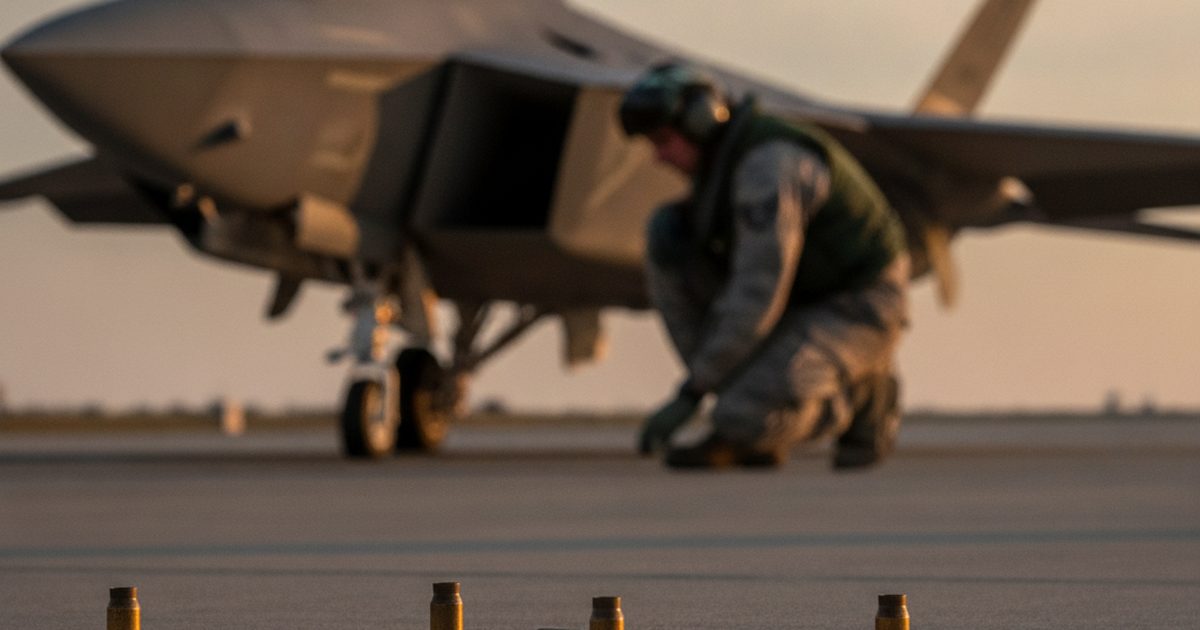
LUKE AIR FORCE BASE, Ariz. — A spent brass casing tumbling six feet to concrete on a night-ops flight line is small, easy to kick aside, and nearly impossible to see. Yet in the discipline of F-35 FOD prevention, that same casing — ingested by an F-35A Lightning II engine — can cost the Air Force more than $20 million.
Two weapons specialists at Luke Air Force Base think they’ve solved the problem for roughly $100.
Tech. Sgt. Zach Allbee and Tech. Sgt. Nik Yakel, each with approximately 15 years in uniform, designed a three-piece 3D-printed bracket and heavy canvas funnel that channels spent casings directly into an ammo can during F-35A gun system downloads. They call it Project ZACH — short for Zero Point Ammunition Cartridge Handler.
F-35 FOD Prevention: The Problem on the Ramp
During a gun system download, the F-35A’s spent casings drop more than six feet from the aircraft’s expedient loading device. Crews have historically relied on positioning an ammo can beneath the chute and hoping for the best. Many casings miss.
Allbee, who estimates he has loaded and unloaded 200,000 to 300,000 rounds across platforms ranging from the A-10 to the F-35, said even experienced load crews routinely lose brass.
“Nine times out of 10, you’re not catching all the rounds in the ammo can,” Allbee told ABC15 Arizona. “During the day, it’s a little bit easier, because I can see where they all went. If you were to do this at night … now you have a piece of hard metal FOD sitting on the flight line that you don’t know about.”
Each missed casing is a potential engine-killer. A single piece of brass ingested by an F-35A’s intake can cause turbine damage exceeding $20 million — on an airframe that itself costs upward of $80 million.
Yakel, the maintenance noncommissioned officer in charge of the 308th Weapons Flight, noted that scattered brass did more than create a safety hazard. It disrupted the rhythm of the entire load crew — adding stress to an already demanding procedure.
A Fix Built From a Craft Store and a 3D Printer
The two sergeants conceived the idea watching brass scatter during a download. They took the concept up their chain of command, gathered feedback from other units using the same expedient loader, and confirmed the problem was widespread beyond Luke.
With backing from their commander and engineering support from civilian specialists at Detachment 9 on base, they moved from an initial proof-of-concept — a 3D-printed bracket lashed together with mesh netting sourced from a craft store — to a purpose-built solution.
The final design uses a three-piece 3D-printed bracket that clamps onto the existing chute, paired with a heavy canvas funnel that directs all ejected brass straight into the ammo can. “Standard canvas material, all-weather, super durable, anti-rip, anti-tear,” Allbee said. “This is about $100.”
Critically, the device attaches to the existing expedient loader without modifying the aircraft or the loader itself — a key factor in gaining regulatory approval. The design files can be shared so any unit can print its own version.
Air Force-Wide Rollout Planned
Luke AFB is home to the 56th Fighter Wing, one of the largest F-35A pilot training operations in the world. Every sortie grounded for a FOD-related engine inspection is training time the Air Force cannot recover.
The team is currently expanding testing to other F-35A units at Luke. Once refinements are complete, they plan to submit the design to the Air Force’s global distribution system, making it available to any F-35A unit worldwide — still at under $100 per copy.
Master Sgt. Austin Fahad, who observed the project develop, said the real achievement was cultural as much as technical.
“The ability to recognize a problem and be willing to vocalize it, not accepting that problem as reality — that’s huge,” Fahad said. He noted the pair “went through the long haul” of prototyping, networking with peer units, and building an evidence base before presenting a finished product.
For Yakel, the reward is simpler: a cleaner ramp and a safer jet.
“It may not be spectacular to look at,” Yakel said, “but it’s something kind of cool that we’re proud of — taking care of our guys and taking care of the aircraft. Those are number one and number two for us.”
Subscribe to FODNews for the latest on FOD prevention, incident reporting, and aviation safety innovations worldwide.