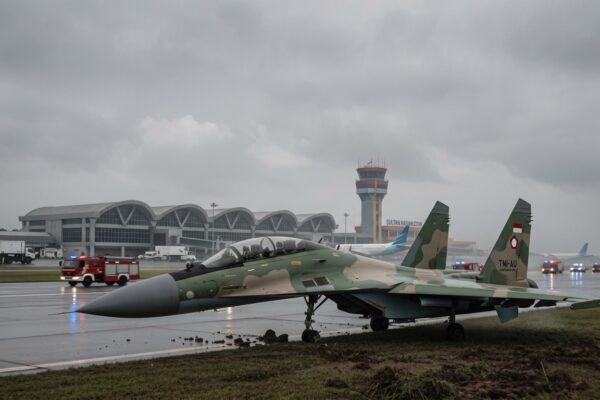
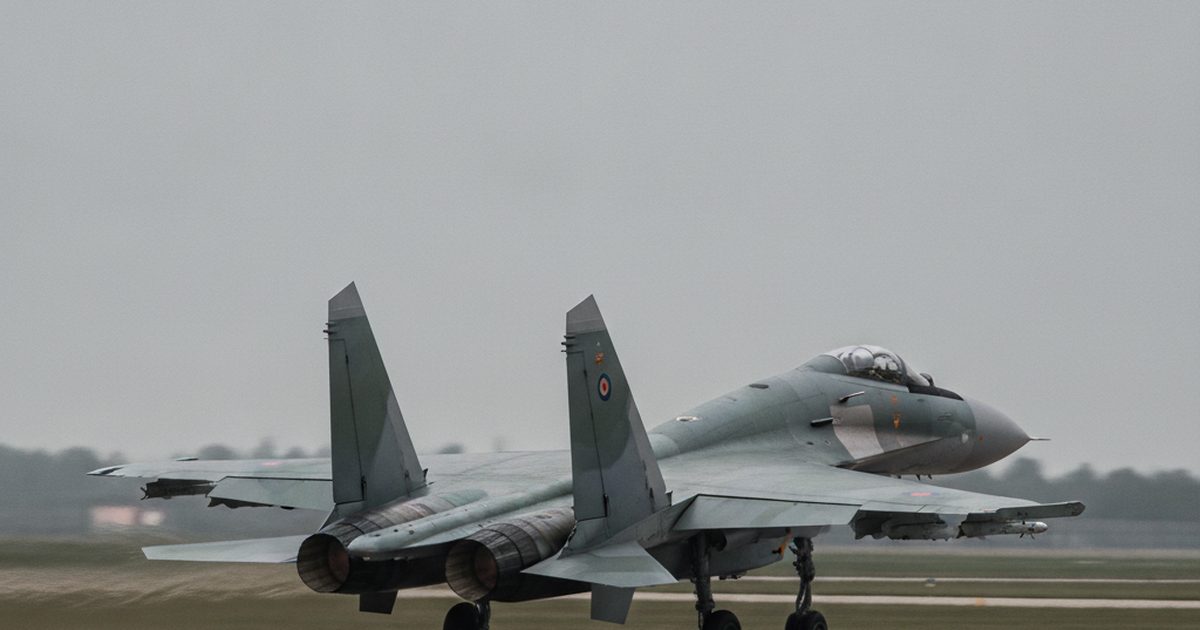
The Royal Malaysian Air Force has developed an indigenous RMAF air intake screen modification — the AIS-MOD — that protects Su-30 MKM fighter jets from bird strikes and foreign object debris up to 656 feet above the runway. That extends coverage far beyond the aircraft’s factory design.
Since entering service in 2025, the modification has prevented at least six bird-strike incidents. RMAF officials credit it with averting approximately MYR 150 million (USD 33–38 million) in engine damage costs.
A Known Vulnerability in the Su-30 Family
The Su-30 MKM is a twin-engine, twin-tail multirole fighter with canards and thrust-vectoring Saturn AL-31FP turbofans. Those engines rank among the most powerful in fourth-generation fighters. They are also among the most expensive to repair after a bird or debris ingestion event.
The aircraft’s factory air intake screen protects the engines during ground operations only. It retracts at approximately 1 foot above the runway on takeoff, leaving both turbofans exposed through departure and the entire approach and landing.
The vulnerability is not unique to Malaysia. Future Warfare Magazine reports the same design weakness across Su-30 operators worldwide. The Indian Air Force, which flies the related Su-30 MKI, faces the same exposure.
Low Cost, High Impact Engineering
Development of the AIS-MOD began in 2021, led by No. 12 Squadron personnel. Their guiding principle: “low cost, high impact.” Adjust the existing screen’s deployment timing to cover takeoff and landing — don’t replace the system.
Four prototypes were built before the team reached a final design. The first failed safety standards; the second and third were too large to install. The fourth passed stress testing, displacement analysis, deformation testing and G-load certification.
Design and manufacturing were completed entirely in-house at the RMAF’s Aerospace Engineering Service Centre (PUSPEKA). The modified screen was first installed on a No. 12 Squadron Su-30 MKM.
656 Feet of Coverage Where There Was None
With the AIS-MOD fitted, the screen remains active from ground level through takeoff and approach, retracting at 656 feet (approximately 200 meters). That window — 1 foot to 656 feet — is precisely where bird strike risk peaks.
Defense analysts note that a significant majority of bird strikes involving military and civil aircraft occur below 500 feet during takeoff and landing. The AIS-MOD directly addresses that window.
The modification was first publicly disclosed at the LIMA 2025 airshow. It received wider international attention when showcased at Defence Services Asia (DSA) 2026 in Kuala Lumpur in April.
Results Since Fielding
The AIS-MOD has averted at least six bird-strike incidents since 2025. Events at Air Force College (KTU) in Kepala Batas, Kedah — an area the RMAF cited for high bird density — are among them. No engine damage from FOD ingestion has been reported since deployment. A recent military bird strike in Myanmar shows how widespread the threat remains.
The estimated MYR 150 million (~USD 33–38 million) in cost savings reflects averted engine damage and repairs. Turbofan overhauls after a serious bird ingestion event can run into the millions per engine; the AL-31FP is no exception.
The AIS-MOD earned second place in the 2025 RMAF Innovation Award. As of DSA 2026, four additional units were in production — bringing the total to 10. The RMAF’s fleet of 18 Su-30 MKMs is expected to remain operational until 2035.
A Model for Indigenous FOD Mitigation
The AIS-MOD illustrates a point military airfield safety professionals sometimes overlook: not every FOD solution requires a new procurement program. The RMAF iterated through prototypes in-house and validated against structural standards — delivering a fielded system in roughly four years. Bernama profiled the project in May 2025, noting No. 12 Squadron drove it from concept to certification.
For air forces with known intake vulnerabilities, the approach is straightforward: find the exposure window, close it, test to standard, field.
Subscribe to FODNews for ongoing coverage of FOD prevention developments in military and civil aviation worldwide.
Sources
- Future Warfare Magazine — “Royal Malaysian Air Force introduces air intake screen modification to reduce SU-30 MKM FOD Risk” (April 27, 2026)
- Bernama — “AIS-Mod: RMAF Innovation Shields Fighter Jets From Bird Strike Threats” (May 24, 2025)
- Aerospace Global News — “Malaysia fixes Su-30 FOD problem with new engine intake screen” (April 30, 2026)