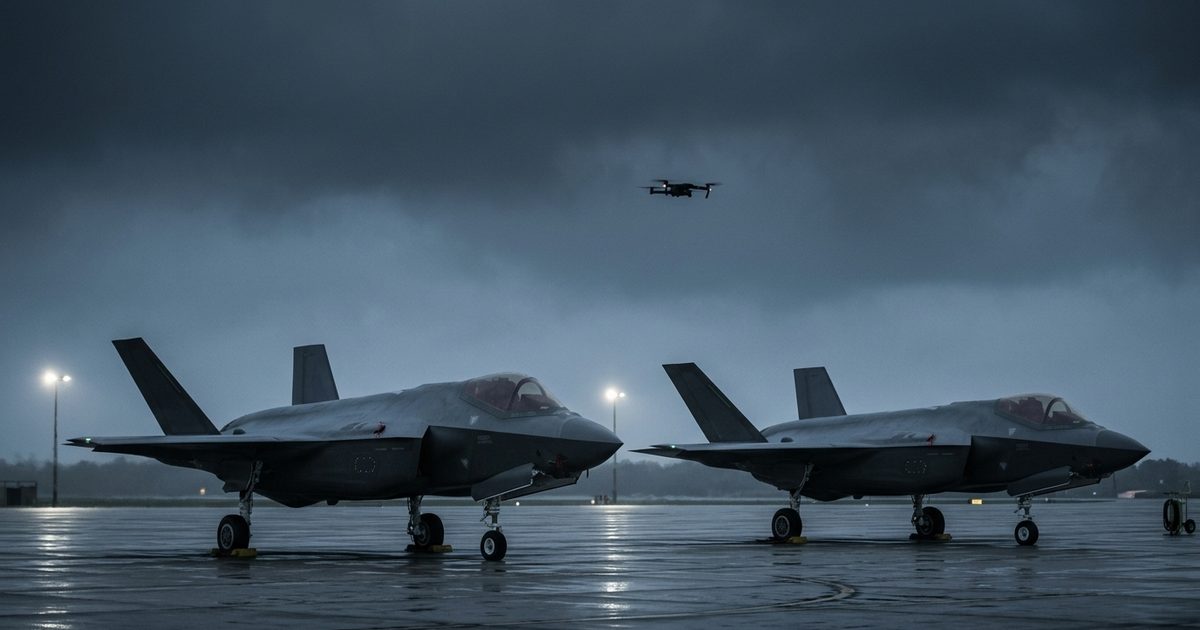
Unidentified drones breached restricted airspace around RAAF Base Williamtown for the second time in a month. New South Wales Police confirmed the incident. The Williamtown drone airspace breach deepens concern over the vulnerability of Australia’s main F-35A fighter base to uncrewed aircraft.
Williamtown sits about 30 kilometers north of Newcastle. It hosts the majority of Australia’s F-35A fleet and sits adjacent to Newcastle Airport. The base also flies E-7A Wedgetail airborne early warning aircraft and Hawk 127/PC-21 trainers. The Department of Defence confirmed earlier in August it was investigating multiple unidentified drones. The drones were flying around both sites over several days between July 11 and 13. Personnel reportedly spotted a swarm near the base’s north gate. They were told to close window blinds to protect sensitive information from view. Police confirmed a second, separate incursion occurred August 5 and 8.
Williamtown’s Drone Breach Fits a National Pattern
Williamtown’s breaches are part of a steep escalation across Australian military sites. Department of Defence data reported by The Daily Telegraph shows confirmed drone incursions at defence facilities climbed nationwide. The total rose from 21 in the 2022-23 financial year to 60 in 2023-24. It then jumped to 147 in 2024-25 — a sevenfold increase in two years. Defence sources have separately recorded at least 20 additional drone incidents involving unidentified operators at RAAF facilities since January. Suspected activity has also occurred at bases including Amberley, Richmond, Edinburgh, and Townsville.
No drones have been intercepted, shot down, or publicly identified in either Williamtown incursion. Authorities have not disclosed who was responsible or why. NSW Police said officers are working with the Australian Defence Force and partner agencies. Together, they are trying to identify the aircraft and their operators. Multiple no-fly zones surround the base. Penalties for breaches reach AU$18,200 — a deterrent that has not stopped repeat incursions.
“You Can Just Fly It Around Over the Base”
“It’s very concerning because it shows Defence is unable to protect its bases,” Strategic Analysis Australia director Michael Shoebridge told ABC News. “They’ve got all these layered security precautions… but it turns out if you have a drone you can just fly it around over the base.” Shoebridge argues Australia’s counter-drone capability lags behind other nations already contending with the same threat. Without effective countermeasures, he warns, aircraft worth hundreds of millions of dollars each remain exposed.
Opposition senator James Paterson raised a similar concern. He noted that reports describing coordinated swarms — not a single hobbyist aircraft — point to a more organized threat. “Teenagers with a $500 drone are not capable of organising a swarm of drones on a base,” he said. “That is something that should be really seriously investigated.”
Why It’s a FOD-Adjacent Risk
No one has reported a drone strike or debris incident at Williamtown to date. These are unauthorized overflights, not collisions. But repeated, unimpeded incursions over an active fighter flight line carry a genuine foreign-object-debris dimension. A drone could enter an engine intake, collide with an aircraft on approach, or come down over an active runway. Any of those outcomes would introduce exactly the hazard flightline security exists to prevent. The longer such incursions go undetected, the greater the odds of an eventual strike rather than a mere overflight.
Government Response Underway
Defence Minister Richard Marles said the government will spend up to AU$22 billion over the next decade on drone and counter-drone capabilities. That includes jammers, sensors, and electronic warfare technology already reaching ADF personnel under Project LAND 156. “We will introduce additional legislative reform this year to further strengthen the ADF’s ability to counter drone threats,” Marles said. Legislative changes made last year already allow defence personnel to seize, disable, or destroy drones near military sites. That authority has not yet been publicly exercised in either Williamtown incursion. Prime Minister Anthony Albanese was asked about the incidents during a visit to the Hunter region. He said Defence would work with NSW Police “to make sure that the area around the airport can operate safely.”
The incidents add Williamtown to a growing list of airfields worldwide grappling with unauthorized drone activity near active flight lines. FODNews has tracked a similar pattern at civilian airports and in F-35 flightline FOD-prevention efforts at Luke Air Force Base.
Subscribe to FODNews for daily coverage of FOD incidents and prevention worldwide.