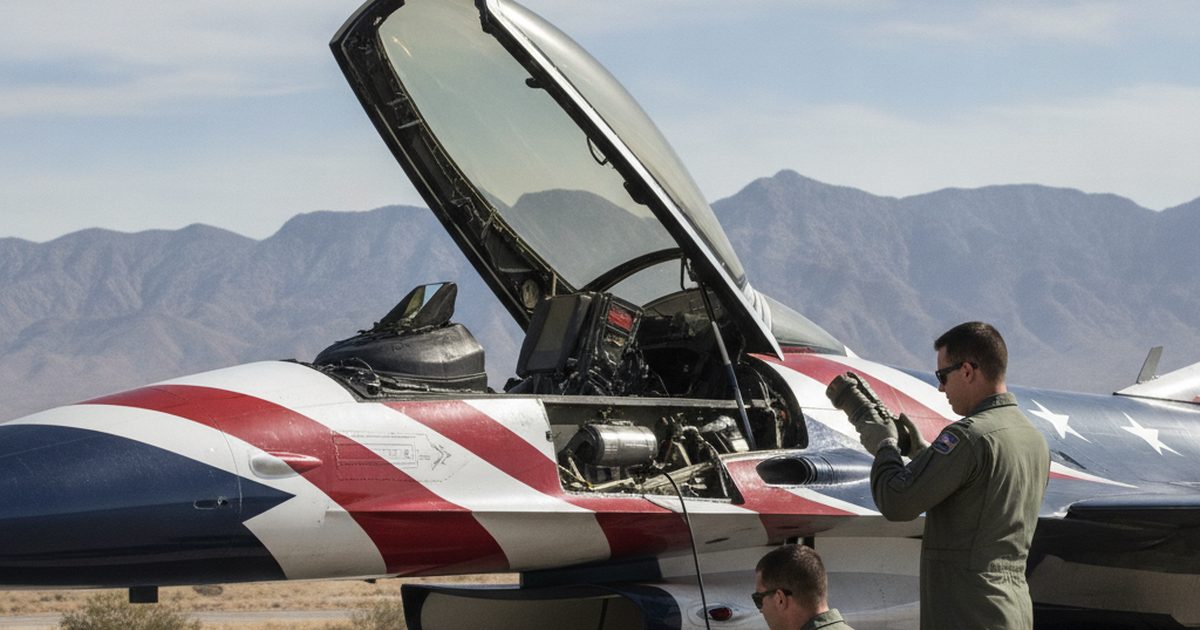
The Air Force has ordered a new borescope inspection for F-16 engines after investigators linked a hidden compressor flaw, inside what crews call an engine “blind spot,” to the loss of a Thunderbirds jet in the California desert.
Air Combat Command released an Accident Investigation Board report on Sept. 21 finding that misaligned compressor vanes destroyed the Pratt & Whitney F100-PW-229 engine aboard an Air Force Thunderbirds F-16CM on Dec. 3, 2025. The jet crashed into a lakebed near Trona, California, about 18 nautical miles east-northeast of Naval Air Weapons Station China Lake. The pilot ejected and survived with minor injuries. The aircraft, valued at $33.46 million, was a total loss.
The board found that three vanes in the engine’s fourth and fifth compressor stages had turned out of position, disrupting airflow deeper in the engine. One fifth-stage and one sixth-stage compressor blade subsequently failed from high-cycle fatigue and separated in flight, according to The Aviationist’s account of the report’s findings. The damage left the engine unable to produce enough thrust to sustain flight, and the pilot ejected about four minutes and 21 seconds after the initial power loss.
F-16 Engine Blind Spot Mattered More Than FOD
Investigators could not conclusively determine what caused the vanes to turn, The Aviationist reported, but the report said the inability to inspect that section of the engine without removing it from the aircraft “substantially contributed to the mishap.” The fourth stage is difficult to reach, and the fifth stage has no accessible port for a camera, meaning a full teardown at a depot facility was previously the only way to check it.
Both the Thunderbird jet and a separate F-16 that crashed near Holloman Air Force Base, New Mexico, in April 2024 had each previously recorded a foreign object debris, or FOD, event in the same engine, Task & Purpose reported. But while both engines had ingested debris beforehand, Air Force officials said they were unable to conclusively tie those FOD events to the misaligned vanes that ultimately caused each engine to fail. Existing maintenance rules required post-FOD inspections, but those checks did not reach the fourth and fifth stages on the F100 engine. Combined, the two crashes destroyed aircraft worth more than $54 million, according to Air & Space Forces Magazine.
On Oct. 8, officials with the Air Force Life Cycle Management Center’s Propulsion Program Office told Task & Purpose that a new borescope inspection procedure now covers the fourth and fifth-stage vane arms on the F100 engine variant. The inspection is required after every FOD event and can be performed by flight-line mechanics without pulling the engine.
“If a turned vane is found during the borescope inspection, the F100 technical data requires the engine to be sent to depot for follow-on inspections and maintenance,” an AFLCMC spokesperson told Task & Purpose. The program office has also worked with Pratt & Whitney to redesign the vane arm for added impact resistance, the spokesperson said.
The rule applies only to F100-powered F-16s; jets using General Electric engines are unaffected. It follows a pattern FODNews has tracked closely, including a Texas Air National Guard F-16 destroyed near Traverse City, Michigan, after a suspected bird strike knocked out its engine.
Air Combat Command, which oversees the Thunderbirds’ Air Demonstration Squadron, said the investigation concluded maintenance crews had followed existing technical guidance and that the pilot’s response to the in-flight emergency was appropriate.
Subscribe to FODNews for continuing coverage of FOD incidents and prevention worldwide.
Sources
- Task & Purpose — “After two F-16 crashes, Air Force revamps how crews inspect a ‘blind spot'” (Oct. 8, 2026)
- The Aviationist — “Turned Compressor Vanes Led to Loss of Thrust in Thunderbird F-16 Crash” (Sept. 25, 2026)
- The Washington Times — “Air Force Thunderbirds’ F-16 lost power, crashed last year due to ‘misaligned’ engine fan blade” (Sept. 28, 2026)