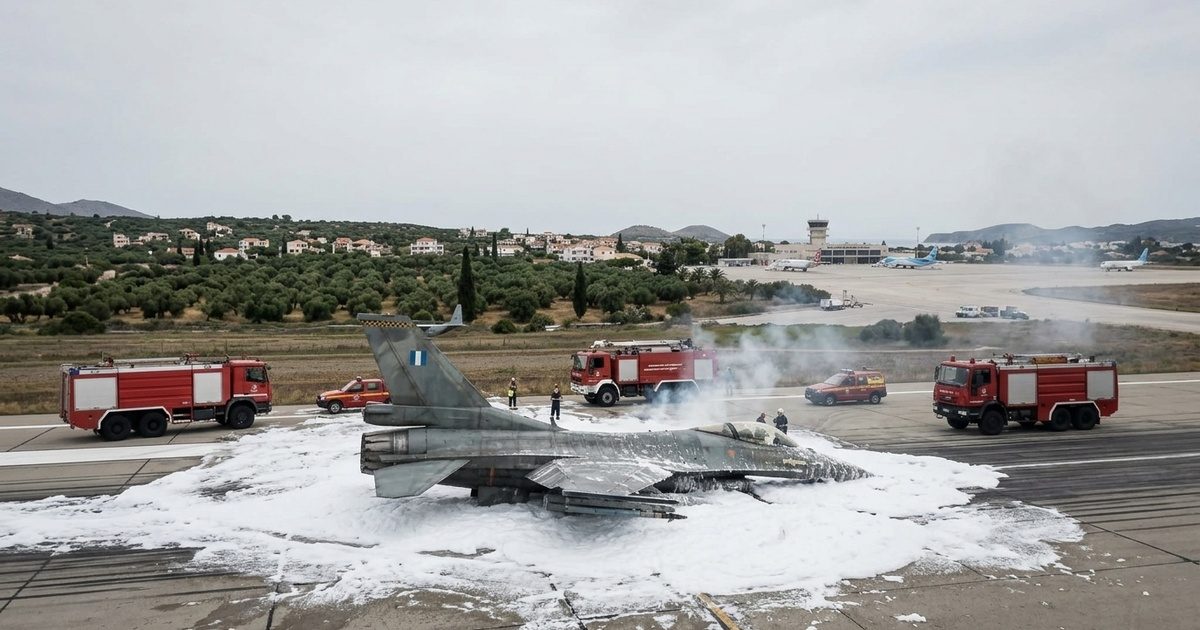
A Hellenic Air Force F-16C Fighting Falcon made a wheels-up emergency landing at Zakynthos International Airport (ZTH) on July 9, 2026. The aircraft slid to a halt on its belly and caught fire. The incident triggered a full runway closure, foam decontamination, and hours of flight diversions at one of Greece’s busiest summer tourist airports.
The aircraft flew with the 335 Squadron of the 116th Combat Wing at Araxos Air Base. The pilot declared an emergency at approximately 13:45 local time and diverted to Zakynthos. He had been flying a routine training sortie over the Ionian Sea.
Double Failure: Compressor and Hydraulics
Greek aviation observers, citing early reporting, say the F-16C suffered a compressor malfunction followed by a simultaneous hydraulic system failure. The dual failure left the pilot without a functioning landing gear deployment system.
Unable to extend the gear, the pilot executed a controlled belly landing. The maneuver places the aircraft’s fuselage, engine nacelle, and all undersurface components directly onto the runway. Airport firefighters pre-positioned and spread foam on the runway in advance, anticipating the gear-up touchdown.
The pilot survived unharmed and exited the aircraft normally through the canopy. Military helicopter transported him to the 117th Fighter Wing at Andravida Air Base for precautionary medical examination.
F-16 Belly Landing Leaves Zakynthos Runway Contaminated
A belly landing is, by definition, a FOD-generating event. When a 20,000-pound fighter slides down a runway on its belly, the contamination is immediate. It leaves behind fire suppression foam, aviation fuel, hydraulic fluid, and metal — all of which must be removed before the runway can safely reopen.
Video footage from the scene showed the single-engine jet engulfed in flames as firefighters doused it with water and foam. Fire suppressant from both the pre-treatment and post-impact application blanketed the runway surface.
Greek state news agency AMNA confirmed the runway would remain closed until at least 19:00 local time. At 18:30, a specialized Hellenic Air Force recovery team deployed to Zakynthos. Their task: remove the fuselage, clean the runway surface, and clear the way for the inspection required to reopen.
Civilian Airport Closed at Peak Season
Zakynthos is a major Ionian island destination, and ZTH handles high volumes of charter and scheduled international traffic in July. Incoming flights diverted to Athens, Corfu, and Thessaloniki; departures were delayed or cancelled. Aerotime reported the airport could not reopen until the fighter jet was removed. That underscores why decontamination — not just removal — is the critical gate.
A civilian airport cannot resume operations with foam residue, hydraulic fluid, or metal fragments on the movement area. Each hazard represents a potential FOD threat to the next aircraft using the runway, whether a narrowbody airliner or a general aviation departure.
The Decontamination Process
Removing a crashed military aircraft from a runway means more than towing it clear. Recovery teams must account for several hazard categories: leaked fuel in drainage channels, fire suppressant residue that degrades pavement friction, hydraulic fluid, and structural fragments shed during the slide. Crews sweep and physically inspect every section before the airfield can certify it safe.
In this case, the process consumed the better part of an afternoon at an international airport running at peak summer capacity.
The Hellenic Air Force General Staff confirmed the pilot’s safety. The causes of the incident are under investigation. Officials will review maintenance records, technical data, and the pilot’s own report before drawing conclusions.
Investigation Underway
In a single-engine aircraft, a compressor failure immediately narrows options. Hydraulic failure compounds the problem — it can affect flight controls, brakes, and landing gear actuation. The pilot had little margin. Nevertheless, he put the aircraft down at a civilian airport without ejection and without ground casualties, reflecting exceptional airmanship under severe systems degradation.
The Hellenic Air Force has opened a formal investigation. Lieutenant Colonel Konstantinos Gravalos, cited in Greek media, confirmed the technical malfunction but declined to characterize the specific failure sequence pending inquiry. Investigators will examine maintenance records, flight data, and the pilot’s report.
Subscribe to FODNews for ongoing coverage of runway safety incidents and airfield FOD events worldwide.