
For decades, researchers at Germany’s Leibniz Institute for Atmospheric Physics aimed high-powered lasers at the sky above the Baltic coast to study the natural metal layers left by meteors ablating in the mesosphere. Now those same instruments are doing something new. Resonance fluorescence lidar, a laser technique tuned to detect the spectral signature of individual elements above 80 kilometers, has proven capable of catching the chemical aftermath of a reentering rocket stage—identifying the material, tracing it back to a specific object, and measuring it in real time. The Falcon 9 detection that proved the method is more than a striking data point; it is evidence that ground-based observatories can serve as permanent monitoring infrastructure for upper-atmospheric chemistry changes driven by human hardware burning up overhead.
How Resonance Fluorescence Lidar Works
The technique exploits a fundamental property of atomic physics. Every element absorbs and re-emits light at a set of characteristic wavelengths—its spectral fingerprint. A resonance fluorescence lidar system fires a laser pulse tuned precisely to one of those wavelengths. When the beam encounters target-element atoms at altitude, they absorb the photons and immediately re-emit them at the same frequency. A sensitive telescope on the ground detects the backscattered signal, and because the laser wavelength is matched to a specific element, only that element responds. Lithium has a resonance line at 670.7926 nanometers; iron, potassium, calcium, and sodium each have their own distinct lines.
At mesospheric altitudes—roughly 80 to 110 kilometers—the natural metal background is extremely sparse. What’s there comes mostly from meteoric ablation. That thinness is precisely what makes the technique powerful for reentry monitoring: a sudden injection of spacecraft-derived material stands out sharply against a quiet, well-characterized baseline. The Leibniz Institute for Atmospheric Physics (IAP) in Kühlungsborn, affiliated with the University of Rostock, runs resonance lidars tuned to potassium, calcium, nickel, and now lithium.
A Falcon 9 Reentry Becomes an Atmospheric Experiment
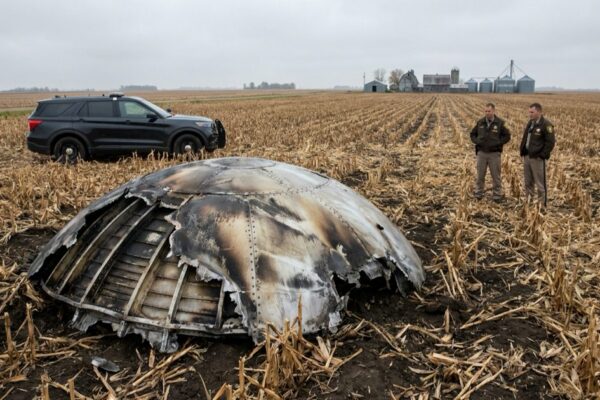
On the night of February 19–20, 2025, a SpaceX Falcon 9 upper stage reentered uncontrolled over the Atlantic west of Ireland. The breakup produced a visible fireball over Europe, and fragments eventually landed near Poznań, Poland. What people on the ground saw was spectacle. What the IAP lidar recorded was chemistry.
Approximately 20 hours after the reentry, the Kühlungsborn instrument detected a sharp anomaly: a tenfold spike in lithium concentration at 94 to 97 kilometers altitude. The enhancement was brief, vertically compact, and chemically specific. Backward trajectory modeling traced the air mass over Germany back through wind patterns to its origin—directly to the Falcon 9’s reentry corridor west of Ireland.
The composition match was not coincidental. Falcon 9 upper stages use aluminum-lithium alloy in their propellant tank walls, an engineering choice that introduces a lithium inventory of roughly 30 kilograms per stage. The natural lithium input to the mesosphere from cosmic dust is estimated at about 80 grams per day. A single reentering rocket stage can therefore deliver hundreds of times that amount into a localized air mass.
The findings, published in Communications Earth & Environment by lead researcher Robin Wing, Michael Gerding, and colleagues, tie a specific chemical signal to a specific object at a specific altitude and time. That logic chain is tighter than what came before. As FODNews documented in earlier direct measurements of reentry chemistry, the field had largely depended on indirect inference—modeling from material compositions, aircraft sampling at lower altitudes, or theoretical estimates. The IAP result is direct.
The Next Targets: Copper, Aluminum Oxide, and Hydrogen Fluoride
Lithium was a strategic first target: rare at mesospheric altitudes, well-represented in modern rocket hardware, and detectable with existing lidar wavelengths. The IAP team is now developing a dedicated three-channel multi-species lidar system to track three additional spacecraft-derived compounds.
Copper is the first expansion target. Spacecraft wiring harnesses, printed circuit boards, and structural components carry substantial copper mass, yet copper has never been directly measured in the mesosphere as a reentry byproduct. Its resonance lines fall in the near-ultraviolet, which imposes additional instrument design requirements but is considered tractable.
Aluminum oxide (Al₂O₃) is the higher-stakes target. When aluminum-rich structures—rocket bodies, satellite buses, solar panel frames—ablate during reentry, they oxidize into alumina particles and vapor. Alumina is believed to be the dominant reentry byproduct by mass, and as FODNews reported in the context of modeled alumina deposition and ozone layer chemistry, Al₂O₃ at those altitudes may catalyze ozone-destroying reactions. Those projections are based on models. Direct detection by lidar would transform the debate.
Hydrogen fluoride (HF) rounds out the initial target list. Fluorine compounds appear in certain propellants and structural materials. The concern is less about mass than reactivity: fluorine at high altitude interacts aggressively with ozone, and its presence at mesospheric concentrations would be a chemically novel input. The cumulative picture—from the growing reentry contamination record to these direct chemical fingerprints—suggests a monitoring challenge no single element can capture.
From One Station to a Network
The Falcon 9 detection required a fortunate alignment: an uncontrolled reentry with known composition, favorable Atlantic winds carrying the plume toward Kühlungsborn, and an instrument already operating in the right mode on the right night. Reproducibility requires infrastructure, not luck.
The IAP is participating in EULIAA (European Lidar Array for Atmospheric Climate Monitoring), an EU-funded project developing compact, deployable lidar systems for wind and temperature profiling across Europe. The current EULIAA architecture targets atmospheric dynamics, but the modular design could accommodate additional measurement channels. The case for adding metal-species channels grows stronger as reentry rates rise.
A Regulatory Layer That Doesn’t Exist Yet
Space debris regulation currently focuses on collision risk in orbit and ground casualty probability from surviving fragments. Environmental law addresses the troposphere and stratosphere. The mesosphere—where the bulk of reentry chemistry occurs—falls between both frameworks. That gap was reasonable when significant anthropogenic inputs at 90 to 100 kilometers were not considered plausible. It is harder to defend as launch rates and constellation sizes grow.
Resonance fluorescence lidar offers the empirical foundation for an argument regulators can evaluate: not projected values from models, but measured values from instruments. The Falcon 9 detection did not demonstrate harm. It demonstrated that detection is possible, and that the tool exists to do it at scale.
Subscribe to FODNews for independent coverage of the science and policy of debris, reentry, and the evolving upper-atmospheric environment.
Sources
- Wing, R., Gerding, M. et al. (2026). “Measurement of a lithium plume from the uncontrolled re-entry of a Falcon 9 rocket.” Communications Earth & Environment, 7, 161.
- Gerding, M. (2026). EGU General Assembly 2026 presentation on multi-species lidar for reentry monitoring. Leibniz Institute for Atmospheric Physics (IAP), Kühlungsborn.
- Daily Galaxy. (2026). “Scientists Spot Rare Atmospheric Signature Tied to Space Debris Reentry.”
- SpaceDaily. (2026). “A Falcon 9 upper stage burned up over Europe last February, and German scientists just caught it doing something to the atmosphere nobody had directly measured before.”
- Space.com. (2026). “Lasers shine a new light on the space junk air pollution problem.”
- Leibniz Institute for Atmospheric Physics. Resonance lidar instruments, Kühlungsborn.