New Research: Mega-Constellation Reentries Releasing Thousands of Tonnes of Alumina Into Stratosphere, Threatening Ozone Layer
WASHINGTON — March 2026 — Scientists have, for the first time, directly measured atmospheric pollution from a reentering spacecraft. The findings raise urgent questions: are the regulatory frameworks governing satellite reentry adequate to protect the ozone layer?
Two independent lines of research, published in the past year, converge on an uncomfortable conclusion. The rapid proliferation of satellite megaconstellations is seeding Earth’s stratosphere with aluminum oxide nanoparticles that act as long-lived catalysts for ozone destruction. Under current growth trajectories, that cumulative burden could render the Montreal Protocol’s hard-won ozone recovery irrelevant.
The First Direct Measurement
In February 2026, researchers at the Leibniz Institute for Atmospheric Physics in Kühlungsborn, Germany, published a landmark study in Communications Earth & Environment — the first time scientists had tied a specific reentry event to a detectable atmospheric pollution plume.
Their instrument — a highly sensitive resonance fluorescence lidar system — routinely monitors the upper atmosphere. On the night of Feb. 20, 2025, it detected a sudden spike in lithium vapor.
Lithium concentrations jumped tenfold: from roughly 3 atoms per cubic centimeter to 31. The spike occurred at altitudes between 94.5 and 96.8 kilometers.
The source: a SpaceX Falcon 9 upper stage that had failed to execute a planned deorbit burn after delivering 22 Starlink satellites to orbit. After drifting uncontrolled for 18 days, it reentered off the west coast of Ireland. Fragments landed in Poland.
Led by researcher Robin Wing, the team ran 8,000 reverse atmospheric trajectory simulations to rule out other sources. Everything pointed back to the rocket. Meteorites supply only about 80 grams of lithium to the entire planet per day. A single Falcon 9 upper stage, by contrast, contains approximately 30 kilograms.
“This is a first step in tracking the actual environmental fallout from space debris reentry,” the paper noted. “It certainly won’t be the last.”
Satellite Reentry and the Aluminum Problem
Lithium is a useful atmospheric tracer precisely because it’s rare. Aluminum is the opposite — it is the dominant structural material in most satellites, and it presents a far more consequential chemistry problem.
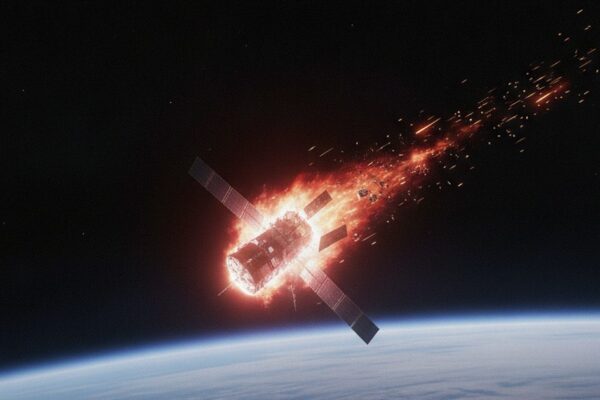
When a satellite vaporizes in the mesosphere — 50 to 85 kilometers above Earth — its aluminum frame oxidizes almost immediately. The resulting particles are aluminum oxide nanoparticles, commonly called alumina. A typical 250-kilogram satellite generates approximately 30 kilograms of them.
Alumina does not directly destroy ozone the way chlorofluorocarbons (CFCs) do. Instead, it acts as a catalyst. A single alumina nanoparticle can facilitate chemical reactions that destroy thousands of ozone molecules. This process unfolds over decades, and the particle itself is never consumed. Each nanoparticle functions as a perpetual reaction site for as long as it remains in the stratosphere.
Researchers at the University of Southern California’s Department of Astronautical Engineering documented an eightfold increase in stratospheric aluminum oxides between 2016 and 2022. Their findings, published in Geophysical Research Letters, correspond directly to the rapid scale-up of Starlink and other megaconstellation deployments.
In 2022 alone, reentering satellites released an estimated 17 metric tons of aluminum oxide nanoparticles. That boosted total atmospheric aluminum input by approximately 29.5 percent above natural levels from micrometeoroids. That same year, total aluminum from satellite reentries reached 41.7 metric tons — roughly 30 percent more than the planet receives naturally from space rock.
The Scale of What’s Coming
The 2022 figures represent a satellite fleet that, by current standards, remains modest. As of early 2026, more than 9,000 Starlink satellites are in orbit. Constellation filings across multiple operators total more than 70,000 spacecraft — part of a surge in low Earth orbit congestion that FODNews has tracked closely.
The USC research projects that full deployment of approved megaconstellations could push annual aluminum oxide emissions to 360 metric tons. That represents a 646 percent increase over natural background levels.
More conservative modeling from NOAA’s Chemical Sciences Laboratory offers a similarly stark projection. If the LEO satellite population reaches 60,000 by 2040, annual alumina deposits could hit 10,000 metric tons.
To put that figure in perspective: it is equivalent to approximately 150 space shuttles vaporizing in the atmosphere every year.
NOAA researcher Chris Maloney led the study, published in the Journal of Geophysical Research: Atmospheres. He found that such a burden could heat the mesosphere by as much as 1.5 degrees Celsius near the poles. It could also reduce wind speeds in the Southern Hemisphere’s polar vortex by roughly 10 percent. The downstream effects on the ozone layer remain poorly constrained.
“What we’re showing is that even from a very crude perspective, there is potential for these reentry aerosols to influence stratospheric and mesospheric processes, whether it’s through heating or transport,” Maloney said.
The 30-Year Time Bomb
One of the most troubling aspects of the alumina problem is its time horizon. Particles deposited in the mesosphere take an estimated 20 to 30 years to descend into the stratosphere. That’s the atmospheric layer between roughly 15 and 50 kilometers altitude, where 90 percent of Earth’s ozone resides.
Consequently, the chemical footprint of today’s constellation buildout will not manifest as measurable ozone impacts until the late 2030s and 2040s. The satellites launching now are pre-loading the atmosphere with catalysts whose consequences won’t be visible for decades.
By the time ozone effects become scientifically unambiguous, the stratosphere could already contain alumina particles from hundreds of thousands of cumulative reentries. Those particles would have accumulated during a period when no regulatory body required anyone to assess the risk.
A Regulatory Framework Built for a Different Era
The rules governing satellite reentries were written for an environment that no longer exists.
The United States established the international reentry safety standard in 1995. It set the threshold at less than a one-in-10,000 probability of injuring someone on the ground. France, Japan, the European Space Agency, and the Inter-Agency Space Debris Coordination Committee adopted similar thresholds. At the time, dozens of satellites reentered the atmosphere each year. The arithmetic was manageable.
It no longer is. A study in Acta Astronautica ran the numbers for eleven major megaconstellations. Using the existing per-satellite standard, it calculated a collective casualty probability of 40 percent. That figure reflects a fundamental mismatch: risk is assessed satellite by satellite — but it accumulates across tens of thousands of objects.
Some regulators have begun to adjust. France updated its Space Operations Act in June 2024 to cap collective constellation risk at one in 100. The European Space Agency revised its guidelines in October 2023 to recommend a stricter per-satellite standard of one in 100,000 for large constellations.
The United States has not updated its threshold. Moreover, no U.S. licensing authority — including the Federal Communications Commission — currently requires applicants to assess or disclose the atmospheric chemistry or ozone depletion potential of proposed satellite systems.
No licensing regime anywhere in the world requires an ozone impact assessment before authorizing a megaconstellation.
Design for Demise — and Its Limits
The industry’s primary response to reentry risk has been a concept called “design for demise” — engineering satellites to burn up completely in the atmosphere, leaving nothing to hit the ground. SpaceX has long asserted that Starlink satellites meet this standard.
Physical evidence has complicated that claim. A 2.5-kilogram fragment of a Starlink satellite landed on a farm in Saskatchewan, Canada, in 2024. Similar fragments have since been reported in Poland, Kenya, North Carolina, and Algeria. SpaceX attributed the Saskatchewan incident to an earlier-than-expected loss of attitude control. That failure reduced atmospheric friction and allowed a fragment to survive reentry.
For the alumina problem, however, design for demise is beside the point. The atmospheric chemistry concern arises precisely because satellites do burn up. It is the vaporization itself — not the surviving fragments — that produces the nanoparticles. A satellite that fully disintegrates in the mesosphere produces more alumina, not less.
SpaceX is now launching second-generation Starlink satellites massing approximately 2 metric tons each. That is more than eight times the weight of the original 250-kilogram design. The alumina yield per reentry scales accordingly.
What Scientists Are Calling For
Atmospheric researchers are increasingly explicit about what they say is needed. They want direct observational campaigns to characterize alumina distribution in the stratosphere. They also call for updated regulatory frameworks that evaluate constellations as systems rather than individual satellites.
The Leibniz team’s newly upgraded lidar can now simultaneously detect lithium, sodium, copper, titanium, silicon, gold, silver, and lead. Each element serves as an elemental fingerprint for different spacecraft materials. In principle, that capability could allow scientists to build a real-time chemical inventory of reentry pollution for the first time.
Nevertheless, measurement without regulation is incomplete. The science is advancing. The governance frameworks have not kept pace.
The Leibniz team’s paper called the February 2025 Falcon 9 event “a first step in tracking the actual environmental fallout from an unintentional space debris reentry.” The question now is whether regulators will act on that knowledge in time. Once the atmospheric ledger tips, it may be impossible to reconcile.
Subscribe to FODNews for continued coverage of space debris, low Earth orbit infrastructure, and the environmental and safety implications of the commercial space boom.
Sources
- Wing, R. et al. “Measurement of a lithium plume from the uncontrolled re-entry of a Falcon 9 rocket.” Communications Earth & Environment, February 2026. nature.com
- University of Southern California / AGU. “Satellite megaconstellations burn, deplete ozone.” Geophysical Research Letters. AGU Press Release
- Maloney, C.M. et al. “Investigating the potential atmospheric accumulation and radiative impact of the coming increase in satellite reentry frequency.” Journal of Geophysical Research: Atmospheres, 2025. NOAA Chemical Sciences Laboratory
- Universe Today. “Scientists Publish the First Direct Measurement of Space Debris Pollution.” March 2026. universetoday.com
- Indian Defence Review. “Starlink Is Dropping From the Sky Again and Again. Scientists Warn Earth Is Already Feeling the Effects.” 2026. indiandefencereview.com
- Acta Astronautica (via Indian Defence Review). Collective casualty probability calculations for megaconstellations. sciencedirect.com