TIME Investigation: Kessler Cascade Risk ‘CRASH Clock’ Has Fallen to 2.8 Days
A new metric developed by researchers at Princeton, UBC, and the University of Regina lays bare how dangerously little margin remains before a catastrophic chain reaction in low Earth orbit.
WASHINGTON — A TIME investigation published April 16, 2026, spotlights a sobering new metric for orbital safety: the CRASH Clock — short for Collision Realization and Significant Harm — has collapsed from 121 days in 2018 to just 2.8 days today.
The figure represents how quickly a catastrophic satellite collision would occur if operators were to lose the ability to conduct avoidance maneuvers — a scenario that is no longer hypothetical.
What the CRASH Clock Actually Measures
The CRASH Clock was proposed by an international research team in a December 2025 preprint paper as a way to quantify cumulative stress on the orbital environment. It asks a single, stark question: if collision avoidance stopped working right now, how long before the first major smashup?
The answer — 2.8 days — reflects current satellite densities in low Earth orbit (LEO) around 500 km altitude. In 2018, before the megaconstellation era took hold, that number was 121 days. That window was wide enough that operators could recover from even the most severe disruptions before a collision became likely.
Today, that margin has essentially vanished.
“There is substantial potential for current or planned actions in orbit to cause serious degradation of the orbital environment or lead to catastrophic outcomes,” the researchers wrote, “highlighting the urgent need to find better ways to quantify stress on the orbital environment.”
The Solar Storm Scenario
The specific threat the CRASH Clock models is a severe solar storm — a coronal mass ejection (CME) powerful enough to disrupt satellite communications and tracking for an extended period.
This isn’t speculative risk modeling. In May 2024, a strong geomagnetic storm forced thousands of Starlink satellites into emergency maneuvers. The chaotic movements, according to the research team, made “collision avoidance maneuvers extremely uncertain” — exactly the kind of situation the CRASH Clock is designed to capture.
The researchers found that if operators lost satellite control for just 24 hours, simulations show a 30% probability of triggering a Kessler chain reaction — a cascading sequence of collisions that could render entire orbital bands unusable for decades.
A full Carrington-level event — comparable to the catastrophic 1859 solar storm — could eliminate ground control capability for a week or more. In today’s orbital environment, that is no longer a survivable disruption.
Numbers That Compound the Risk
The scale of what now occupies LEO makes the math daunting.
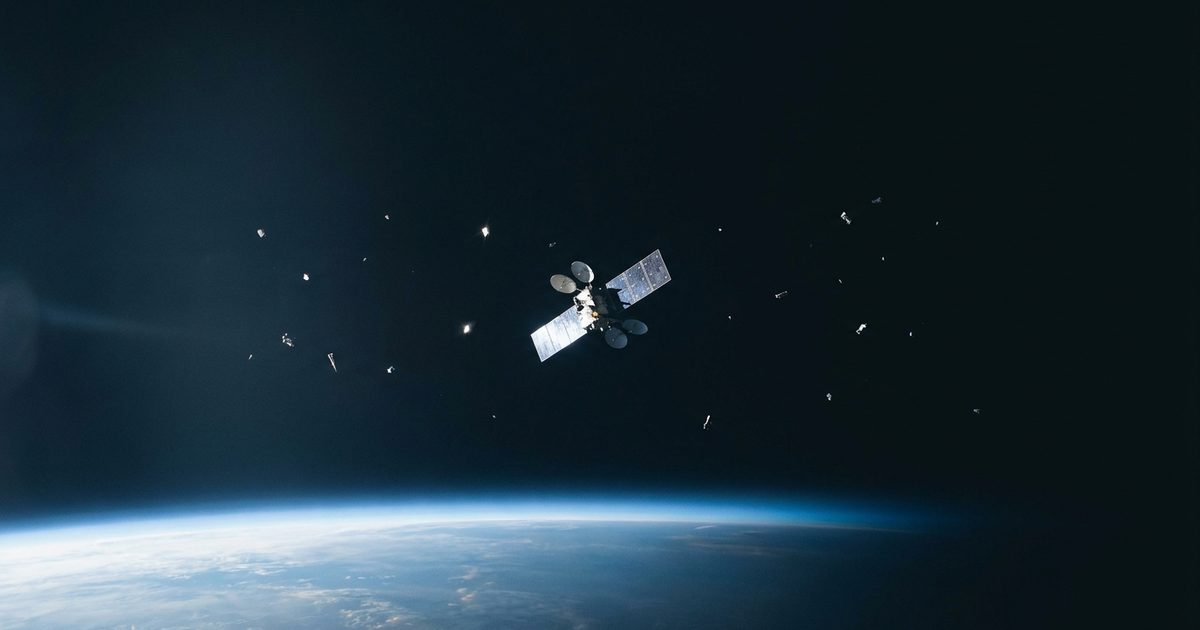
According to NASA’s Orbital Debris Program Office, more than 25,000 objects larger than 10 cm currently orbit Earth. That number grows to 500,000 in the 1–10 cm range and 100 million at the millimeter scale — each capable of inflicting catastrophic damage at orbital velocities of 17,500 mph.
SpaceX’s Starlink constellation alone now accounts for 9,400 satellites — roughly 63% of the approximately 14,900 active satellites in orbit, according to the TIME report. SpaceX is seeking FCC approval to expand Starlink to 20,000 spacecraft. In a January 2026 filing, the company also proposed launching up to one million AI satellites.
Blue Origin filed a parallel request in March 2026 to launch up to 51,600 AI-focused satellites of its own.
“The number of objects in low Earth orbit has grown ten-fold in the last 10 to 15 years,” Chris Blackerby, chief operating officer of debris-removal company Astroscale, told TIME. “When Astroscale started in 2013, there were about 1,000 satellites in LEO. Now there’s roughly 15,000.”
FODNews has tracked the accelerating pace of near-misses. In a four-day span in late March 2026, SpaceX’s Starlink constellation logged nine conjunction threat events, including one classified as HIGH risk with a closest approach of just nine meters. That same month, a Starlink satellite fragmented at 560 km altitude, scattering hundreds of trackable debris pieces — the second such fragmentation event for the constellation in four months.
Debris Already Outpacing Decay
ESA’s Space Environment Report 2025 confirms the structural problem underlying the CRASH Clock’s deterioration: debris generation in LEO already outpaces natural atmospheric removal.
In 2024 alone, fragmentation events — primarily non-collisional explosions from aging hardware — generated more than 3,000 newly catalogued fragments. ESA’s MASTER model shows net population growth in LEO even without new launches, meaning the environment is degrading under its own accumulated mass.
The report identifies a critical altitude band between 800 and 1,000 km as effectively off-limits for new constellation deployment. “If you take orbits between 800 km and 1,000 km, these are typically orbits where operators don’t launch constellations anymore because it’s too risky,” Luc Piguet, CEO of debris-removal firm ClearSpace, told TIME.
At altitudes commonly used by commercial constellations — around 550 km — orbital decay takes years. At 1,000 km, debris can persist for centuries without active removal.
The Exxon Valdez Analogy
What would a triggering collision actually look like? Not Hollywood’s version, the researchers say.
The 2009 collision between Iridium 33 and the defunct Russian Kosmos 2251 satellite — the last confirmed accidental breakup at scale — produced more than 1,800 pieces of trackable debris. The collision did not cause a cascade. But it happened in an orbital environment far less crowded than today’s.
“In the short term, a major collision is more akin to the Exxon Valdez oil spill disaster than a Hollywood-style immediate end of operations in orbit,” the CRASH Clock researchers write. “Indeed, satellite operations could continue after a major collision, but would have different operating parameters, including a higher risk of collision damage.”
Kessler syndrome, in other words, is not an instant catastrophe. It is a slow-motion degradation — one that, once begun, may be irreversible on any meaningful human timescale.
“While collisional cascades can take decades to centuries to develop, a single collision could create substantial stress on the orbital environment immediately, even if it does not lead to a runaway,” the paper states.
The Traffic Control Gap
Unlike geostationary orbit — where the International Telecommunications Union assigns slots to individual countries and companies — LEO has no equivalent governance framework. Operators must coordinate informally, sharing trajectory data and planned maneuvers to avoid conflicts.
SpaceX’s Starlink satellites carry autonomous collision avoidance systems and execute maneuvers when impact probability exceeds three in 10 million. The company performed approximately 300,000 avoidance maneuvers in 2025 alone, according to a December FCC filing.
“The problem with space traffic control is when companies or countries don’t tell us where the satellites are going to be,” Gwynne Shotwell, SpaceX’s president and COO, told TIME. “You really need to share your ephemeris.”
But ephemeris sharing is voluntary, not mandated. And as constellation counts climb toward the hundreds of thousands, the computational and coordination burden grows exponentially.
Mitigation: Necessary but Insufficient
Analysts widely agree that passive compliance with deorbit rules — even the FCC’s updated five-year post-mission disposal mandate — cannot stabilize the LEO environment on its own.
ESA’s Zero Debris Approach calls for limiting new debris production by 2030 through lower operating orbits, passivation of rocket stages, and active removal missions. ESA estimates that removing just five to 10 of the largest legacy objects annually could meaningfully slow the population growth curve.
Commercial active debris removal is transitioning from demonstration to early operations. Astroscale’s ELSA-M mission uses magnetic capture to deorbit decommissioned satellites; the company’s COSMIC mission, targeting uncooperative debris, is aimed at a 2027 demonstration. ESA’s ClearSpace-1 mission has faced complications following an unrelated debris strike on a reference object.
But none of these missions operate at the scale needed to reverse current trends. Analysts estimate that at least five to 10 large objects must be removed from LEO annually — simply to hold debris levels flat — even under a scenario of 90% compliance with disposal guidelines.
What 2.8 Days Means
The CRASH Clock does not predict that catastrophe is imminent. The sun does not launch a Carrington-scale event on a fixed schedule, and today’s operators are more capable than ever at managing orbital traffic.
What the metric reveals is margin — or the near-complete absence of it.
In 2018, four months of buffer existed between normal functioning of the orbital environment and catastrophic failure. Today, that buffer is measured in hours rather than months. When the next major solar storm arrives — and solar physicists agree it is a matter of when, not if — the crowded constellation era will face its first real stress test.
“Is it an immediate existential problem now?” Astroscale’s Blackerby told TIME. “Probably not. But is it something that is building to be a problem in the future? Undoubtedly yes.”
The CRASH Clock currently reads 2.8 days. The question is whether the international community can act before it reaches zero.
Subscribe to FODNews for ongoing coverage of orbital debris, space safety, and LEO congestion.
Sources
- TIME: “The Looming Risk of Too Many Satellites and Debris in Space” (April 16, 2026)
- CRASH Clock preprint paper — Princeton / UBC / University of Regina (December 2025)
- ESA Space Environment Report 2025
- NASA Orbital Debris Program Office — FAQ
- Phys.org: “Days to Disaster: Earth’s Orbit” (December 2025)
- ESA: The Kessler Effect and How to Stop It
- NASA Technical Reports Server: Iridium-Cosmos Collision Analysis