Airport FOD Detection Market on Track to Hit $75.2M by 2031 as AI and Drone Systems Go Mainstream
The global airport FOD detection market is forecast to nearly double over the next seven years, reaching $75.2 million by 2031 from $46.5 million in 2024 — a compound annual growth rate (CAGR) of 7.1%, according to analysis published by Persistence Market Research. The expansion reflects mounting pressure on airport operators to move beyond manual runway walks and toward continuous, automated monitoring as air traffic volumes and fleet utilization intensify.
The $13 Billion Problem Driving Investment
Foreign object debris (FOD) — the catch-all term for debris on runway and taxiway surfaces, from loose hardware and pavement fragments to wildlife remains and baggage parts — costs the global aviation industry an estimated $13 billion annually when direct damage and indirect disruption are combined.
The stakes are well documented. The 2000 Concorde crash, traced to a 43-centimeter titanium strip on a Paris runway, remains the starkest reminder that small objects carry catastrophic potential. Today, with global passenger numbers projected to double by the mid-2030s, airports face growing scrutiny over inspection frequency and reliability.
Automated detection systems offer round-the-clock coverage that manual inspections cannot match, and they generate digital audit trails that satisfy regulatory requirements — making them an increasingly standard part of airport safety infrastructure.
Radar and AI Lead the Technology Mix
Radar-based systems currently dominate the market, valued for their all-weather reliability and ability to detect both metallic and non-metallic objects across large surface areas.
QinetiQ’s Tarsier system — described by the company as the first runway hazard management platform with fully automatic FOD detection — uses millimeter-wave radar to continuously sweep the runway surface. When debris is detected, a high-zoom camera pans to the location, sending a live image and GPS coordinates to the operations center for visual confirmation and rapid retrieval. The system is deployed at major international airports including Heathrow, Dubai, Doha, and Vancouver.
Xsight Systems’ FODetect platform combines millimeter-wave radar with electro-optical high-definition imaging and AI analytics, completing a full runway scan in under 60 seconds with no blind spots. Mounted on existing runway edge lights and integrated into Xsight’s RunWize suite, FODetect uses laser guidance to direct ground crews to the precise location of detected objects — reducing response time and false-alarm rates.
AI integration is reshaping both system categories, according to Persistence Market Research analysis. AI-powered analytics improve detection accuracy, cut false positives, and are beginning to enable predictive maintenance by identifying patterns in historical FOD data.
Drones Compress Inspection Times to Minutes
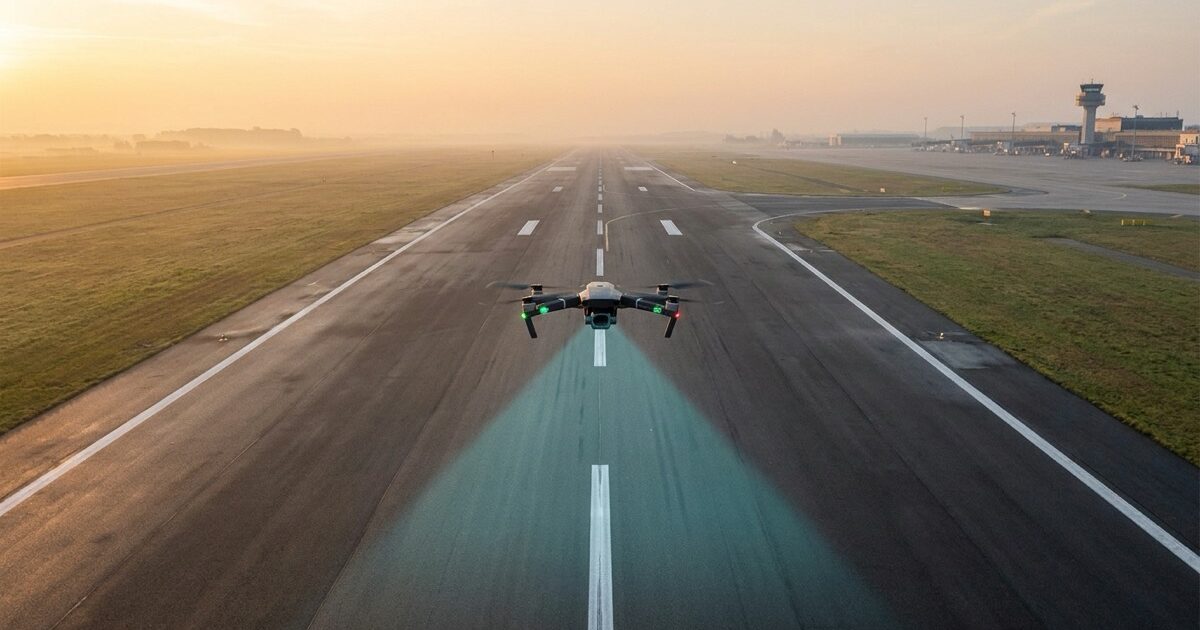
Unmanned aerial systems are emerging as a complementary layer in airport FOD programs, particularly for airports where installing fixed radar infrastructure involves significant capital outlay.
Drone inspection platforms equipped with AI computer vision, thermal imaging, and LiDAR can cover a full runway in 3 to 8 minutes — compared with 15 to 30 minutes for a vehicle-based manual inspection — while detecting objects as small as 5 millimeters, according to aviation maintenance data. Thermal imaging extends effective operating hours through the night, and onboard AI classifies objects in real time, automatically logging GPS coordinates and imagery into maintenance systems.
The capability gap over manual inspection continues to widen as sensor resolution and AI model accuracy improve year over year.
Munich Airport has moved to integrate autonomous robots into its FOD detection workflow ahead of a broader rollout planned for 2027. FODNews previously reported on Munich’s program as one of the more advanced deployments in European commercial aviation.
Regional Landscape: North America Leads, Asia-Pacific Surging
North America holds the largest share of the current FOD detection market, underpinned by advanced aviation infrastructure, early technology adoption, and stringent Federal Aviation Administration regulatory requirements.
Europe is the second-largest market, supported by strong safety mandates from the European Union Aviation Safety Agency and established deployment records at major hub airports.
Asia-Pacific is forecast to be the fastest-growing region through 2031, driven by a wave of new airport construction across China, India, Southeast Asia, and the Gulf states. Greenfield airports offer an opportunity to embed automated FOD detection from the outset rather than retrofitting existing infrastructure — a dynamic that is accelerating procurement timelines.
Key Players and Market Structure
The competitive landscape includes Smiths Detection, QinetiQ, Thales, and Xsight Systems among the leading vendors, alongside emerging players deploying AI-native drone platforms. Multi-sensor fusion — combining radar, optical, thermal, and LiDAR inputs — is becoming the baseline expectation for new procurements, market analysts note.
The shift from hardware-centric to software-and-services revenue models is also underway. Vendors increasingly package FOD detection as a managed service with ongoing analytics support — a model that lowers upfront costs for airport operators while creating recurring revenue streams for vendors.
- Persistence Market Research via OpenPR — Airport Runway FOD Detection Systems Market to Reach US$75.2 Million by 2031
- OXmaint — Runway Inspection Drones for Airport FOD Compliance (2026)
- QinetiQ — Tarsier Automatic Foreign Object Debris Detection
- Xsight Systems — FODetect Runway FOD Detection System
Subscribe to FODNews for weekly coverage of runway safety, FOD incidents, and detection technology.