Munich Airport Plans Autonomous FOD Detection Robots by 2027, Trials Show 10x Better Detection Than Humans
MUNICH — Munich Airport is targeting full deployment of autonomous foreign object debris detection systems by 2027, with early trials by program partners showing machines detect 10 times more FOD than human inspection crews.
The announcement came as Munich Airport and Lufthansa formally joined the FTE Smart Ramp initiative — a global collaborative program managed by Future Travel Experience and innovation consultancy nlmtd — alongside members including International Airlines Group, Royal Schiphol Group, KLM, All Nippon Airways, Miami International Airport, and Metropolitan Washington Airports Authority.
A 2027 Autonomy Milestone
Thomas Hoff Andersson, chief operating officer at Munich Airport, outlined FOD detection as a concrete milestone in the airport’s broader push toward automated ramp operations.
“Our goals are clear and our ambitions are strong as we work toward becoming the smartest, data-driven airport with an autonomous ramp,” Andersson said in a statement tied to the program launch.
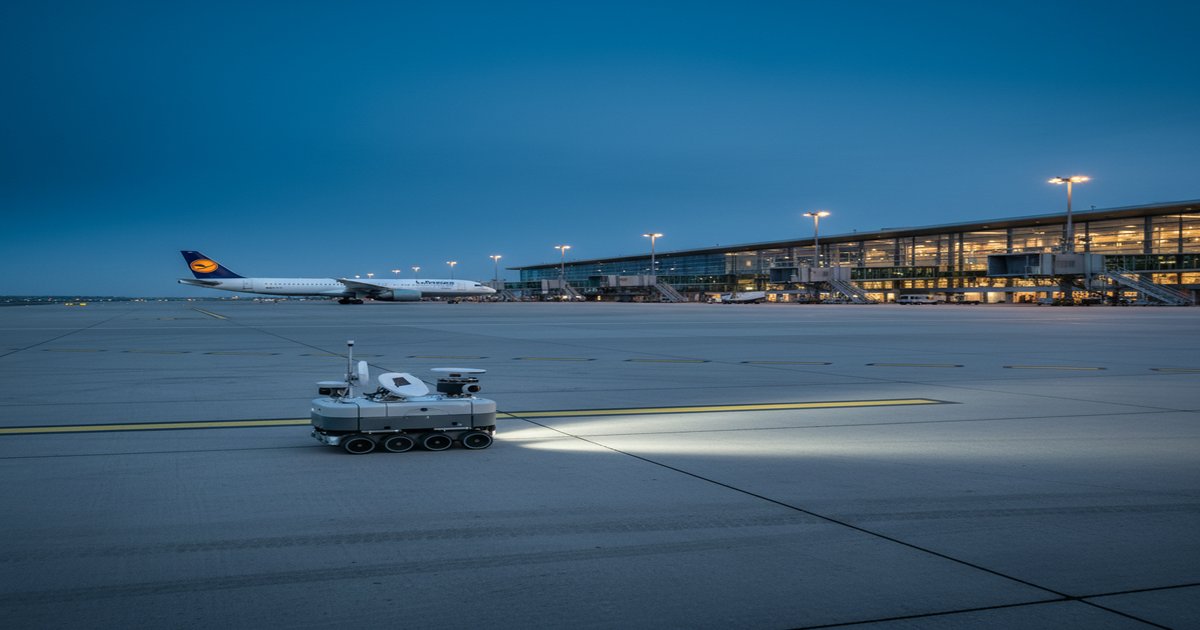
The autonomous FOD capability would enable continuous detection, mapping, and removal of debris from runways, taxiways, and aprons — surfaces where stray hardware, loose pavement fragments, and other materials routinely threaten aircraft engines, tires, and airframe systems.
What Trials Have Shown So Far
The 10-times detection finding comes from early-stage trials conducted within the FTE Smart Ramp consortium, not yet from Munich Airport’s own airfield. Munich’s COO cited those results as direct justification for the 2027 target.
Royal Schiphol Group, one of the initiative’s earliest members, completed an initial trial with one autonomous FOD detection provider. A follow-up trial with a second vendor — testing both detection and physical removal capabilities — was planned to begin in a controlled setting before moving to live apron conditions in late 2025. Schiphol’s Strategy and Innovation Advisor Daan Boot said the first trial revealed that autonomous robots “can behave in unpredictable ways on the ramp,” underscoring how much work remains before these systems are ready for live deployment at busy commercial airports.
Why Human Inspection Has Limits
FOD walks — crews physically walking runways and aprons to collect debris before flight operations — remain standard practice at airports worldwide. The process is labor-intensive, time-limited, and dependent on daylight and weather conditions.
Autonomous detection systems use combinations of high-resolution cameras, LiDAR, radar, and machine learning models to continuously scan pavement surfaces, flagging objects as small as a 2-inch bolt in real time. Fixed radar-based systems have been evaluated at U.S. airports including JFK and O’Hare under FAA-funded programs, though mobile autonomous robot platforms represent a newer and potentially more flexible approach.
The FAA has estimated that effective FOD management systems can generate returns of more than $15 million over a three-year period for major airports, factoring in avoided damage, reduced delays, and lower insurance exposure.
Part of a Broader Ramp Automation Push
FOD detection is one piece of a larger autonomous ramp vision that Munich Airport and Lufthansa are building toward in partnership. Roswitha Becker, head of ground operations for Lufthansa at Munich Airport, described a three-to-five-year horizon in which autonomous systems take over routine and physically demanding ramp tasks — freeing ground crews for work that requires human judgment.
Other projects underway through the FTE Smart Ramp program include autonomous ground power unit connection — involving a robotic arm that must precisely connect a 50-kilogram cable to an aircraft — as well as AI-based turnaround monitoring using computer vision to track each step in the aircraft servicing process.
Assaia’s ApronAI system, which uses computer vision to predict and flag turnaround delays, is also being deployed at Munich Airport as part of these broader digitization efforts.
Industry Significance
If Munich Airport achieves its 2027 target, it would become one of the first major European hub airports to deploy autonomous FOD detection as a standard operational capability rather than a trial program.
The 10-times detection differential — if validated at scale — would represent a meaningful safety argument for broad adoption. Most current FOD walk protocols rely on inspections conducted two to four times daily, leaving extended windows during which debris on active movement areas goes undetected.
Continuous autonomous monitoring would, in theory, reduce that exposure to near zero.
Subscribe to FODNews for independent coverage of FOD incidents, technology, and prevention practices across aviation, defense, and motorsport.
Sources
- Future Travel Experience — Inside Munich Airport and Lufthansa’s collaborative approach to innovation, robotics and automation as they join pioneering FTE Smart Ramp initiative (March 2026)
- Future Travel Experience — How Schiphol is leveraging technology and cross-industry collaboration to drive Smart Ramp innovation (September 2025)
- Airports Council International — The Silent Airside Threat: How AI Is Fighting FOD (April 2025)
- FAA Airport Technology R&D Branch — Automated FOD Detection System Evaluation