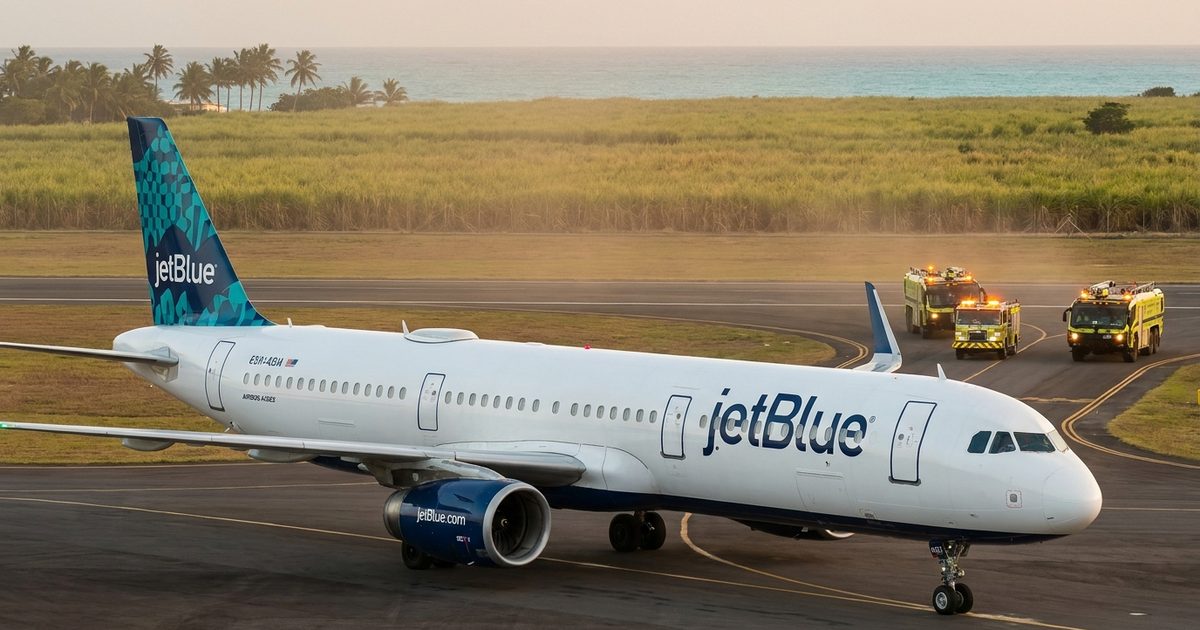
VIEUX FORT, Saint Lucia — The takeoff roll was over before it really began. At 19:58 UTC on May 8, 2026, a bird strike hit the left engine of JetBlue Flight 882 as the Airbus A321-231 accelerated down Runway 10 at Hewanorra International Airport (UVF). The crew aborted, rolled out, and backtracked to the stand. No injuries. One runway. No alternatives.
The incident, documented by the Aviation Safety Network, involved registration N957JB — a 2015-vintage A321 powered by IAE V2533-A5 engines. The flight was operating as B6882, JetBlue’s New York-JFK service out of Saint Lucia.
Single Runway, Single Option
Hewanorra sits near Vieux Fort on Saint Lucia’s southern tip — the island’s primary international gateway, handling long-haul traffic that the shorter, northern George F. L. Charles Airport (SLU) cannot accommodate.
Its single runway — designated 10/28, 9,003 feet of asphalt — is the only one. There is no parallel taxiway. A rejected takeoff requires backtracking the full length of the surface before the aircraft can return to the apron. No alternate runway, no secondary approach path, no way to divert while an inspection clears the field.
What a Bird Strike Means Mid-Roll
A bird ingested by a jet engine at takeoff thrust presents unknown internal damage — fan blade deformation, core disruption, potential fire risk. Without a post-incident borescope inspection, there is no safe way to declare the powerplant airworthy.
Continuing on a potentially damaged engine at a single-runway island airport — one with limited emergency infrastructure and no divert field within practical range — was not a viable option. The crew executed the procedure the training exists for. The system worked as designed.
Passengers Stranded; JetBlue Cites Uncontrollable Event
The aircraft did not depart that evening. Inspections grounded the service overnight, and JetBlue rescheduled the departure for approximately 11:00 a.m. the following morning.
No hotel accommodations were provided. The airline classified the bird strike as an “uncontrollable” event — a categorization consistent with U.S. airline policy and European Court of Justice rulings under EU Regulation 261/2004, which typically exempt carriers from compensation when extraordinary circumstances cause disruption. Passengers were directed to travel insurance or credit card trip delay benefits.
The policy is legally defensible. For travelers who arranged Caribbean holidays around the itinerary, it offered little comfort. Passenger accounts on social media described scrambling for overnight accommodation at their own expense.
Wildlife Strike Risk Doesn’t Stay Home
The JetBlue incident at UVF is a reminder that bird strike risk is not confined to major hub airports or temperate migration corridors. The FAA’s Wildlife Strikes to Civil Aircraft database recorded 22,372 wildlife strikes in the United States alone in 2024 — a 14 percent increase over 2023. Since 1990, U.S. strikes have destroyed more than 360 aircraft and killed 82 people domestically.
That data captures only domestic U.S. operations. Caribbean airports operate under national aviation authorities with separate reporting systems. Incidents logged through outlets like Aviation Safety Network and local press may represent the only public record of strikes outside U.S. airspace.
Hewanorra’s coastal position — bordered by open water and agricultural land at Saint Lucia’s southern end — places it in habitat attractive to shorebirds, frigatebirds, and migratory species transiting the Lesser Antilles corridor. Wildlife hazard management programs at smaller Caribbean airports remain an underexamined area of regional aviation safety.
Sources
- Aviation Safety Network — Incident record, Airbus A321-231 N957JB, 8 May 2026
- AviationA2Z — JetBlue Passengers Stranded in St. Lucia, 11 May 2026
- FAA — Wildlife Strikes to Civil Aircraft in the United States, 1990–2024
Subscribe to FODNews for coverage of FOD incidents and prevention worldwide.