FAA Greenlights Anti-Drone Laser Weapons Near Commercial Flight Paths Along US Border
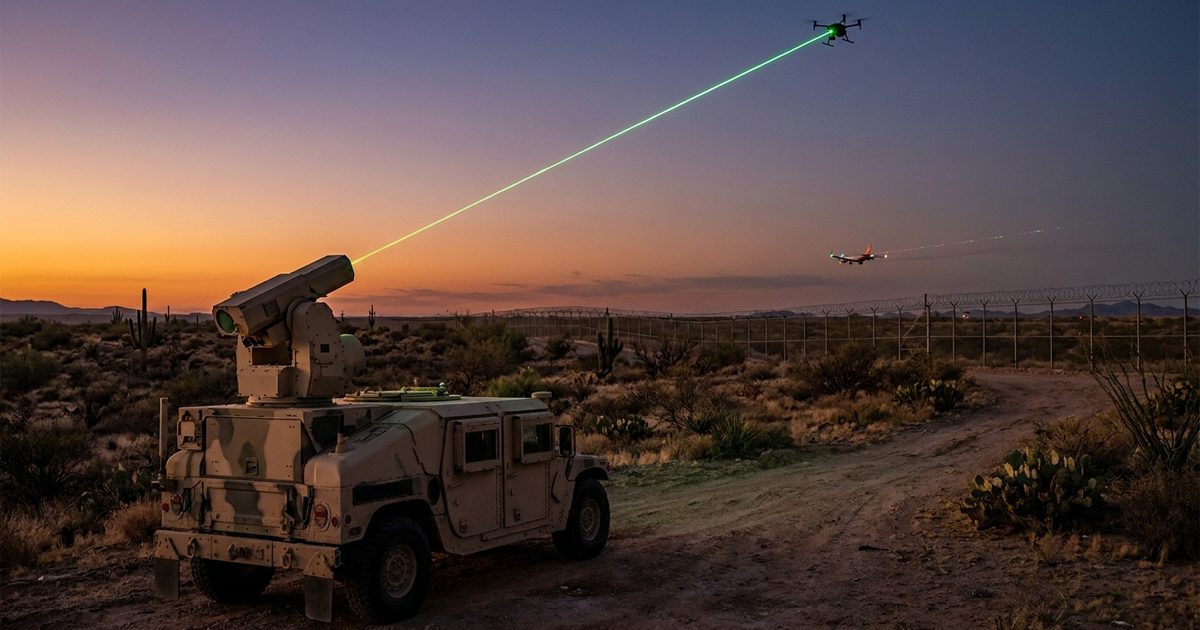
WASHINGTON — The Federal Aviation Administration and the Department of War have signed a landmark agreement clearing high-energy laser systems to neutralize drones near commercial air corridors along the southern U.S. border — the first such authorization in the history of civil aviation.
The agreement, announced April 15, 2026, follows a joint safety assessment that concluded the laser systems “do not pose undue risk to passenger aircraft” when proper safety controls are in place.
“The FAA’s top priority is protecting the safety of the American flying public, and we value the collaboration with the Department of War in that effort,” FAA Administrator Bryan Bedford said in a statement. “Following a thorough, data-informed Safety Risk Assessment, we determined that these systems do not present an increased risk to the flying public.”
From Chaos to Coordination
The deal marks a sharp reversal from the confusion that preceded it.
On the night of Feb. 10, 2026, the FAA abruptly closed the airspace over El Paso International Airport, grounding commercial flights, cargo operations, and at least one medical transport carrying surgical equipment — with no advance warning to local officials or travelers.
The closure stemmed from the uncoordinated use of a military counter-drone laser near Fort Bliss. It lasted only a few hours before the FAA rescinded it early Feb. 11, but the incident exposed a dangerous gap between military border operations and civil aviation oversight.
Local lawmakers said they received no prior notification. A separate 10-day temporary flight restriction remained in place around Santa Teresa, N.M., roughly 15 miles northwest of the airport.
In a concurrent incident, a U.S. military laser-based counter-drone system mistakenly shot down a drone operated by U.S. Customs and Border Protection — adding to mounting scrutiny over how the technology was being deployed in shared airspace.
Demonstrations Paved the Way
In the weeks that followed, the FAA and Department of War conducted joint demonstrations of the laser system at White Sands Missile Range in New Mexico on March 7–8. The agencies said the demonstrations validated that the system could operate safely within defined parameters without threatening civilian aircraft.
U.S. Army Brig. Gen. Matt Ross, director of JIATF-401, called the outcome a milestone for interagency coordination.
“By working hand-in-hand with the FAA and our interagency partners, the Department of War is proving that these cutting-edge capabilities are safe, effective, and ready to protect all air travelers from illicit drone use in the national airspace,” Ross said.
New Rules for Airspace Operations
Under the agreement, future laser deployments will no longer automatically trigger airport closures, provided coordinated safety protocols are followed. The Department of War committed to notifying the FAA before operations to ensure civilian aircraft, pilots, navigation equipment, and air traffic services are not affected.
The FAA has also issued a directive requiring aircraft operating within five nautical miles of the southern border in affected areas to carry ADS-B Out equipment — transponder technology that enables air traffic surveillance systems to track flights in real time during counter-drone operations. The ADS-B requirement is consistent with the agency’s broader push to modernize airspace safety infrastructure, reflected in its FY2027 budget priorities.
Officials tied the deployment to persistent drone activity along the southern border, where the government says criminal organizations have used unmanned aircraft for drug trafficking and surveillance.
Questions Remain
The agreement stops short of full transparency. The government has not publicly released the specific safety procedures or operational protocols governing laser use in civilian airspace. Lawmakers who pressed for answers after the February disruptions welcomed the deal but said they still want a fuller briefing on the safety case.
The FAA was also careful to distinguish military high-energy counter-drone lasers from the far more common problem of civilians pointing low-powered laser pointers at cockpits. Pilots reported 10,993 laser incidents in 2025, according to the agency.
Violators face civil penalties of up to $11,000 per incident and up to $30,800 for multiple violations, in addition to potential federal criminal penalties including up to five years in prison and fines up to $250,000.
Subscribe to FODNews for the latest on airspace safety and foreign object debris prevention worldwide.
Sources
- FAA and DOW Sign Landmark Safety Agreement to Protect Southern Border — Federal Aviation Administration
- FAA and military agree on how to use lasers to take down drones at the southern border — KVIA ABC-7 El Paso
- Pentagon, FAA dispute over lasers to thwart cartel drones led to airspace closure — Military.com