Garuda Indonesia 737-800 Lands with Severe Radome Damage Nobody Noticed Mid-Flight
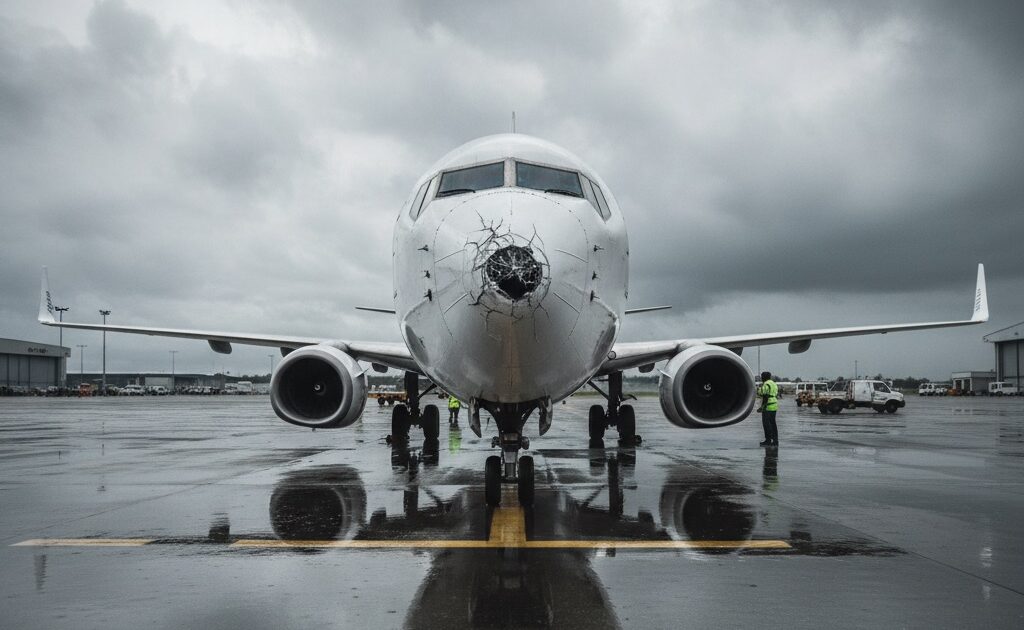
PEKANBARU, Indonesia — March 7, 2026 — A Garuda Indonesia Boeing 737-800 completed an 80-minute flight from Jakarta and touched down at Sultan Syarif Kasim II International Airport carrying what engineers would later classify as severe aircraft radome damage. No one on the flight deck had any idea.
The aircraft, registration PK-GFF operating flight GA176, carried 117 passengers on the Soekarno-Hatta to Pekanbaru route. Crew members noted an unusual noise during approach — but no cockpit warnings fired, all flight instruments remained nominal, and the weather radar functioned normally throughout. The aircraft landed without incident.
It was a post-flight walk-around that changed everything.
Aircraft Radome Damage Found After Landing, Not During Flight
Ground engineers inspecting the aircraft after engine shutdown discovered deep dents and cracks in the radome’s composite structure on the left side of the nose cone. The damage was significant enough to ground the aircraft immediately.
The return service to Jakarta was cancelled. Passengers were rebooked on Citilink. PK-GFF, a 737-800 with about 15 years in service, remained in Pekanbaru pending investigation and likely faces a full radome replacement.
Garuda Indonesia confirmed the aircraft landed safely and stated no passenger safety was compromised, citing navigation redundancies built into the 737-800’s avionics suite.
KNKT Probing the Cause
Indonesia’s Komite Nasional Keselamatan Transportasi (KNKT) — the national transportation safety committee — has opened an investigation into the incident.
Three primary causes are under examination: a bird strike, contact with an airborne drone, or material fatigue in the radome’s aging composite skin. Investigators note that no blood, feathers, or organic debris were found at the impact site, which complicates the bird strike hypothesis but does not eliminate it. High-speed impacts can, in some cases, leave little biological trace.
The absence of cockpit alerts during the flight raises a separate question investigators will likely need to address: at what point did the damage occur, and why did existing systems provide no indication?
Why Radomes Are Uniquely Vulnerable
The radome’s job is to be invisible to radio waves, not to be tough. Aircraft nose cones house weather radar antennas and must be made from materials with low dielectric properties — typically fiberglass or epoxy-based composites — that allow radar signals to pass through cleanly. That design priority comes directly at the expense of impact resistance.
Unlike the metal airframe structures surrounding them, radomes are thin-walled and not engineered to absorb high-energy impacts. A bird, a drone, or a piece of airborne debris that would leave only a dent on a metal fuselage can crack, delaminate, or collapse a composite radome entirely.
The FAA does not impose specific bird strike certification requirements on radomes under 14 CFR Part 25. Certification standards focus on engines, windshields, and load-bearing structures — radomes occupy a regulatory gap that safety researchers have flagged for years. An EASA study on bird strike certification found that frontal-zone strikes — where radomes sit — account for a disproportionate share of aircraft damage cases, and that current standards may undervalue radome risk in composite structures.
A reportedly comparable case involved an Air France Airbus A350 in which a bird strike debonded the radome’s inner skin during a previous flight. The damage went undetected until the radome partially collapsed at cruise altitude, triggering speed unreliability warnings and requiring crew intervention. That incident prompted Airbus to update inspection procedures for inner radome surfaces.
The Walk-Around That Matters
The Garuda incident is a reminder that post-flight inspections remain one of aviation’s most reliable FOD and damage detection tools — even when every sensor on board says nothing is wrong.
Foreign object debris and airborne impact hazards represent an ongoing challenge across all phases of flight operations, from runway FOD ingested at takeoff to inflight strikes at cruise altitude. The Aviation Safety Network has logged the incident in its database as the investigation continues.
For an aircraft type in scheduled commercial service carrying over 100 passengers, the combination of undetected structural damage and no in-flight alert raises questions that extend well beyond this single aircraft and carrier. Investigators will want to understand whether the timeline of impact — pre-departure, during takeoff roll, or inflight — affects conclusions about inspection intervals and airworthiness protocols.
KNKT has not published a preliminary report as of publication. FODNews will update this article as findings emerge.
Stay current on FOD incidents, aviation safety developments, and prevention strategies. Subscribe to FODNews for weekly coverage delivered to your inbox.
Sources
- Aviation Safety Network — Garuda Indonesia Boeing 737-800 PK-GFF incident, March 7, 2026
- Aviation Direct — Severe damage discovered on nose of Garuda aircraft
- Garuda Indonesia — Official statement on GA176 landing (Bahasa Indonesia)
- EASA — Bird Strike Certification Study (Final Report)
- Airbus Safety First — Bird or Hail Strikes on the Radome