Dallas-Fort Worth International Airport has issued a procurement request for an autonomous FOD removal robot that would rank among the most ambitious foreign object debris programs deployed at any U.S. commercial airport — one that doesn’t just detect debris, but physically removes it without human intervention.
The request for quote, posted March 27, 2026, seeks a fully autonomous hardware-and-software solution capable of detecting, reporting, and removing FOD from active airside areas while simultaneously inspecting runway surfaces for defects. The estimated contract value ranges from $500,000 to $2 million.
A Step Beyond Detection
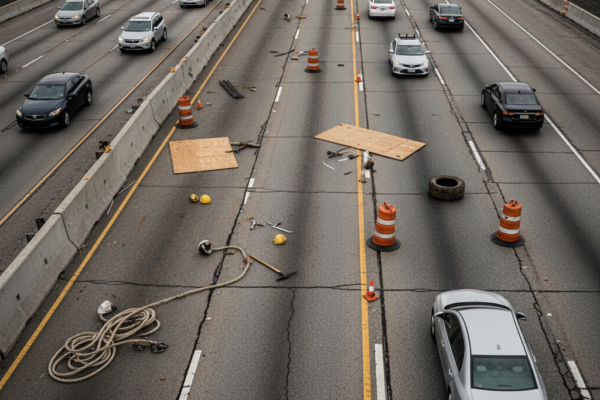
Most deployed FOD technology — radar arrays, fixed cameras, vehicle-mounted sensors — stops at detection, alerting human crews who then respond to retrieve the debris. DFW’s requirement goes further: the autonomous FOD removal robot must complete the removal step in real time, without human intervention in the loop.
That distinction matters operationally. FOD accounts for an estimated $4 billion in direct aircraft damage annually in the United States alone, according to Boeing industry estimates, and upward of $22.7 billion when indirect costs — delays, cancellations, unscheduled maintenance — are factored in, per FAA cost-benefit analyses. The gap between detecting a problem and eliminating it has long been the operational bottleneck.
DFW is the nation’s fourth-busiest airport by operations, handling tens of thousands of aircraft movements per month across seven active runways. A January 2026 request for quote for autonomous airfield FOD detection signaled a broader strategic push into autonomous airside technology; this March solicitation escalates that ambition considerably.
What the Contract Requires
According to the procurement documents, the winning contractor must deliver a complete deployment package — not just hardware. Responsibilities include shipping, installation, setup, and calibration of the robot; a site visit to assess operational areas; a pre-implementation study to train the AI algorithm; and staff training sessions covering both operation and troubleshooting.
Deliverables include full documentation — specifications, safety protocols, operational requirements — along with a comprehensive test plan tracking FOD detection rates and runway surface conditions. The pilot runs through the conclusion of the program as defined in the project plan.
Bidders must hold Small Business Enterprise certification from a recognized agency, including the North Central Texas Regional Certification Agency or the Women’s Business Council Southwest.
An Emerging Global Race
DFW is not alone in pursuing this technology. Munich Airport has announced plans to deploy autonomous FOD detection robots by 2027, with early trials showing the machines identified roughly 10 times more FOD than human inspection crews. Munich’s testing also surfaced a key operational challenge: autonomous robots “can behave in unpredictable ways on the ramp,” according to trial documentation — a finding that underscores how much operational validation remains ahead for the entire sector.
On the detection-only side, AI-powered fixed systems are already moving into commercial deployment. Skylark Labs has deployed AI-driven FOD detection at commercial airports, demonstrating continuous monitoring capability without human operators in the surveillance loop. What DFW is seeking would represent the next logical step: closing the loop from identification to removal.
FAA’s Posture on Autonomous Ground Vehicles
The regulatory framework for autonomous ground vehicles on active airfields is still taking shape. The FAA’s Emerging Entrants Bulletin 25-02 and Part 139 CertAlert 24-02 outline guidance for autonomous ground vehicle systems testing, recommending early coordination with regional Airports Division offices and risk mitigation protocols when operating in active movement areas.
The agency has stated it welcomes innovation but has not yet established full certification standards for autonomous airside robots. Airports pursuing these programs must demonstrate they can safely integrate autonomous systems alongside manned aircraft operations — a requirement that makes DFW’s inclusion of a comprehensive pre-implementation study and performance metrics plan a practical necessity, not just a procurement formality.
The FAA’s runway safety focus adds broader context. The agency has identified more than 150 U.S. airports as runway incursion hot spots — a designation reflecting the persistent challenge of managing complex airside environments where any debris or unexpected element elevates risk.
What Comes Next
DFW has not announced a contract award timeline or identified shortlisted vendors. The pilot scope — algorithm training, site assessment, staff training, and documented performance metrics — suggests the airport is treating this as a controlled evaluation rather than a full operational rollout.
If the pilot succeeds, DFW’s scale and operational complexity would make it a credible proof-of-concept for the broader industry. A viable autonomous removal system validated at one of the world’s busiest airports would carry considerably more weight than a controlled lab test.
The results, when published, will be closely watched.