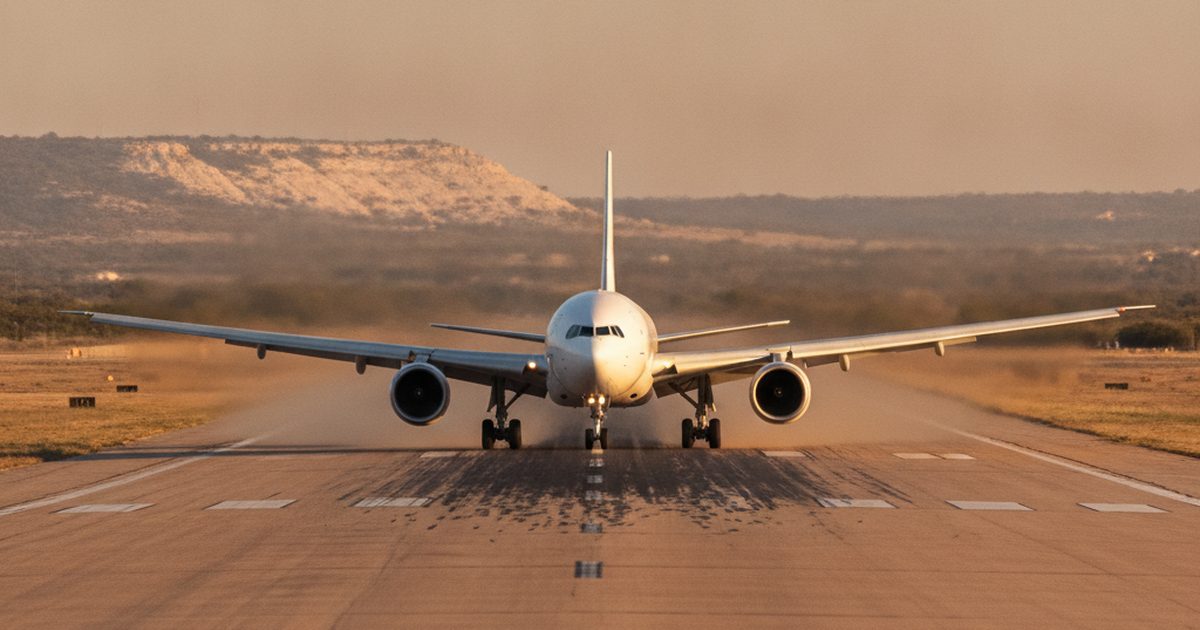
HORSESHOE BAY, Texas — The Federal Aviation Administration is investigating after a Boeing 777-200LR freighter performed a high-speed low pass at Horseshoe Bay Resort Jet Center in Texas on June 24, 2026, with flight-tracking data and video showing the widebody aircraft skimming to within approximately 25 feet of the runway surface.
The aircraft, registration N705DN, is a former Delta Air Lines 777-200LR converted to a freighter by Mammoth Freighters and owned by Jetran LLC, a company based in Horseshoe Bay. Though painted in Qatar Airways Cargo livery at the time of the maneuver, the aircraft was not owned or operated by Qatar Airways, and the pilots aboard were not Qatar Airways personnel, according to Jetran.
FlightRadar24 ADS-B data recorded the aircraft at a reported altitude of 950 feet above mean sea level during the pass. After accounting for the airport’s approximately 1,080-foot field elevation and local atmospheric pressure, the tracking service assessed the aircraft was at or near runway level — roughly 25 feet above the ground. Video circulated widely on social media shows the 777’s right wingtip appearing within feet of the pavement as the aircraft banked hard off the runway.
Audio from LiveATC.net captured the crew announcing the maneuver in advance: “We are turning final runway 17 for a low approach, 5DN heavy.”
The FAA confirmed it is reviewing the event. “The FAA is aware of reports about this event and is looking into it,” the agency said in a statement to aviation media. The probe is ongoing as of publication.
Former National Transportation Safety Board Chair Robert Sumwalt was direct in his assessment. “Another example of stupid pilot tricks,” he told CBS News, adding: “I see no legitimate reason at all to perform this maneuver the way that it was done. They clearly had planned it, they had an audience standing by to watch it and to video it, so there’s no real reason why they should have been doing this.” Sumwalt said pilots involved could face credential suspension.
ABC News aviation analyst Steve Ganyard described the maneuver as “flat-hatting” — aviation slang for reckless low-altitude showboating — calling it “showing off in a way that was dangerous or endangered that airplane and the rest of the crew.”
Jetran issued a statement acknowledging “a video circulating on social media showing a freighter aircraft conducting a low-pass flight in a manner that does not reflect operational standards.” The company confirmed the aircraft was on a final pre-delivery test flight before its planned entry into the Qatar Airways Cargo fleet, and said it “expects the relevant parties and authorities to investigate this matter thoroughly and take appropriate action.” Mammoth Freighters separately stated it was not the owner and was not in control of the aircraft at the time of the maneuver.
The aircraft had departed Grissom Aeroplex in Indiana earlier that day and ultimately landed at Fort Worth Alliance Airport in Texas.
The FOD Risk Behind the Boeing 777 Low Pass
No contact with the runway surface occurred, and no debris was reported. But the incident illustrates a hazard rarely discussed in runway safety contexts: the potential for catastrophic foreign object debris generation from an aircraft making contact mid-maneuver.
At the approach speeds typical of a widebody aircraft — above 150 knots — a wingtip or landing gear strike against runway pavement would have been catastrophic. The 777-200LR carries fuel capacity exceeding 47,000 gallons; a fuel tank rupture at those speeds would have spread burning jet fuel across the runway environment while shredding composite and metal airframe components into high-energy projectiles. The resulting debris field could have incapacitated the airport for extended operations and posed severe risk to ground personnel and any aircraft in the vicinity.
Horseshoe Bay Resort Jet Center is a private, uncontrolled general aviation airport. Spectators were on the field watching the maneuver as it occurred.
The FAA’s investigation remains open. Federal regulations under 14 CFR §91.13 prohibit careless or reckless operation of an aircraft — the provision most commonly cited in cases of deliberate low-altitude maneuvering. Enforcement outcomes can include pilot certificate suspension or revocation and mandatory retesting.
Subscribe to FODNews for continuing coverage of runway safety incidents and aviation hazard events.