
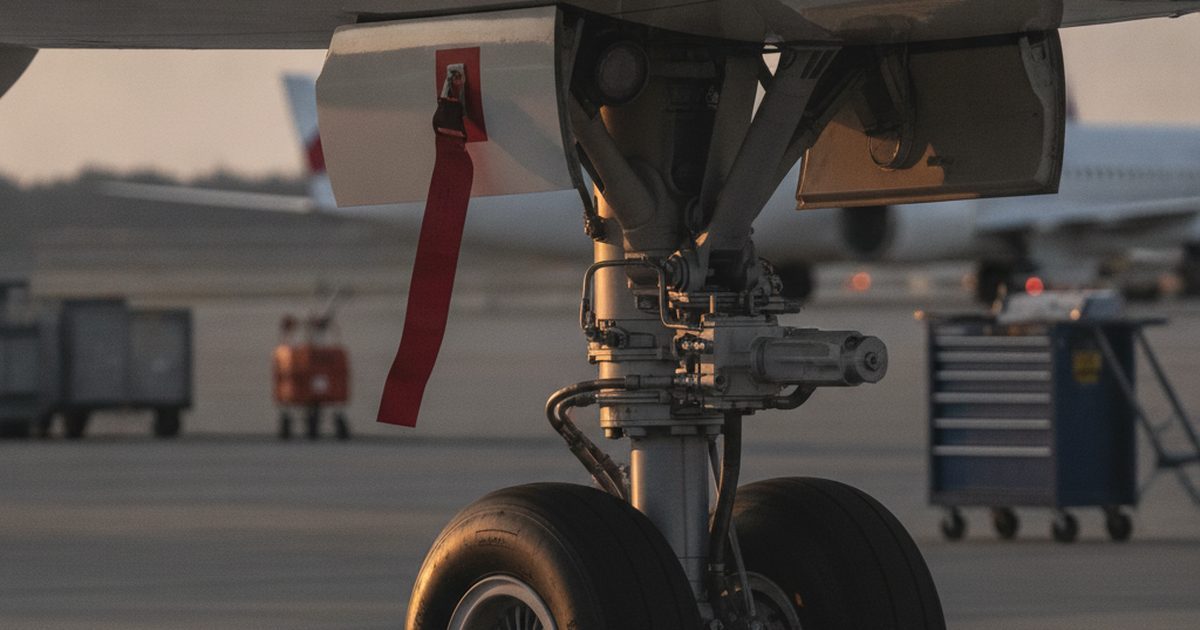
When Germany’s Federal Bureau of Aircraft Accident Investigation (BFU) published its interim report on the June 4, 2026, nose gear collapse of a Lufthansa Boeing 787-9 at Frankfurt Airport, the proximate cause was blunt: a single downlock safety pin was never installed. The deeper story, however, is one of tool control in aviation maintenance—the discipline of accounting for every piece of ground-support hardware before a system test begins. That discipline failed, and 23 people were injured as a result.
The aircraft, registered D-ABPQ and named “Herne,” had arrived from Austin, Texas, that morning and was parked at gate A15 for its next departure to Los Angeles. A maintenance discrepancy logged the previous evening—an error message in the main landing gear door control system—meant technicians were working through Boeing’s Fault Isolation Manual on a tablet before the aircraft could be released.
At approximately 10:45 UTC, with two technicians in the cockpit, the landing gear lever was commanded to the “up” position as the diagnostic procedure required. The nose landing gear retracted immediately. The forward fuselage and both engine nacelles struck the concrete apron.
One Pin. One Storage Box. One Catastrophic Omission.
Boeing’s Fault Isolation Manual for this procedure explicitly requires technicians to install downlock pins on all three landing gear assemblies before cycling the gear lever. The pins physically prevent the gear from retracting during a ground test—the primary safeguard keeping the aircraft on its wheels while the hydraulic system is active.
According to the BFU interim report, the four downlock pins for the two main landing gears were correctly installed. The pin for the nose landing gear was not. Investigators found it untouched in its designated storage box in the avionics compartment beneath the cockpit—red warning flag still attached.
The BFU was unambiguous: the 787’s landing gear system performed exactly as designed. The failure was not mechanical. It was a maintenance accountability failure.
Tool Control Is Foreign-Object Discipline—Applied to Hardware
In aviation maintenance, “tool control” refers to formal programs that track every tool, component, and ground-support item from sign-out through use to sign-in. The underlying logic is identical to the foreign-object discipline applied on airfields and flight lines: every item must be accounted for, every item has a designated place, and any unaccounted item is a hazard.
A downlock safety pin is not a wrench. It is a large, tagged, red-flagged safety device specifically designed to be visible. The red streamer—modeled on “REMOVE BEFORE FLIGHT” tags used across military and commercial aviation—exists so technicians notice the pin and remember to remove it before departure. In this case, the streamer never moved from the storage box.
Shadow boards, tool inventory logs, and check-in/check-out systems are the standard infrastructure of tool-control programs. A shadow board uses cutouts or silhouettes in each tool’s storage position; any gap signals a missing item. When applied rigorously, these systems make the absence of a safety device as visible as its presence. The BFU findings suggest that whatever accountability system existed for the nose gear downlock pin was not sufficient to catch its omission.
How Accountability Systems Break Down: Human Factors at Work
Safety researchers have identified several recurring human-factors patterns behind tool-control failures in aircraft maintenance. None of them require malice or incompetence—they emerge from the conditions under which technicians routinely work.
Normalization of Deviance
When a shortcut is repeated without consequence, it gradually becomes normalized. A technician who has performed gear-cycling tests before may carry an unconscious assumption that preparatory steps are already complete. The pin installation may feel redundant when the procedure “always goes fine.”
Task Interruption and Assumption Handoff
Interruptions during multi-step procedures are among the most reliably documented contributors to maintenance errors. If responsibility for pin installation was implicitly assumed to have shifted to another technician, the gap can go undetected by everyone involved. Aviation human-factors literature calls this “assumption handoff.”
The “Four Out of Five” Trap
Four of the five downlock pins were correctly installed at Frankfurt. Completing most of a safety checklist creates a powerful psychological sense of completion. Notably, checklists only prevent this failure mode when they require explicit sign-off for each discrete item—not a collective confirmation for the group.
As Aviation Week noted, the BFU has not yet published its full organizational analysis. The final report—required within one year under ICAO standards—may bring additional findings about maintenance management and oversight.
A Near-Identical Precedent at Heathrow
The Frankfurt collapse has a closely documented predecessor. On June 18, 2021, a British Airways Boeing 787-8 at London Heathrow suffered a nose gear collapse during a similar maintenance test. The UK Air Accidents Investigation Branch (AAIB) found that an engineer had inserted the downlock pin into an adjacent apex pin bore—deceived by tactile and auditory feedback that made the misplaced pin feel correctly seated. That finding led to an Airworthiness Directive requiring operators to fit a blocking insert in the apex pin bore.
The Lufthansa case differs in a critical respect: the pin was not installed in the wrong place—it was not installed at all. Whether Lufthansa had completed the apex-bore modification on D-ABPQ has not been publicly confirmed, but that modification would not have addressed an omission as complete as the one the BFU documented.
What Best Practices Require—and What They Demand of Programs
FAA Advisory Circular AC 120-FOD and related EASA and ICAO guidance establish foreign-object damage prevention as a programmatic discipline. Safety pins, downlock pins, and tagged ground-support hardware must be positively controlled—not merely listed. Positive control means a documented, verified check that each item is either installed or returned to its designated location before any system activation. In practice, this translates to:
- A dedicated line item on the task card or work order, requiring an individual sign-off
- A second-person verification—an independent check by someone other than the technician who performed the step
- A physical location check (the shadow board or storage tray is empty before the system is activated)
- A verbal or written confirmation in the cockpit before the gear lever is touched
In high-consequence steps—those where a single omission can cause structural damage and injuries—redundant verification is the standard, not the exception. The BFU interim report does not yet specify which of these controls, if any, were in place or bypassed during the June 4 procedure. That analysis is expected in the final report.
Twenty-Three Injured. One Aircraft Grounded for Months.
The human cost of the Frankfurt incident was revised upward from Lufthansa’s initial disclosure. Two individuals sustained serious injuries and 21 others were treated for minor injuries—23 casualties in total. Ground handling personnel on the apron and crew members aboard were among those affected.
The aircraft sustained substantial damage to the nose section, landing gear, and engine nacelles. Because the 787’s primary structure is built from carbon fiber reinforced plastic, composite repair work is time-intensive. Analysts expect D-ABPQ to remain out of service for several months. Flight LH450 to Los Angeles was canceled; the aircraft had been in service for fewer than five months when the incident occurred.
A tool-control failure ended a nearly new aircraft’s commercial operation for the foreseeable future. The accountability discipline exists precisely because its cost of failure is not abstract—it is counted in injuries, aircraft, and months.
The BFU interim report is available in English at the bureau’s official website. FODNews will follow the final report as it develops.
Subscribe to FODNews for independent coverage of foreign-object discipline, maintenance safety, and aviation incident analysis.
Sources
- BFU Interim Report IR26-0454 — Bundesstelle fur Flugunfalluntersuchung (July 9, 2026)
- Aviation Week: Boeing 787 Nose Gear Collapse Due To Missing Pin, Investigators Say (July 10, 2026)
- Simple Flying: Investigators: Lufthansa Boeing 787-9’s Nose Gear Was Missing Downlock Pin Before Collapse (July 9, 2026)
- Aviospace: Lufthansa Boeing 787 Nose Gear Collapse at Frankfurt Traced to One Missing Pin (2026)
- Reuters: German investigators link misplaced pin to Boeing 787 incident (July 9, 2026)