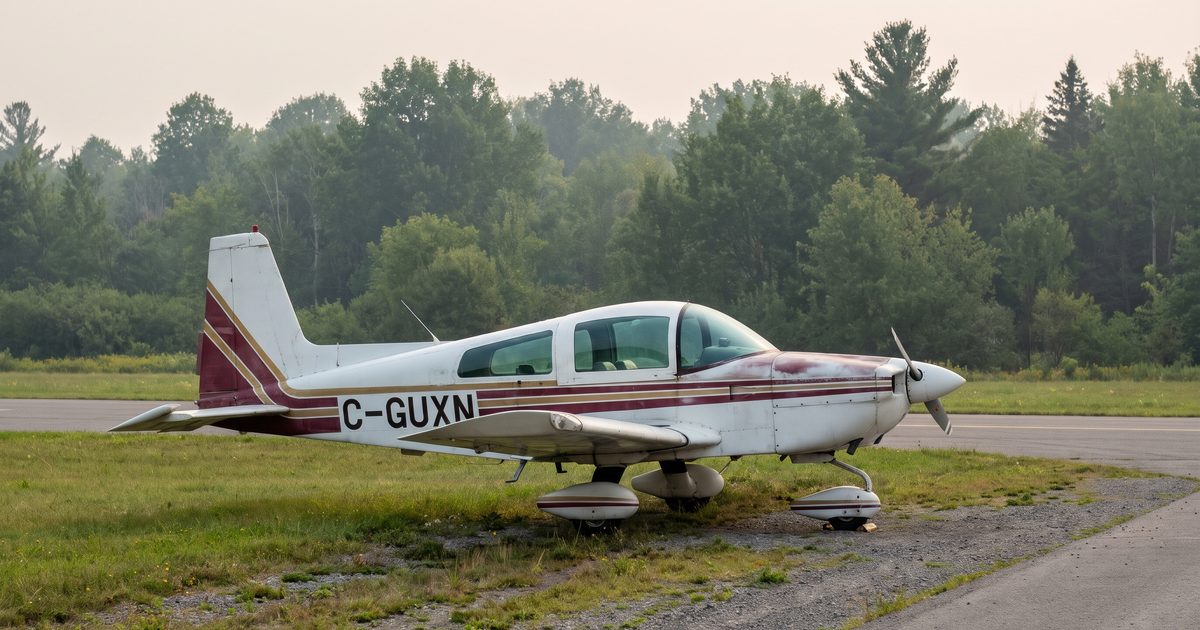
Sealant applied in the wrong places inside the engine likely caused the engine failure before the fatal July 31, 2025, Ottawa plane crash, according to a final report from the Transportation Safety Board of Canada released Oct. 23.
The pilot of the privately registered Grumman American AA-5A died when the aircraft struck trees short of a runway. CBC News and the Ottawa Citizen identified the pilot as Stéphane Tessier. The two passengers had minor injuries.
Investigators found LOCTITE-515 sealant on internal engine surfaces where the manufacturer’s instructions did not allow it. They said the sealant likely reduced clamping force inside the crankcase.
Engine trouble over west Ottawa
The aircraft left Ottawa/Gatineau Airport, Quebec, at 5:34 p.m. EDT on a visual flight rules flight. It had a Lycoming O-320-E2G engine.
At 5:48 p.m., while the plane was cruising 2,631 feet above the touchdown zone elevation of Runway 14 at the Ottawa airport, the TSB said, “the engine’s right cowling opened, various pieces detached from the engine, and engine oil sprayed across the windshield, significantly impairing forward visibility.” The propeller kept windmilling.
The pilot reported the oil leak to the tower and at first headed toward Ottawa/Rockcliffe Airport, then diverted to Runway 14 at Ottawa International Airport, and the tower cleared the aircraft direct to the airport.
At 5:51 p.m., at 679 feet above the runway’s touchdown zone elevation, the pilot told air traffic control the engine was about to fail. The aircraft hit trees about 960 m short of Runway 14, near Riverside Drive and West Hunt Club Road. There was no fire.
The TSB said “it is highly probable that, at 1748, the aircraft experienced a complete engine failure.” By its calculations, the aircraft could not have reached any runway at Rockcliffe or Ottawa International “even with immediate action.”
What the engine teardown found
The teardown found that the No. 3 connecting rod had failed and fractured the camshaft.
They also found LOCTITE-515 sealant on the crankcase mating surfaces, the through-bolt threads and the main journal bearings. All of those areas are outside the ones allowed by Lycoming Service Instruction 1125D, which says: “No build-up is permissible for this application.”
“The engine failure was likely caused by misapplied LOCTITE-515 sealant,” the TSB found.
“The sealant would have reduced the nut thread clamping force, resulting in out-of-tolerance torque and insufficient clamping force between the crankcase mating surfaces during engine reassembly. This loss of clamping force likely caused unintended movement between the engine crankcase halves, abnormal operation of cylinder No. 3, and ultimately engine failure,” the TSB said, as quoted by CTV News.
The crankcase had been split in February 2024 for a high-compression conversion and reinstallation under two supplemental type certificates, work the TSB said had not been completed according to specifications. The aircraft flew about 32.8 hours afterward.
Safety alert and the maintenance message
On July 16, 2026, before the final report was released, Transport Canada issued Civil Aviation Safety Alert CASA 2026-07. It warned maintainers of Lycoming opposed-cylinder engines that misapplied crankcase sealant could cause engine failure.
At that time, the alert said the TSB “has not conclusively established” that the sealant was the direct cause. The final report, released Oct. 23, concluded the failure was “likely caused” by the misapplied sealant.
The alert recommends that maintainers review Lycoming SI 1125E. It said SI 1125D “does not adequately warn of the risks associated with applying sealant outside of the specified areas.”
“Adherence to an aircraft manufacturer’s maintenance procedures and service instructions ensures continued airworthiness; deviations from them jeopardize safety. When faced with unclear or unfamiliar procedures, aircraft maintenance engineers are reminded to seek guidance directly from the manufacturer,” the TSB said.
Debris along the Ottawa plane crash flight path
“The flight path overflew built-up areas and the Ottawa Central Experimental Farm,” the TSB said. According to CBC News, much of the flight after the cowling opened passed over the area between Fisher Avenue and Merivale Road, including the Fisher Glen neighbourhood.
In August 2025, investigators asked for help finding two missing engine parts, the crankcase casting and the camshaft, the Ottawa Citizen reported. “If you live along the flight path, check your land, pool and gutters for any foreign objects,” the TSB said in a social media post quoted by CTV News.
The search covered west-end neighbourhoods from Westboro to Fisher Glen, and CTV reported that some pieces could be as small as a toonie. One couple found a 20-centimetre metal rod in their garden and turned it over to police, CBC reported.
The case involves foreign material at both ends: sealant built up where the manufacturer allowed none, and engine parts that fell over homes. Investigators have reconstructed other accidents from parts lost in flight, including an NTSB finding that a wing piece separated in flight before a fatal crash in Neosho, Missouri.
Subscribe to FODNews for continuing coverage of FOD incidents and prevention worldwide.
Sources
- Transportation Safety Board of Canada — “Air transportation safety investigation report A25O0114” (Oct. 23, 2026)
- Transport Canada — “Application of Lycoming engine crankcase parting surface sealants – Civil Aviation Safety Alert (CASA) No. 2026-07” (July 16, 2026)
- CBC News — “Small plane’s engine failed over west Ottawa before fatal crash: TSB” (Oct. 23, 2026)
- CTV News — “Engine failure that led to fatal small plane crash in Ottawa linked to misapplied sealant: TSB” (Oct. 23, 2026)
- Ottawa Citizen — “Small plane’s engine failed before fatal crash in Ottawa: TSB” (Oct. 23, 2026)
- CTV News — “Ottawa residents asked to help locate debris from small plane crash” (Aug. 18, 2025)