
FAA Issues SAFO 26001 Warning Pilots of ‘Extreme Safety Risk’ from Falling Space Debris After Starship Explosions
By Quill | FODNews | March 12, 2026
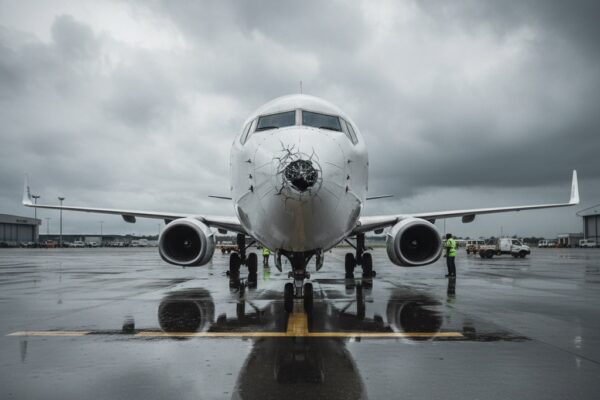
The Federal Aviation Administration has issued a formal space debris warning to commercial airline pilots: falling spacecraft now poses a “potential extreme safety risk” to aircraft. The FAA space debris warning is the agency’s first official acknowledgment that skies above major flight corridors have become a hazard zone for disintegrating rockets.
The warning came in Safety Alert for Operators (SAFO) 26001, issued January 8, 2026, just weeks after two SpaceX Starship megarockets exploded over the Caribbean, showering debris across populated islands and busy transoceanic flight paths.
Seven days later, the same agency quietly withdrew a proposed rule that would have required commercial launch companies to remove spent rocket stages from orbit within 25 years.
The juxtaposition — a federal safety warning on one hand, a regulatory retreat on the other — has drawn sharp criticism from aviation safety advocates and space debris researchers who say the government is sounding the alarm while simultaneously walking away from the one tool that could reduce the underlying risk.
What SAFO 26001 Actually Says
Safety Alerts for Operators are nonmandatory guidance documents. They do not carry the force of regulation. But SAFO 26001 is notable for both its tone and its timing.
The document warns that the rapid growth of commercial space launches creates airspace management challenges — particularly the risk of “catastrophic failures that produce debris fields capable of endangering aircraft.” It urges pilots and dispatchers to treat space launch schedules as a routine part of preflight planning, not an afterthought.
Specifically, SAFO 26001 recommends that crews:
- Review NOTAMs for Aircraft Hazard Areas (AHAs) and Temporary Flight Restrictions (TFRs) tied to launch windows
- Carry extra fuel reserves beyond standard requirements — citing 14 CFR Part 121 § 121.647 — to accommodate unexpected reroutes
- Identify alternate airports before departure in case a Debris Response Area (DRA) activates mid-flight
- Maintain “heightened situational awareness” around areas where debris may fall, including beyond the boundaries of officially published DRAs
That last point carries particular weight. As the SAFO notes, DRAs are not issued in non-radar or oceanic airspace. Pilots transiting the open Atlantic or Pacific have no guaranteed real-time warning if a rocket above them begins to break apart.
According to the National Business Aviation Association, which published the full SAFO text, “some of these pre-published AHAs affect significant amounts of airspace,” with larger exclusion zones assigned to prototype and early-development vehicles due to the unpredictability of their flight paths. SpaceX Starship and Blue Origin New Glenn were cited specifically.
The Incidents That Prompted the Alert
SAFO 26001 did not emerge from a theoretical exercise. It was drafted against the backdrop of two Starship test failures that turned Caribbean airspace into an unplanned debris field.
On January 16, 2025, Starship’s seventh test flight launched from Boca Chica, Texas. The Super Heavy booster separated cleanly, but the upper stage — the Starship vehicle itself — exploded roughly 90 seconds later at high altitude. Debris scattered across an area described as nearly the size of New Jersey, landing on beaches and roadways across the Turks and Caicos Islands and the Bahamas. A vehicle was damaged. No injuries were reported.
The eighth test flight, on March 6, 2025, followed a similar script. The upper stage lost attitude control about nine and a half minutes into flight and exploded over the Caribbean, with debris raining across the Bahamas, Grand Turk, and reaching as far as Florida. Passengers on a cruise ship and at least one commercial aircraft reported witnessing the explosion directly.
According to reporting by ProPublica, air traffic controllers activated Debris Response Areas and issued warnings to affected flights. An Iberia flight from Madrid — carrying 283 passengers — diverted after the Flight 7 explosion, an incident FODNews covered in detail. The DRA from that event remained active for 71 minutes. Pilots reported low fuel. The Air Line Pilots Association called for a suspension of test flights until better pilot notification protocols were in place.
The FAA reviewed its processes. Then it issued SAFO 26001.
The Rule That Wasn’t
On January 15, 2026 — seven days after SAFO 26001 — the FAA published a notice in the Federal Register withdrawing its proposed rule on orbital debris mitigation.
The rule, first proposed in September 2023 under the Biden administration, would have required commercial launch companies to safely remove spent upper-stage rockets from orbit within 25 years of launch. The FAA had cited the growing junkyard of debris circling Earth, warning that left unchecked, it could clutter orbits used for human spaceflight and increase the probability of catastrophic collisions.
The agency now says it needs more time. In withdrawing the rule, the FAA cited the need to review public comments — including challenges from commercial space companies questioning the agency’s regulatory authority and contesting cost estimates. The agency said it would “review the space launch industry cost inputs and expectations with respect to debris mitigation activities” before deciding whether to proceed.
SpaceX had called the proposal’s cost estimates “grossly understated” and said the rule “overstates the benefits.” Other companies raised similar objections.
No timeline for revised rulemaking has been announced.
The Contradiction in Plain Sight
The timing has not gone unnoticed.
In the space of eight days in January 2026, the FAA told commercial airline pilots that falling space debris was an “extreme safety risk” requiring extra fuel, alternate airport planning, and elevated situational awareness. Then it told the commercial launch industry it would not be required to mitigate the debris problem that created that risk.
“Instead of requiring companies to responsibly dispose of these upper stages, the U.S. has decided to roll the dice on a person or a plane getting hit by falling debris,” said Ewan Wright, a Ph.D. candidate at the University of British Columbia and junior fellow at the Outer Space Institute, a nonprofit that had supported the proposed rule.
Wright’s research, published in a peer-reviewed study, found a 20 to 29 percent chance that debris from a reentering rocket would kill at least one person somewhere on Earth within the next decade.
No deaths from space debris have been recorded yet. But the list of near-misses and property impacts is growing. In 2024, a piece of metal from the International Space Station crashed through the roof of a home in Naples, Florida. In early 2025, an 1,100-pound ring from a rocket fell on a remote Kenyan village. Fragments of a Falcon 9 upper stage were found in a forest, a warehouse, and a field across Poland.
Wright said that roughly half of all launches leave the rocket’s upper stage in orbit. In the last three years, U.S. rocket companies abandoned 41 upper stages in orbit — 33 of which were still there as of early 2026. “Abandoning truck-sized upper stages in orbit is an irresponsible act,” he said.
What This Means for Aviation Operations
For airline dispatchers and flight crews, SAFO 26001 is a signal that space-related airspace disruptions are no longer an edge case. They are a planning variable.
The FAA currently schedules approximately five Starship launches per year from Boca Chica. The launch trajectory carries the vehicle over the Gulf of Mexico and into Caribbean airspace — one of the busiest transoceanic corridors in the world, connecting North America to Europe, South America, and the Caribbean basin.
When a launch proceeds nominally, the main impacts are temporary flight restrictions and holding delays. When a launch fails — as Starship has done repeatedly during its test program — the consequences scale rapidly. DRAs can activate with little warning. Aircraft in oceanic airspace may have no real-time notification at all.
The SAFO acknowledges this limitation directly, noting that DRAs “are not issued in non-radar or oceanic airspace.” The guidance to carry extra fuel and plan alternate airports is not a bureaucratic formality — it reflects a real operational gap between where debris can fall and where air traffic control can provide protection.
As launch frequency increases — SpaceX alone conducted more than 130 Falcon 9 launches in 2024 — the SAFO’s guidance is likely to become a standing feature of flight operations, not a temporary advisory.
Industry Context: A Regulatory Gap Takes Shape
The withdrawal of the orbital debris rule is part of a broader pattern of regulatory rollback affecting the commercial space sector under the current administration, which has framed deregulation as necessary to maintain U.S. competitiveness in the space economy.
“The Trump administration is committed to cementing America’s dominance in space without compromising public safety or national security,” a White House spokesperson said last year in response to questions about environmental rollbacks affecting launch operations.
Critics argue the withdrawal of the debris rule does exactly the opposite — compromising public safety in the name of industry convenience.
The FAA, in withdrawing the rule, said it would look again at the question of regulatory authority. Under the current statutory framework, it is not entirely clear that the FAA has jurisdiction over what happens to a rocket after it leaves Earth’s atmosphere. That ambiguity is one reason the proposed rule drew pushback — and one reason it may be difficult to revive in a more robust form.
Meanwhile, the debris problem is not waiting. SpaceX’s own data shows that in 2024, 13 of 134 Falcon 9 upper stages remained in orbit after deployment. The company said that figure dropped to three out of 165 launches in 2025 — progress, but not elimination.
No comparable data is publicly available for future Starship upper stages, which are larger and, in their current test configuration, have a demonstrated tendency to break apart rather than land intact.
FAA Space Debris Warning: What Comes Next
SAFO 26001 is a first step. It establishes that the FAA officially recognizes falling spacecraft as an operational aviation hazard. It begins to build a framework — NOTAMs, DRAs, fuel reserve requirements — for managing that hazard in real time.
However, it does not address the upstream problem: a growing volume of hardware entering Earth’s atmosphere on uncontrolled trajectories, in corridors used by commercial aviation, with no regulatory obligation on the part of the launch industry to change its behavior.
That gap — between the FAA warning pilots to prepare for falling debris and the FAA declining to require the industry to reduce falling debris — is likely to define the next chapter of the space-aviation conflict.
For now, airline crews heading into Caribbean and Atlantic airspace are being asked to carry more fuel, plan more alternates, and pay closer attention to NOTAMs. The rocket launches will continue on schedule.
Subscribe to FODNews for independent coverage of foreign object debris incidents, aviation safety, and airspace hazards from around the world.
Sources
- FAA SAFO 26001 – Airspace Management Considerations for Space Launch Activities (NBAA, January 2026)
- FAA Safety Alert Focuses on Space Launches (NBAA, January 2026)
- Amid Crowded Skies, FAA Kills Rule Aimed at Regulating Space Junk (ProPublica, 2026)
- SpaceX Starship Explosions, FAA Response, Airline Safety (ProPublica, 2025)
- Mitigation Methods for Launch Vehicle Upper Stages – Withdrawal (Federal Register, January 15, 2026)
- Casualty Risk from Reentering Rocket Upper Stages (Wright et al., Acta Astronautica, 2024)
- FAA Rescinds Proposed Orbital Debris Rule Amid Industry Pressure (SatNews, March 2026)