
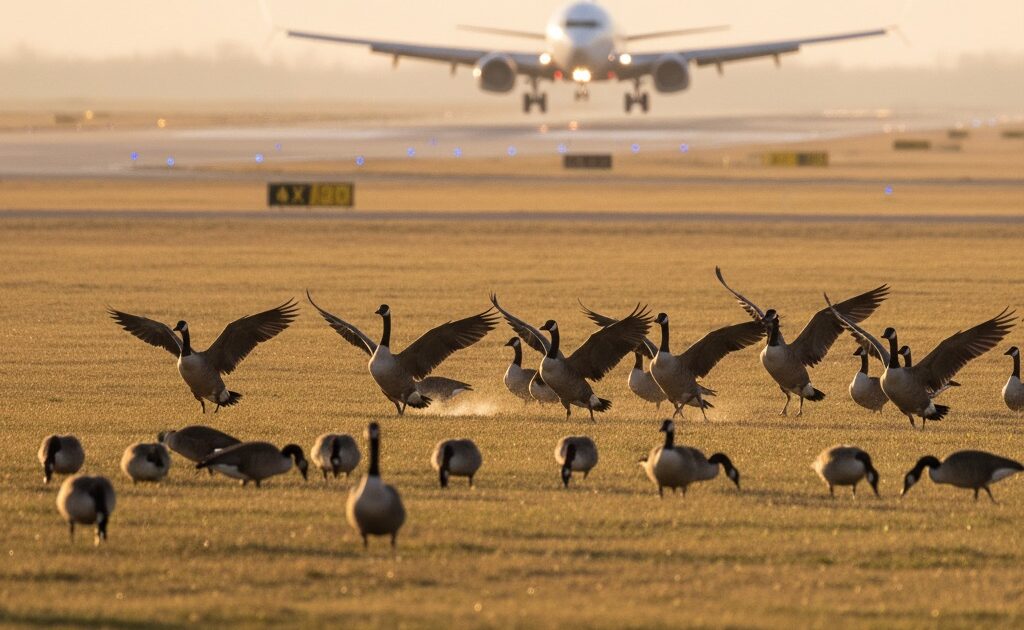
Inside the FAA’s Wildlife Strike Mitigation Playbook: ‘No Fowl Play’
The numbers keep climbing. In 2024, U.S. civil aircraft were involved in 22,372 reported wildlife strikes — a 14% increase over 2023. Those figures now join more than 300,000 entries in the FAA wildlife strike mitigation database. The record spans three decades of accumulated trend data.
And yet, by the metrics that matter most — damage rates, body mass, catastrophic outcomes — the program is delivering results. That tension, between rising strike totals and falling damage rates, defines the state of aviation wildlife hazard management in 2025.
A recently published FAA blog post titled “No Fowl Play: How Wildlife Strike Mitigation Helps Ensure Safe Skies” lays out the agency’s framework in detail. It covers what’s working, what the data shows, and where the program is headed. The picture that emerges is one of genuine progress — built on painstaking data collection, multi-agency coordination, and a growing deterrent toolkit. It also reveals the persistent gaps that continue to challenge smaller airports and voluntary reporting systems.
The Database: Thirty Years of Trend Intelligence
The modern era of wildlife hazard management traces back to the early 1990s. In 1994, the FAA and U.S. Department of Agriculture established the National Wildlife Strike Database. The centralized repository has since become the gold standard for aviation wildlife data worldwide.
“Every country that I’ve talked to uses the U.S. strike database as their gold standard,” said John Weller, the FAA’s chief biologist in the airports organization.
The database draws submissions from every corner of civil aviation. Contributors include airline captains, general aviation pilots, air traffic controllers, mechanics, and grounds personnel. In 2024 alone, it received 22,372 entries. That figure reflects sustained reporting efforts — not just increased wildlife activity.
Reporting is voluntary, which is both a strength and a persistent weakness. The breadth of contributors gives the database reach that a mandatory system might not achieve as efficiently. However, it also means the data is incomplete in ways that are difficult to quantify.
USDA scientists filter and analyze the submissions to identify trends. They track which species are most hazardous and which flight phases carry the highest risk. They also identify what times of year drive the most strikes. As a result, that analysis feeds directly into FAA guidance and grant allocations.
What the Numbers Actually Show
The headline strike total in 2024 — 22,372 — sounds alarming. But the FAA points to a more nuanced picture embedded in the data.
The average body mass of reported bird strikes decreased by 64% between 2000 and 2024. That shift matters enormously from a safety standpoint. A starling and a Canada goose are categorically different hazards when either hits a jet engine — in terms of damage potential, there is simply no comparison.
Damaging strikes — those that result in actual aircraft damage — have also fallen sharply. In 1996, 6% of all reported strikes caused damage. By 2024, that figure had dropped to 3.7%.
“The data shows that strikes may happen every day, but damaging strikes remain rare events because of the research, analysis and mitigation strategies we implement and recommend, both domestically and internationally,” Weller said.
Over the full 1990–2024 period, wildlife strikes with U.S. civil aircraft caused 82 fatalities and destroyed 126 aircraft. Globally, the toll is far higher — at least 643 deaths and more than 360 aircraft destroyed. Those figures underscore that this remains a lethal hazard when mitigation fails.
The rise in general aviation strikes has drawn particular attention from researchers. Specifically, damaging strike rates at GA airports have trended upward, as have rates at altitudes above 500 feet on approach and climb. Part 139 commercial airports, by contrast, have maintained stability. Two factors are driving the GA increase: growing bird populations nationally, and the quieter engine profiles of newer aircraft. Birds simply have less auditory warning of an approaching plane.
FODNews has previously covered surge patterns at general aviation fields, including the distinct challenges facing smaller GA airports that lack the staffing and resources of their commercial counterparts.
The FAA Wildlife Strike Mitigation Toolkit
The FAA’s approach is deliberately multi-layered, reflecting the diversity of airport environments, species compositions, and resource levels across the country’s more than 5,000 public-use airports.
Habitat modification is the foundation. Eliminating standing water, managing vegetation, and reducing adjacent food sources all make airport environments far less attractive to hazardous species. Gulls, waterfowl, raptors, and deer rank among the most dangerous wildlife in the strike database. Land uses that concentrate these animals — landfills, wastewater treatment facilities, wetlands — create documented elevated risk when sited near airports.
Some airports have undertaken dramatic habitat interventions. Spirit of St. Louis Airport, for example, converted wetlands into a golf course with underground water storage. The project eliminated standing water as an attractant — expensive, but effective.
Physical barriers remain a critical line of defense. Upgraded perimeter fencing capable of excluding deer and large mammals has been a priority for FAA Airport Improvement Program (AIP) grants. The FAA has issued approximately $400 million in AIP grants for wildlife mitigation. Funded projects include fencing upgrades, wildlife hazard assessments, pyrotechnic launchers, infrared cameras, and canine patrol programs.
Active deterrence — scaring wildlife away — is another core pillar. Methods range from propane cannons and pyrotechnic devices to trained border collies that patrol airfield perimeters. Southwest Florida International Airport has deployed canine patrols since 1999. The approach exploits the deep-rooted prey response in birds and mammals. A dog on patrol triggers avoidance behavior more reliably than most static deterrents.
Remote sensing technology is increasingly central to real-time wildlife management. Avian radar and infrared cameras can detect wildlife at distances up to five miles from an airport perimeter. That early-warning capability gives controllers and wildlife managers time to act before a hazard enters the airfield. Additionally, the FAA notes that FOD radars already installed at some airports provide a secondary wildlife detection benefit on the ground — a dual-use capability that offers real cost efficiency.
Drones have also become a growing tool, particularly for surveying difficult terrain. They can fly predetermined routes to detect wildlife habitats and disperse animals from active areas. Furthermore, drones can monitor perimeters across large water bodies or rough ground that is impractical to patrol on foot.
The General Aviation Gap
The FAA’s mitigation framework works best when airports have both the regulatory mandate and financial resources to implement it fully. That condition applies reliably at Part 139-certificated commercial airports. Under 14 CFR Part 139.337, those airports must take immediate action when wildlife hazards are detected. They are also required to maintain funded mitigation programs.
General aviation airports face a fundamentally different regulatory environment. Without the Part 139 mandate, wildlife hazard assessments and formal management plans are optional rather than required. AIP grants have historically prioritized certificated airports. Additionally, GA airports typically lack the dedicated staffing — biologists, wildlife control officers — that larger commercial facilities can employ.
The result is a two-tier system. The airports with the fewest resources to address the problem also face the fewest requirements to do so. As GA wildlife strike rates trend upward, this gap is becoming harder to ignore.
FODNews has reported on wildlife strike incidents at GA facilities, including events in Sacramento and a broader look at the systemic risks at general aviation airports that fall outside the commercial safety net.
The Voluntary Reporting Problem
For all the database’s value, its voluntary architecture creates a structural blind spot that the FAA openly acknowledges.
Reporting rates vary enormously across airport types and aviation sectors. Commercial carriers and their mechanics have established internal processes for documenting strikes — engine inspections, airframe checks — that generate reliable data. General aviation pilots, by contrast, operate smaller aircraft with less formal post-flight routines and report at far lower rates.
This skews the database in ways that affect hazard assessment. If GA strikes are systematically underreported, trend analysis will undercount risks at smaller airports. The consequence could be misallocated mitigation resources.
The FAA has attempted to address this through outreach — QR codes on printed materials, public education campaigns, and streamlined electronic submission. In 2024, 74% of reports were filed electronically via FAA Form 5200-7. Nevertheless, the fundamental challenge remains: a voluntary system depends on participation that is uneven by design.
The International Dimension
Foreign aviation regulators routinely turn to the FAA for guidance on wildlife hazard management. In response, the agency has increasingly structured its international engagement around hands-on knowledge transfer.
In 2024, at the request of the Kenyan government, the FAA delivered a multi-day wildlife hazard management workshop. The event brought together experts and stakeholders from nine countries. Topics included developing management programs, detecting and monitoring wildlife, and navigating the complexities of protected species near airports. That last challenge is particularly acute in regions with higher biodiversity and stricter conservation frameworks.
Weller is currently leading the team updating the International Civil Aviation Organization’s global bird strike manual — the primary reference for aviation regulators worldwide. The FAA’s domestically developed frameworks are being codified into those international standards.
The international picture is not uniformly positive. Indeed, FODNews has covered a bird strike surge in Indonesia — a reminder that the safety gains achieved in North America and Europe have not been replicated globally. Rapid air traffic growth in regions with limited wildlife management infrastructure creates compounding risk.
What’s Next: Emerging Technology and Unresolved Questions
The FAA is evaluating several emerging technologies for wildlife detection and deterrence. Bi-static radar configurations — which separate transmitter and receiver to create wider coverage patterns — are under review as a potential improvement over current avian radar systems. Research into aircraft lighting modifications is also ongoing. The central question: whether different lighting profiles can improve aircraft visibility to birds at low altitudes.
Notably, 90% to 93% of turbine engine strikes occur below 500 feet above ground level. That statistic defines the critical intervention window. Nearly all damaging strikes happen during takeoff and approach — the few minutes when an aircraft is most vulnerable and airspeed provides the least margin for error.
For high-profile incidents that breach all mitigation layers, the consequences can be severe. Earlier this year, an Alaska Air A330 bird strike demonstrated that even well-equipped commercial carriers are not immune to significant damage events. The question is not whether strikes can be eliminated — they cannot. The real measure is whether the damage rate can continue its downward trajectory as total strike volume rises.
The FAA’s data suggests the answer, so far, is yes. But the margin for complacency is thin. Wildlife populations are expanding. Urban development is pushing habitat closer to airport perimeters. And GA airports remain outside the full umbrella of the federal mitigation framework.
The Bottom Line
The FAA’s wildlife strike mitigation program represents one of aviation safety’s genuine success stories. It is a decades-long collaboration between federal agencies, airport operators, biologists, and pilots that has measurably reduced the damage caused by an unavoidable hazard.
The 64% reduction in strike body mass and the decline in damaging strike rates from 6% to 3.7% are not accidents. They are the product of systematic research, data-driven policy, and significant capital investment.
But the program’s gaps are real and growing. The voluntary reporting system leaves a substantial portion of the strike population unmeasured. The regulatory divide between commercial and general aviation airports means the fastest-growing risk segment is also the least managed. Moreover, the global picture — where the FAA’s best practices remain aspirational rather than operational — means every international flight carries exposure that the domestic framework cannot fully address.
The playbook is solid. The gaps in who’s required to follow it are not.
Subscribe to FODNews for weekly coverage of aviation safety, wildlife hazards, and airfield operations worldwide.
Sources
- FAA Cleared for Takeoff Blog: “No Fowl Play: How Wildlife Strike Mitigation Helps Ensure Safe Skies”
- FAA National Wildlife Strike Database
- FAA Wildlife Management Program
- FAA Wildlife Strike Report 1990–2024
- FAA Advisory Circular AC 150/5200-32C: Reporting Wildlife Strikes (July 2024)
- NBAA: Proactive Airports and Pilots Minimize Wildlife Strike Hazards
- USDA APHIS National Wildlife Research Center — Airport Wildlife Hazards Program