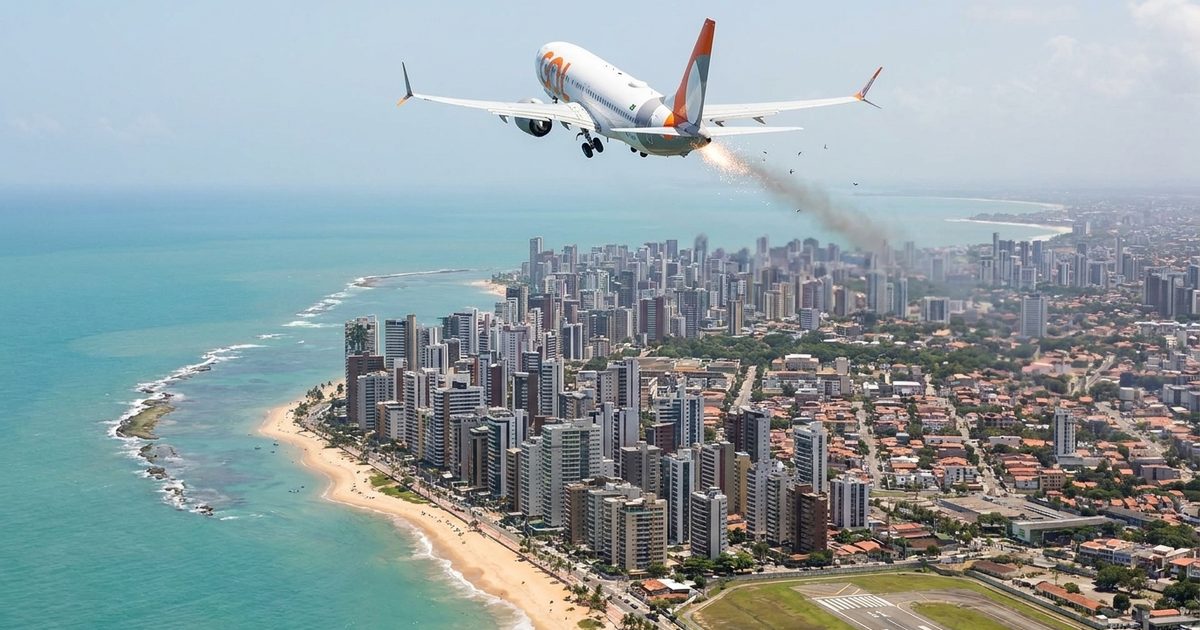
A bird strike sent sparks and flame — visible in video filmed by residents on the ground — trailing from the right engine of a GOL Boeing 737 MAX 8 moments after it departed Recife on Monday, prompting the jet to circle and return safely. GOL said no fire occurred and Aena Brasil said no emergency was declared, according to Brazilian outlets G1 and Folha de S.Paulo.
The flight, operated by GOL Linhas Aéreas and identified by airport operator Aena Brasil as GL 1587, lifted off from Recife/Guararapes International Airport at 1:16 p.m. local time on Oct. 5, bound for São Paulo–Guarulhos International Airport, Folha reported. Shortly after takeoff, a bird struck and was ingested into the right engine of the Boeing 737 MAX 8, which was carrying up to 186 passengers, according to the newspaper.
Residents of Piedade, a neighborhood in Jaboatão dos Guararapes directly beneath the departure path, filmed the jet trailing sparks and flame as it climbed, with loud bangs audible from the ground, G1 reported. Clips spread quickly on social media, with many viewers describing what appeared to be an engine explosion.
GOL disputed that characterization. The airline said no explosion or fire occurred and that the sparks seen in the footage did not affect engine performance or passenger safety, Folha reported. The carrier said the eventual landing “occurred normally, without incident,” and that the aircraft was sent to maintenance afterward. Aena Brasil, which operates Recife/Guararapes, said separately that the pilot requested the return but did not declare an emergency.
As standard procedure ahead of an overweight return, the crew circled the Recife metropolitan area to burn fuel, covering roughly 213 kilometers over 31 minutes before touching back down at Recife/Guararapes at 1:47 p.m., Folha reported. The flight was canceled, and GOL said affected passengers were rebooked under ANAC Resolution 400, which governs airline obligations to customers on disrupted flights.
Passengers described a tense few minutes in the air. Thiago Lima, a programmer aboard the flight, told G1 he heard a series of loud bangs before the noise stopped and the aircraft began circling. Gorete Alves, a teacher, said the plane shook and she grew frightened until the pilot explained there was a “technical problem” and that the aircraft would return to Recife.
Bird Strike Over Recife Highlights Brazil’s Rising Wildlife Risk
Brazil’s air transport association recorded 5,100 bird strike occurrences nationwide between 2022 and 2024, and roughly 1,100 in the first half of 2025 alone — a 33% jump from the 869 cases logged in the same period the previous year, G1 reported, citing the Associação Brasileira das Empresas Aéreas. The figures underscore how routine, if rarely dangerous, bird encounters have become for airlines operating in and out of Brazil’s coastal airports.
Brazil’s air force said its Center for Investigation and Prevention of Aeronautical Accidents (CENIPA) was notified and, after an initial review of available data, classified the occurrence as an “aeronautical incident” to be handled under Annex 19 of the International Civil Aviation Convention, G1 reported. Further findings will be published through CENIPA’s SIPAER reporting panel once consolidated.
Laissa Ribeiro, a pilot and aeronautical sciences professor at Uninassau who spoke to TV Globo, said commercial crews train regularly for bird-strike scenarios and that a jet can continue flying safely even if an engine is lost. Unlike a helicopter, she noted, a fixed-wing aircraft can glide, giving pilots time to assess the situation and plan a safe landing.
Modern turbofans, including the CFM International LEAP engines that power the Boeing 737 MAX family, must meet bird-ingestion certification standards set by regulators such as the FAA and EASA, which require engines to withstand strikes from birds of specified sizes without an uncontained failure. Airports also run wildlife-hazard management programs — including habitat control and active deterrence — to reduce the odds of a strike during the most vulnerable phases of flight, takeoff and initial climb.
The Recife incident adds to a string of bird-strike engine events FODNews has tracked this year, including a Delta A330 engine fire climbing out of Barcelona and a FedEx 767 bird strike over Campinas that forced a two-hour holding pattern before landing.
Subscribe to FODNews for continuing coverage of FOD incidents and prevention worldwide.
Sources
- G1 Pernambuco — “Motor de avião pega fogo ao colidir com pássaro no Grande Recife; VÍDEO” (Mon. Oct. 5, 2026)
- G1 Pernambuco — “‘Birdstrike’: entenda incidente que fez motor de avião pegar em PE” (Tue. Oct. 6, 2026)
- Folha de S.Paulo — “Avião da Gol volta a Recife após pássaro avariar motor” (Mon. Oct. 5, 2026)