Intercepted Missile Debris Injures Six, Ignites Three Fires at Abu Dhabi Industrial Zone
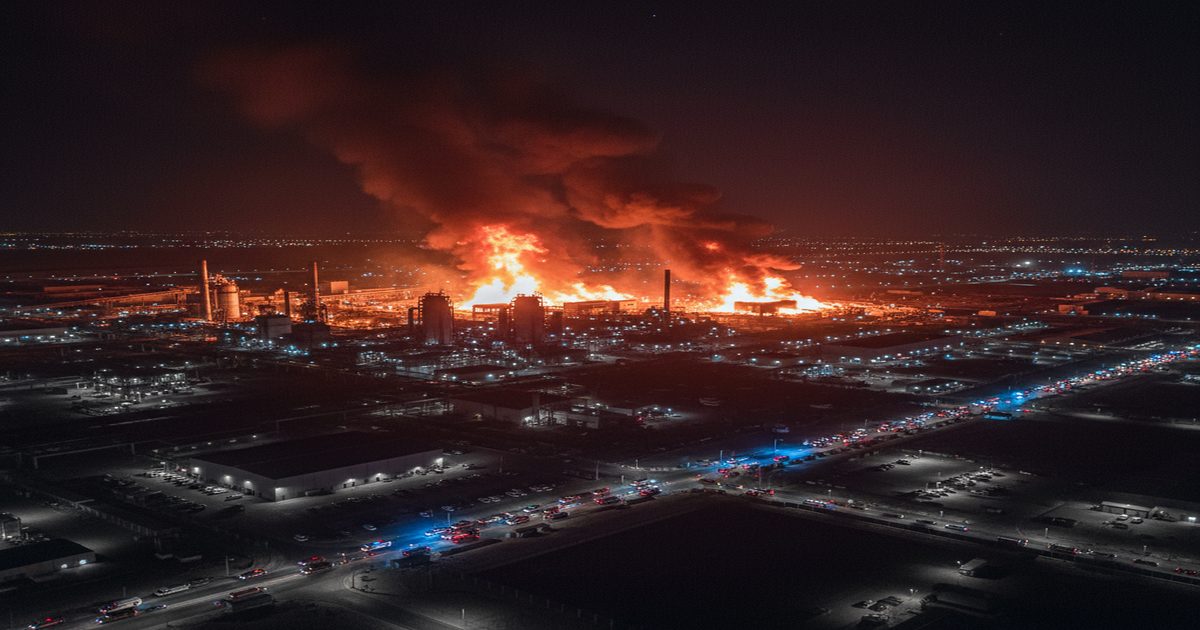
ABU DHABI, UAE — March 28, 2026 — Missile debris from an Iranian ballistic missile intercepted by UAE air defenses struck the Khalifa Economic Zones (KEZAD) industrial area Saturday, injuring six workers and igniting three separate fires — the latest case of kinetic intercept FOD causing significant industrial damage. Emergency crews scrambled to contain the blazes.
The Abu Dhabi Media Office confirmed the injuries in two statements issued throughout the day. Five Indian nationals sustained injuries ranging from moderate to minor. A sixth victim — a Pakistani national — was confirmed in an updated release, bringing the total to six. No life-threatening injuries were reported.
All three fires were brought under control, the Abu Dhabi Media Office said, with cooling operations continuing at the affected sites.
Emirates Global Aluminium Confirms ‘Significant Damage’
Emirates Global Aluminium (EGA), one of the world’s largest premium aluminium producers, confirmed that its Al Taweelah site within KEZAD sustained “significant damage” during the attack. The company said a number of its employees were among the injured.
“The safety and security of our people is our top priority at EGA at all times,” said EGA CEO Abdulnasser Bin Kalban in a statement issued Saturday. “We are deeply saddened and are assessing the damage to our facilities.”
The Al Taweelah complex is one of the largest aluminium smelting operations in the world and produced 1.6 million tonnes of cast metal in 2025. EGA is jointly owned by Mubadala Investment Company and Investment Corporation of Dubai and represents the UAE’s largest industrial firm outside oil and gas.
EGA noted that it held substantial metal inventory afloat and at overseas locations when the conflict began — factors the company said may help cushion near-term supply disruptions. Damage assessments were ongoing as of Saturday.
Kinetic Intercept Debris: A Secondary FOD Threat
The incident highlights an underappreciated hazard in active conflict zones: successful missile interceptions do not eliminate the threat. They redistribute it.
When an air defense system destroys an incoming ballistic missile in flight, the intercepted warhead and airframe fragment into high-velocity debris that continues on a ballistic arc toward the ground. That debris — metal shards, structural components, propellant fragments — can scatter across a wide radius, behaving as uncontrolled foreign object debris (FOD) over populated and industrial areas.
Unlike conventional FOD on airfields or runways, kinetic intercept debris is largely unpredictable in its distribution pattern. It strikes without warning, at high velocity, across potentially large footprints. The KEZAD incident — three fires, six injuries, significant structural damage at a major industrial facility — illustrates what that secondary debris field can do.
A separate incident around the same period prompted Abu Dhabi authorities to shut down a gas facility following missile debris impacts, underscoring the breadth of infrastructure vulnerability across the emirate.
Broader Regional Context
Saturday’s strike was part of a broader wave of Iranian missile and drone attacks targeting Gulf states. Anadolu Agency reported that Iran has launched retaliatory strikes against Israel and Gulf countries hosting U.S. military assets since late February, causing casualties and disrupting infrastructure across the region.
Bahrain’s Aluminium Bahrain (Alba) also confirmed damage to its aluminium facilities from Iranian attacks, making EGA’s Al Taweelah the second major Gulf aluminium operation struck during the same conflict period.
UAE Minister of Industry Dr. Sultan Al Jaber, speaking in Washington, said the UAE had faced “more than 2,200 missiles and drones” since Feb. 28 — more than 60 percent of everything launched at the Gulf — and that UAE defenses had held.
The Abu Dhabi Media Office advised the public to rely only on official sources and to avoid spreading unverified information about the ongoing situation.
What Industrial Operators Should Know
For facility managers and safety officers operating near active conflict theaters, the KEZAD incident is a case study in a hazard category that standard FOD management frameworks rarely address: debris originating from overhead intercept operations.
Traditional FOD protocols focus on ground-level accumulation — maintenance residue, tool control, material handling failures. Intercept debris introduces a vertical dimension: high-energy objects arriving from above, at unpredictable intervals and locations, with no tactile or visual warning before impact.
For sites near active air defense corridors, the practical questions are significant: Where do personnel shelter? How quickly can fires be suppressed? What pre-positioned fire-suppression and cooling resources are required? The KEZAD response — controlling three simultaneous fires across an active aluminium smelter complex — required substantial emergency coordination.
Those are operational questions the industry will need to take more seriously as kinetic conflict intersects with critical industrial infrastructure in active theaters.
Subscribe to FODNews for ongoing coverage of FOD incidents and hazard prevention across aviation, military, and industrial operations worldwide.
Sources
- Gulf Today — Missile debris causes fire in Abu Dhabi industrial zone, six people injured (March 28, 2026)
- Anadolu Agency — Debris from intercepted missile injures 5 near Khalifa Economic Zones in Abu Dhabi (March 28, 2026)
- Gulf Business — Emirates Global Aluminium says its KEZAD site damaged amid Iranian attacks (March 28, 2026)
- EGA Official Statement — Al Taweelah site at KEZAD sustains significant damage (March 28, 2026)