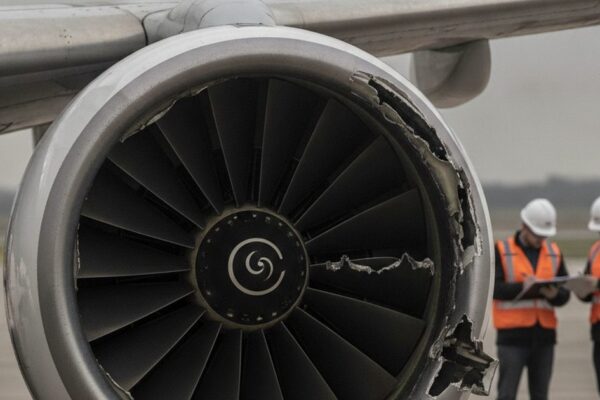
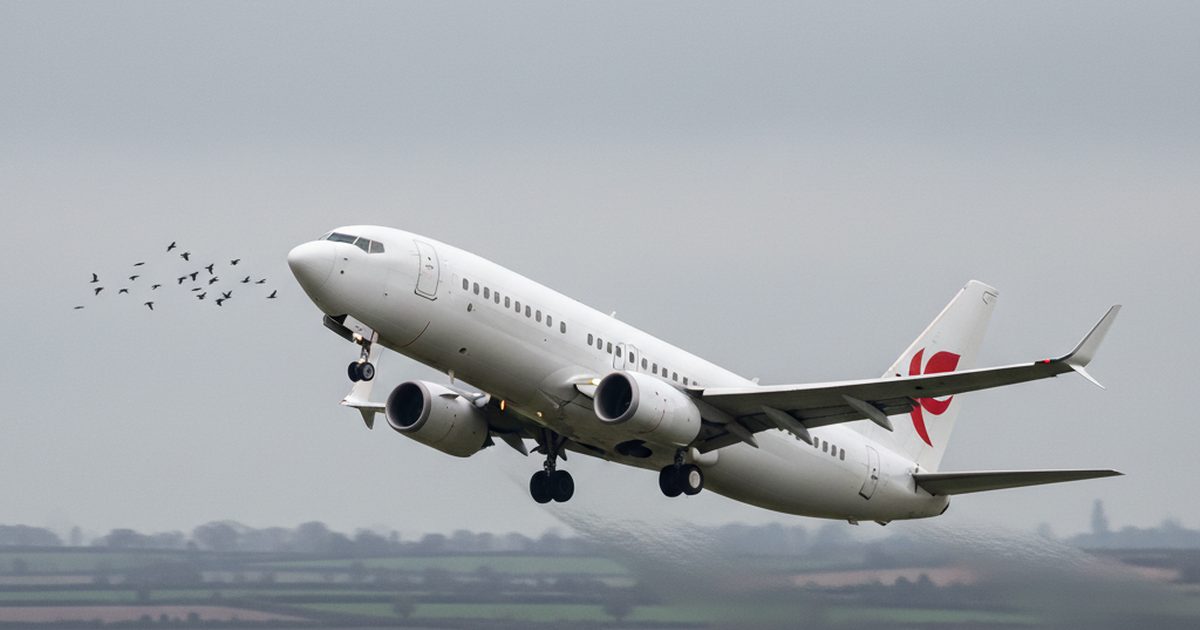
LEEDS BRADFORD, England — A 28-year-old Jet2 Boeing 737-800 bound for Crete suffered a bird strike shortly after takeoff from Leeds Bradford Airport on Monday. The crew leveled off at low altitude to run safety checks. Then they diverted to Manchester Airport for inspection. The Jet2 bird strike is the latest in a run of UK diversions. Wildlife management remains squarely at the front of airline operations.
Flight LS443, registered G-GDFD, departed Leeds Bradford (LBA) at roughly 08:00 UTC on April 27. Passengers were booked for Heraklion (HER). The 1997-build Boeing 737-8K5 is powered by CFM International CFM56-7B engines. It encountered the strike during the initial climb, according to incident details logged by the Aviation Safety Network.
ADS-B tracking reviewed by aviation observers showed the jet hold at low altitude. Initially the aircraft circled around 4,500 feet. Eventually it leveled closer to 7,000 feet while the crew worked through post-strike checks south of the airport. The pilots then elected to fly to Manchester Airport (MAN) rather than return to Leeds Bradford. The aircraft landed safely. Emergency services met it as a precaution. No injuries occurred.
Why Manchester, not Leeds Bradford?
Diverting roughly 65 km southwest to Manchester is a routine choice for narrow-body jets after a wildlife encounter. Manchester offers longer runways, full maintenance facilities, and the operational depth to rebook a charter-style holiday flight quickly. Leeds Bradford, by contrast, sits at 681 feet on a single 7,382-foot runway (14/32). It is a short, hilltop strip. The narrower margin matters for an aircraft of uncertain post-strike performance.
For Jet2, MAN also keeps a fault-isolation pathway open. The carrier uses both airports as bases. As a result, engineers can borescope the engines and inspect the airframe without ferrying it on uncertain power.
A 28-year-old narrow-body in a maturing fleet
G-GDFD is among the oldest aircraft in Jet2’s mainline fleet. Manufacturer’s serial number 27982 dates the airframe to 1997. The same aircraft was involved in a fumes, smoke and odor event west of Luxembourg in May 2025, per Aviation Safety Network records.
Jet2’s overall fleet skews older than many European short-haul competitors. Public fleet trackers place the Leeds-headquartered carrier’s 737-800 average age in the 13- to 16-year range. Meanwhile, the operator is retiring some of its oldest 737-800s through 2025 as it inducts new Airbus A321neos. Fleet age does not on its own drive bird-strike outcomes. However, older airframes typically face deeper, slower inspections after any ingestion event because of cumulative fatigue history.
UK bird strikes ticked higher in 2024
The Jet2 incident lands against rising UK strike volumes. The UK Civil Aviation Authority’s latest birdstrike dataset logged 1,839 reports in 2024. That total includes 1,691 confirmed strikes, 136 sightings or near-misses and 12 unconfirmed. Reports are up from 1,766 the prior year. Of the confirmed strikes, 97 caused damage or a system issue.
Activity is highly seasonal. Q3 covers the late-summer holiday peak driving much of Jet2’s network. Accordingly, that quarter accounted for 744 of 2024’s reports — more than any other. Barn owls topped the species table with 71 reports.
The CAA cautions against ranking airports by raw strike volume. Its guidance notes that “the volume of birdstrikes reported at a particular airport or aerodrome does not imply greater hazard.” UK aerodromes must maintain a wildlife hazard management plan under CAA guidance, including CAP 772. The plan covers habitat control, deterrence, monitoring and trained personnel.
Not the first Jet2 bird strike at LBA
This is not the first Jet2 bird strike on departure from Leeds Bradford. On October 29, 2023, Jet2 flight LS255 suffered a bird strike on takeoff from runway 32. The aircraft was a Boeing 737-300 (G-GDFM), according to an Aviation Safety Network entry. No injuries occurred.
Leeds Bradford sits in the Yorkshire uplands. Reservoirs, farmland and gull-roosting habitat surround the airfield. As a result, wildlife management is a year-round task there. A standard post-event playbook is now in motion at Manchester. First, engineers will run a borescope inspection of both CFM56-7B engines. Next comes airframe inspection for impact damage. Then tissue sampling will identify the species. Finally, the operator files an entry in the occurrence reporting chain to the CAA. Whether the airframe returns to the line in days or weeks will depend on what inspectors find when the cowls come off.
—
Sources
– Aviation Safety Network, Incident Boeing 737-8K5 (WL) G-GDFD, Monday 27 April 2026 – AIRLIVE, 28-year-old Jet2 Boeing 737 is circling after bird strike out of Leeds (April 27, 2026) – UK Civil Aviation Authority, Birdstrike data (2023–2024) – Aviation Safety Network, Prior incident: Jet2 LS255 bird strike at LBA, October 29, 2023 – Yorkshire Evening Post, Emergency services attend Leeds Bradford runway after bird strike
—
Stay informed — subscribe to FODNews for daily coverage of FOD incidents and prevention worldwide.