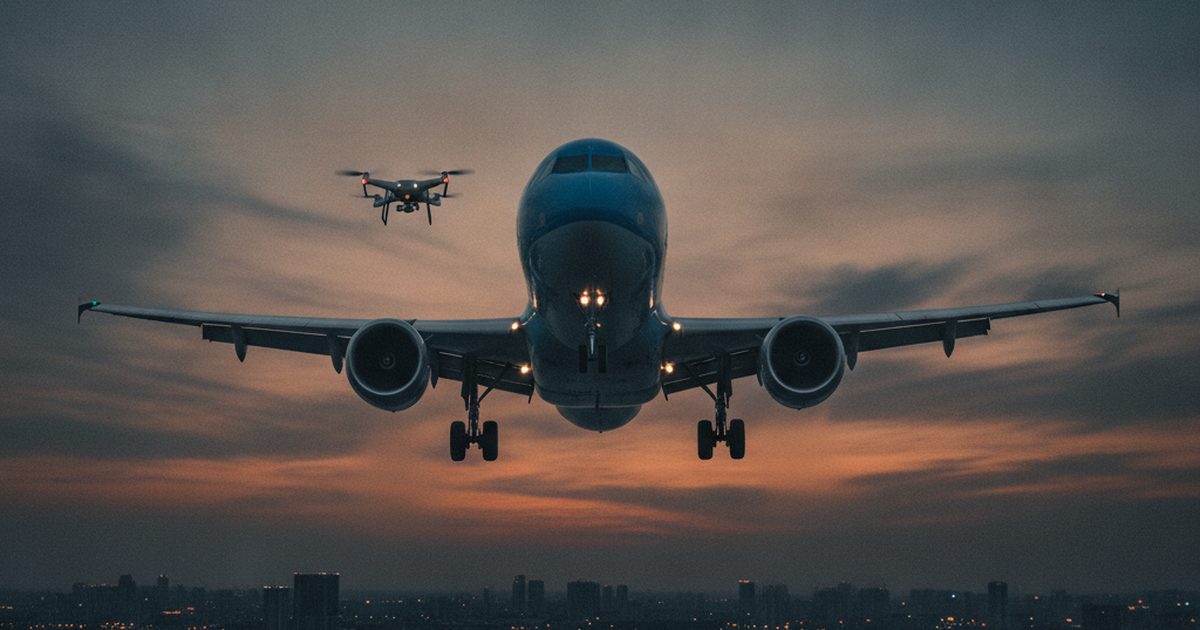
NEW YORK — The crew of JetBlue Flight 948 reported a possible drone strike near JFK during final approach June 29. However, the JetBlue drone strike report remains unconfirmed. JetBlue found no damage, and the Federal Aviation Administration said it could not confirm drone activity at the reported location, altitude or time.
What Did the JetBlue Drone Strike Report Say?
The Airbus A321 was operating from Las Vegas to New York. During final approach, the captain radioed air traffic control and reported a drone encounter.
According to the crew report, the aircraft was descending through about 3,000 feet. It was roughly 10 miles from JFK at the time.
The pilot told controllers the aircraft had “collided with a drone” during a turn near ASALT, a waypoint on the JFK approach. The crew also reported the object struck “right above the cockpit.” Still, the flight continued safely, and the crew said it did not need assistance.
JetBlue said passengers deplaned normally after the aircraft landed. In addition, the airline removed the Airbus A321 from service for inspection. Maintenance teams found “no damage or evidence of a collision,” JetBlue said.
What Has the FAA Confirmed?
The FAA opened an investigation after the pilot report. However, the agency said it could not confirm drone activity in that area at that time.
No drone operator has been identified. Also, no drone debris has been reported publicly.
According to Reuters, the FAA receives more than 100 reports of unauthorized drone sightings near airports each month. That volume makes each report important. It also shows why investigators need physical evidence, radar data or other corroboration before confirming a strike.
The agency restricts most recreational drone operations to 400 feet unless the operator has specific authorization. Therefore, a drone at 3,000 feet in terminal airspace would be a serious safety concern if investigators verify the report.
Why Does an Unconfirmed Report Matter?
Even without confirmation, the report highlights a persistent risk around busy airports. Final approach gives crews limited time and altitude to respond.
Also, a dense object near the cockpit could create a different hazard than a bird strike. Drones contain batteries, motors and rigid components.
The JetBlue report came during a late-June cluster of drone concerns around New York-area airports. Around the same period, a United Airlines crew reported seeing a drone near its aircraft while descending into Newark Liberty International Airport. The FAA opened a separate investigation into that report.
If investigators confirm the JetBlue incident, it would be one of the first documented drone-airliner collisions involving a U.S. commercial passenger flight. For now, though, the record remains limited. It includes a crew report, an airline inspection with no damage found and an open FAA investigation.
What Happens Next?
Investigators will review available air traffic control information, pilot statements and other data. Meanwhile, JetBlue said it will cooperate with the FAA.
Unauthorized drone operations near airports can bring civil fines, federal penalties and, in some cases, criminal prosecution. As a result, the case remains significant even if the FAA cannot confirm a collision. It shows how quickly one drone report can trigger safety and regulatory questions in crowded terminal airspace.