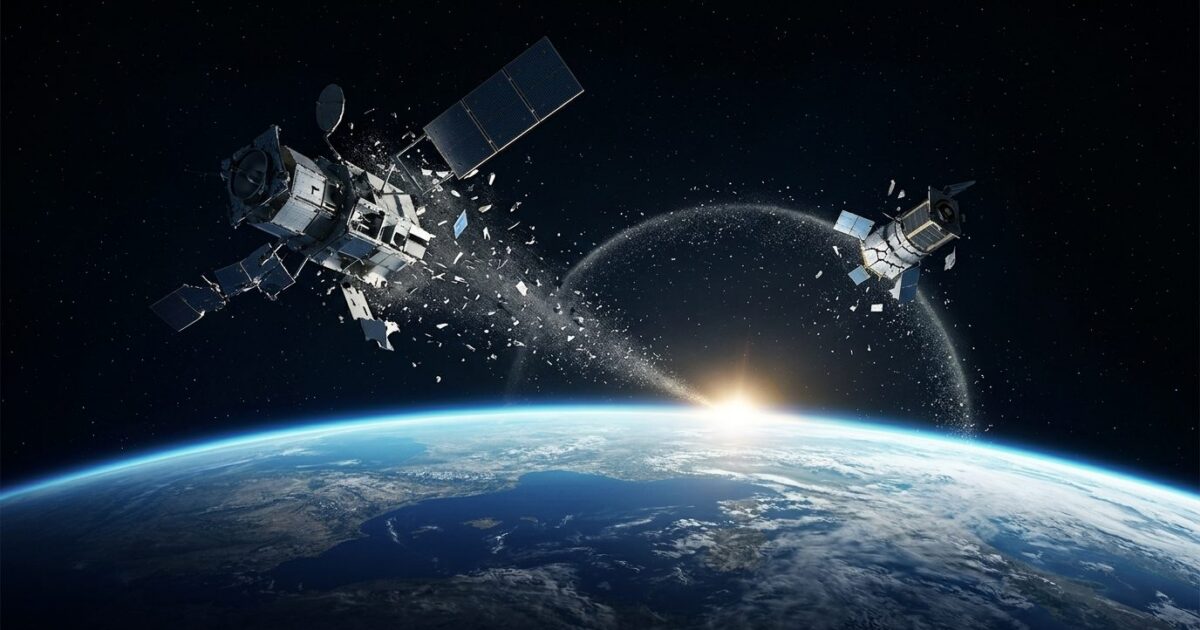
A peer-reviewed analysis published July 31 on arXiv finds that six of 16 planned or operational satellite constellations—collectively representing 1.7 million satellites—cross the threshold into Kessler Syndrome mega-constellations territory. Beyond that threshold, debris generated by collisions grows without limit. Prof. Hugh G. Lewis of the University of Birmingham authored the study. It is the most comprehensive application of Kessler’s stability model to modern commercial constellation plans. The implications for low Earth orbit are stark.
What Is Kessler Syndrome—and Why It Matters Now
The concept takes its name from NASA astrophysicist Donald Kessler, who first described the cascade scenario in 1978. In a Kessler cascade, collisions between satellites generate debris. That debris strikes other satellites, producing more debris, triggering more collisions—a self-sustaining chain reaction that no regulatory mandate can stop once it begins.
For decades, Kessler Syndrome was theoretical. The debris population in low Earth orbit (LEO) was sparse enough that cascade thresholds seemed distant. That calculus has changed. In the past five years, the number of active satellites in LEO has roughly tripled, driven almost entirely by commercial mega-constellations. Regulators have struggled to keep pace. The rules they rely on were written for individual satellites. They were never designed for fleets numbering in the tens or hundreds of thousands.
Lewis previously collaborated with Kessler himself on updating the stability model. He decided to apply a modified version of that framework to today’s commercial plans. The result is a rare quantitative answer to a mostly qualitative question: How many satellites are too many?
The Study’s Methodology: A “Critical Size” for Every Constellation
Lewis drew constellation data from three sources: the U.S. Federal Communications Commission licensing database, the European Space Agency (ESA), and satellite-tracking astronomer Jonathan McDowell. He identified 16 planned or operational constellations with a combined scale of approximately 1.7 million satellites.
For each constellation, Lewis fed key parameters into a modified version of the Kessler-Anz-Meador stability model. Those parameters included satellite count, altitude, physical dimensions, mass, and operational lifespan. The model tracks how often a satellite or debris piece intersects a given atmospheric point. That frequency determines how quickly drag pulls orbiting objects back to Earth.
Two debris-mitigation factors were also incorporated: a satellite’s ability to maneuver away from potential collisions, and adherence to post-mission disposal requirements. Lewis modeled two disposal regimes: the FCC’s five-year deorbit rule and a stricter “control-to-reentry” standard requiring active guided reentry.
From this, Lewis derived a “critical size” for each constellation—the maximum number of satellites before the debris population becomes unstable or enters full runaway. He evaluated every constellation in isolation, without accounting for existing debris or other planned constellations. Lewis called this approach “an optimistic view.”
Six Kessler Syndrome Mega-Constellations Cross the Runaway Threshold
The headline finding: six of the 16 constellations exceed the critical size for a runaway debris environment. That holds even under optimistic assumptions about collision avoidance and disposal compliance.
The six are:
- Starmind (SpaceX) — 1 million satellites planned as orbital data centers
- Guowang (China) — approximately 13,000 satellites
- Project Sunrise (Blue Origin) — the unstable threshold is met with fewer than 16 satellites at 1,800 km altitude; the runaway threshold is less than 1 satellite at that orbital shell
- Stampede (Cowboy Space Corporation) — exceeds the runaway threshold when Starlink-class satellite characteristics are applied to its 20,000-satellite plan
- Starcloud (SpaceX) — approximately 90,000 satellites; just exceeds the runaway threshold if satellite mass and area are doubled relative to the Starcloud-1 reference object
- E-Space Cinnamon and Semaphore — a combined nanosatellite system whose 10-kilogram satellites lack sufficient propulsion for effective collision avoidance
Three additional constellations—including SpaceX’s third-generation Starlink, planned for approximately 100,000 satellites—were found to reach an “unstable” state. Debris would increase, but it would not grow without limit. Even so, Lewis notes that unstable constellations impose costs on every other orbital user by raising the ambient debris density.
The Starmind Problem: Scale as a Physical Constraint
SpaceX’s Starmind proposal deserves particular scrutiny because of its scale. At one million satellites, Starmind would be by far the largest constellation ever proposed. Lewis does not yet have design specifications for Starmind satellites. Instead, the study uses the known mass and cross-sectional area of the current Starlink fleet as a proxy.
Even under those proxy assumptions, Starmind far exceeds the runaway threshold across multiple altitude bands. The study’s figures show the planned deployment profile crossing above both the unstable threshold and the runaway threshold at nearly every modeled altitude.
That result carries a pointed implication: Starmind’s debris risk is not primarily a function of satellite design choices that have yet to be made. It is a function of raw scale. One million satellites in LEO—even well-designed ones—may be physically incompatible with a stable debris environment when evaluated in isolation.
SpaceX has not publicly responded to the study.
Small Constellations Are Not Exempt
One of the study’s more counterintuitive findings is that constellation size alone does not determine debris risk. Orbital placement and satellite design can push even modest fleets past critical thresholds.
A Eutelsat proposal was found to reach an unstable debris state with just 528 satellites. That number would barely register in a world of million-satellite plans, yet the orbital shell into which those satellites are placed makes the difference. At higher altitudes, atmospheric drag is weaker, debris lingers longer, and fragments accumulate faster.
The E-Space Cinnamon and Semaphore nanosatellites present a different problem. At 10 kilograms each, they are too small to carry meaningful propulsion systems. The model treats that design characteristic as rendering them incapable of effective collision avoidance. That single factor is enough to push the combined system past the Kessler runaway threshold.
What Could Pull Constellations Back from the Edge
Lewis is explicit that the findings are not a verdict of inevitability. Several design and operational modifications could bring borderline constellations back below critical thresholds.
Increasing a satellite’s drag surface area accelerates orbital decay after end of life. This can be achieved by making the satellite physically larger or equipping it with drag augmentation devices. Less time spent in orbit means less collision risk. Extending operational lifespans would also help, by cutting the frequency of replacement launches and reducing satellites cycling through the debris-generating orbit-raising phase.
“Even relatively modest changes could cut the risk,” the researchers wrote. Those changes include ensuring satellites leave orbit before collision and extending operational lifetimes to reduce replacement launches. “Decisions must be made even in the face of uncertainty.”
The problem is that none of the six runaway-threshold constellation operators have publicly committed to the modifications that would change the outcome. Lewis acknowledges this gap directly. Current international debris mitigation guidelines—including the IADC guidelines and the FCC’s five-year deorbit rule—were not designed with mega-constellation aggregate risk in mind.
A Regulatory Gap That Preprint Papers Can’t Fill
Lewis gathered his data from FCC and ESA licensing databases. Those filings represent what companies have told regulators they plan to do. The study evaluates whether those plans—taken individually and at face value—are consistent with long-term orbital stability. Six of them are not.
That finding lands against a backdrop of ongoing regulatory debate. The FCC has tightened deorbit timelines in recent years. But its review process still evaluates constellations satellite by satellite. Aggregate fleet risk remains outside the scope of any FCC assessment. ESA has pushed for stronger international standards through the Inter-Agency Space Debris Coordination Committee (IADC), but those standards remain voluntary.
As FODNews has previously reported, one metric tonne of uncontrolled space debris already falls to Earth every week as agencies push for stricter disposal rules. Meanwhile, the U.K. has committed £85 million to expand space debris surveillance at facilities including the Chilbolton Observatory. That investment reflects how tracking the existing debris population has itself become an industrial-scale challenge.
The conjunction risk is already manifesting operationally. Five Starlink conjunctions in five consecutive days in August 2026 illustrated the growing difficulty of managing traffic in an increasingly crowded LEO environment. In one documented case, a Starlink satellite and the MONOLITH spacecraft passed within 6 meters. That near-miss would have produced a debris cloud capable of threatening hundreds of nearby objects.
On the sensing side, NASA and JAXA have completed the critical design review for a new LEO debris sensor. The sensor targets smaller fragments that current ground-based radar cannot reliably detect. Better detection, however, does not remove debris—it only extends warning time before impact.
An Optimistic Model With Pessimistic Results
Lewis is careful throughout to note the assumptions embedded in his analysis. Each constellation is evaluated in isolation—no existing debris, no other constellations, no cumulative background risk. The model also assumes full compliance with stated debris mitigation measures, a condition the current operational record of the industry does not reflect.
“The results demonstrate the need for more stringent approaches to regulation and suggest careful consideration of some recent constellation plans,” Lewis wrote in the paper’s abstract.
The arXiv paper, titled “Critical Sizes of Satellite Constellations”, was submitted July 31, 2026. It has not yet completed peer review, though the methodology builds on decades of established work in orbital debris modeling. Coverage in Science and multiple international outlets followed quickly after posting.
The core message is difficult to soften. A researcher who worked alongside Donald Kessler himself has run today’s commercial plans through the model that defined the cascade threshold. Six of them fail—in isolation, under optimistic assumptions, before accounting for anything already in orbit.
The window to avoid a Kessler environment in LEO remains open. Whether regulators and constellation operators act before it closes is a different question.
Sources
- Lewis, H.G. (2026). “Critical Sizes of Satellite Constellations.” arXiv:2607.29644 [astro-ph.EP]
- Planned satellite megaconstellations could generate runaway space debris — Science.org (2026-08-07)
- SpaceX’s Starmind Satellites Risk Kessler Syndrome Debris Cascade — The Chosun Ilbo (2026-08-09)
- SpaceX mega-constellations drive sharp rise in satellite collision risk — Dong-A Science (2026-08-08)
- One Metric Tonne of Uncontrolled Space Debris Falls to Earth Every Week — FODNews
- Britain Bets £85 Million on Space Junk Surveillance as Debris Cloud Grows — FODNews