GUATEMALA CITY — The wind did it. As midday approached on Sunday, Nov. 22, strong gusts pushed dry grass and other plant material across the only runway at La Aurora International Airport, and Guatemala’s civil aviation authority shut it down. The La Aurora airport runway debris kept the strip closed until about 12:10 p.m., Prensa Libre reported.
The Dirección General de Aeronáutica Civil, known as DGAC, called the closure preventive. Dry grass looks harmless. But an engine can suck it in, and it can harm tires.
So nothing took off, and nothing landed. La Aurora has a single runway, Transporte.com noted, and when it closes, the whole airport waits.
How the La Aurora airport runway debris was cleared
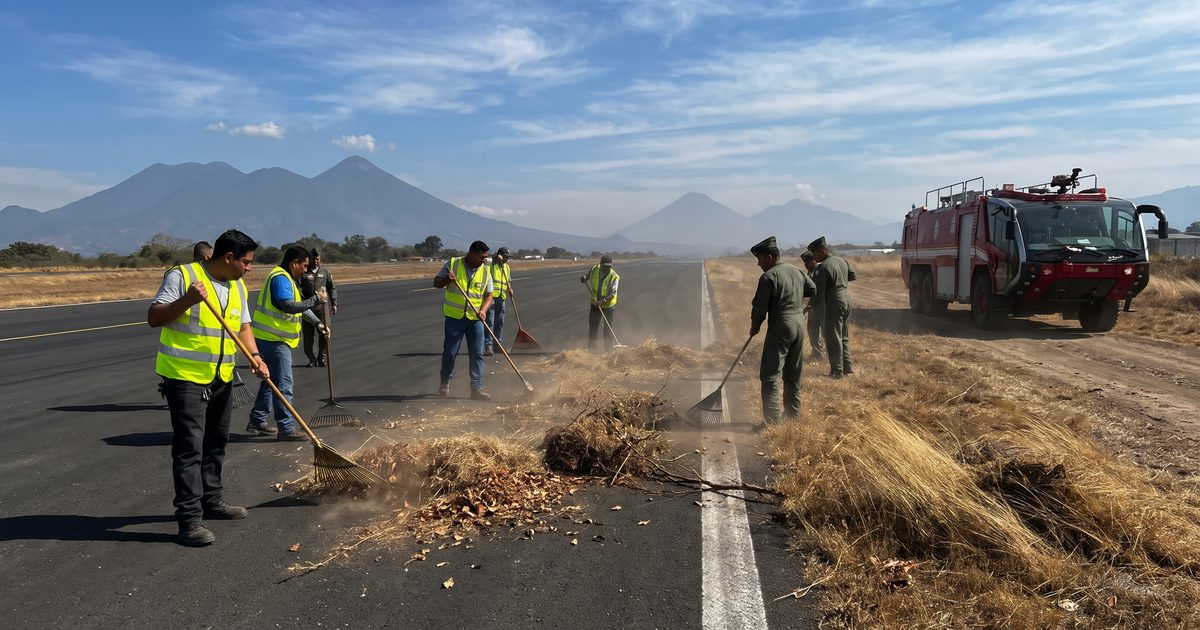
Then the crews went to work. Teams from aviation security, operations, airport upkeep and the fire and rescue service spread out along the runway. They did not work alone.
Guatemalan Air Force personnel joined them. The air force said it supported the cleanup through its Central Air Command, according to Emisoras Unidas. It said debris and foreign objects had left the runway inoperative. The army also reported working at the site.
Clearing the grass was only half the job. Before the runway reopened, the teams checked that no foreign objects remained on the surface, La Hora reported.
How long was the runway closed?
The closure lasted roughly an hour to an hour and a half, depending on the report. Prensa Libre described a little over an hour of cleaning. La Hora put the suspension at about an hour, while Emisoras Unidas said at least an hour and 30 minutes.
Some flights had to wait in the air. Several aircraft held in patterns until the runway reopened, Transporte.com reported, citing TV Azteca Guatemala. DGAC said there were no incidents with aircraft.
At about 12:10 p.m., the wait ended. DGAC posted on X that the runway was active and operating normally. Flights resumed.
Wind, or rotor wash?
DGAC’s official explanation was the wind: strong gusts carried dry plant material onto the runway. Strong winds had come back again and again in the last week of November, La Hora said.
However, another account circulated in local media. Soy502 and TV Azteca Guatemala reported that rotor wash from departing U.S. military helicopters lifted grass from the green areas beside the runway, as summarized by Transporte.com.
Either way, the result was the same. Loose grass sat on a runway that aircraft needed, and someone had to remove it.
Why grass counts as foreign object debris
Foreign object debris usually brings metal to mind: a dropped bolt, a strip of torn tire, a part shed by a jet. Sunday’s closure is a reminder that the list is longer. On a windy day, the grass beside a runway can become debris too.
Other examples range from an Antonov An-124 part that fell onto the runway at Chubu Centrair to Vancouver International’s FOD-detection radar upgrade. The hazards differ. The response does not.
That response played out in Guatemala City. The authority closed the runway before any aircraft met the debris. Civil and military crews then swept the surface together and checked it for anything left behind.
Only then did the runway reopen. A full sweep before the first departure is the standard, and here it cost roughly an hour of a Sunday. For an airport with one runway, that was a small price.
Subscribe to FODNews for continuing coverage of FOD incidents and prevention worldwide.
Sources
- Prensa Libre — “Aeropuerto La Aurora reanuda operaciones tras cierre de pista por fuertes vientos” (Nov. 22, 2026)
- La Hora — “Aeropuerto La Aurora reanuda operaciones tras suspensión de una hora por fuertes vientos” (Nov. 22, 2026)
- Emisoras Unidas — “Abren pista del Aeropuerto La Aurora tras labor de limpieza” (Nov. 22, 2026)
- Transporte.com — “DGAC cerró una hora la pista de La Aurora por grama” (Nov. 24, 2026)