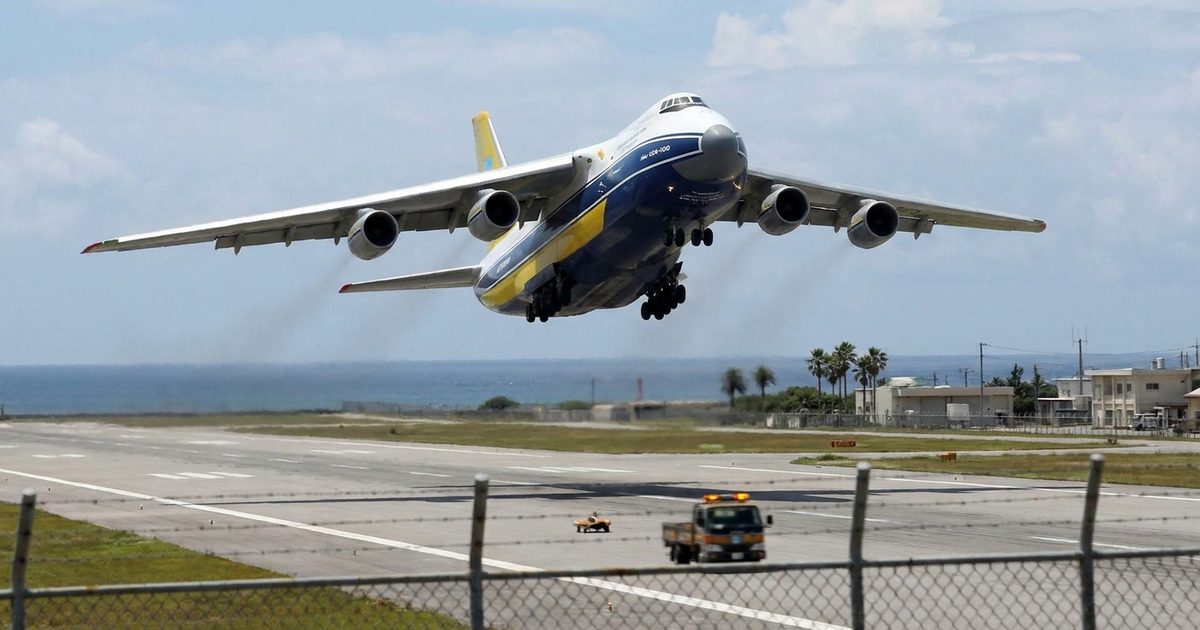
NAGOYA, Japan — An Antonov AN-124-100 freighter was climbing out from runway 36 on Nov. 10 when it dropped a part onto the Chubu Centrair runway it had just left, The Aviation Herald reported.
The jet kept going. Flight ADB-357F, registration UR-82007 and operated by the Antonov Design Bureau, continued toward Angeles, Philippines. On the ground, the airport had a part on its runway and a line of flights waiting behind it.
Anything left on a runway is foreign object debris, and the next aircraft rolling down that pavement at takeoff speed could strike it or pull it into an engine. No one was hurt by the falling part. The danger was to whoever came next.
How the Chubu Centrair runway closure unfolded
The part fell shortly after 4 p.m. as the cargo aircraft was taking off, according to Chubu Centrair International Airport, as reported by Tokai TV on FNN Prime Online. The runway was shut, and airport staff went out to recover the part.
“Nagoya’s runway was closed for about 50 minutes for inspection,” The Aviation Herald wrote. Once checks found no abnormality and safety was confirmed, runway operations resumed shortly before 5 p.m., Tokai TV reported.
NHK reported that operations had resumed but that the closure affected takeoffs and landings for some flights. Tokai TV said multiple flights were affected, and its News One program aired video of the freighter’s climb-out.
A safe landing in Angeles
The AN-124-100 never turned back. It continued to Angeles and landed safely on runway 02 about 4 hours 50 minutes after departure, according to The Aviation Herald.
That left the more pressing problem in Japan. A freighter that lands safely hours later is a good outcome for its crew. A part sitting unnoticed on a runway is a hazard for every aircraft that uses it next, and in this case it was found, recovered and the surface checked before flights resumed.
Investigators look for the cause
The Ministry of Land, Infrastructure, Transport and Tourism said a cargo aircraft part was believed to have fallen onto the runway, according to an earlier NHK report. The ministry and others carried out on-site checks before operations resumed.
The ministry and others are now investigating in detail the circumstances at the time and the cause of the drop, Tokai TV reported.
FODNews has reported on a runway FOD chain reaction at Taoyuan, where debris left behind by one departing aircraft became a threat to another jet. The Nagoya incident shows how quickly the same setup can take shape.
Why a dropped part becomes everyone’s problem
When a part comes off an aircraft on takeoff, it stops belonging to that aircraft. It becomes runway debris for every departure and arrival behind it, until someone finds it and confirms the surface is clean.
The next crew may not see a small object at speed. That leaves detection and a fast closure to the airport, and the roughly 50 minutes Chubu Centrair spent recovering the part and checking the runway is the delay that buys that safety.
The disruption to some flights was real. A tire or an engine meeting that part at takeoff speed would have cost far more.
Subscribe to FODNews for continuing coverage of FOD incidents and prevention worldwide.
Sources
- The Aviation Herald — “Incident: Antonov A124 at Nagoya on Nov 10th 2026, dropped part during departure” (Nov. 10, 2026)
- NHK News — “中部空港の滑走路50分閉鎖 一部の便の離着陸に影響” (Nov. 10, 2026)
- NHK News — “中部空港の滑走路再開” (Nov. 10, 2026)
- FNN Prime Online / Tokai TV — “複数の便の離着陸に影響…中部空港で離陸する貨物機から部品が落下 撤去のため滑走路を一時閉鎖も安全が確認され再開” (Nov. 10, 2026)