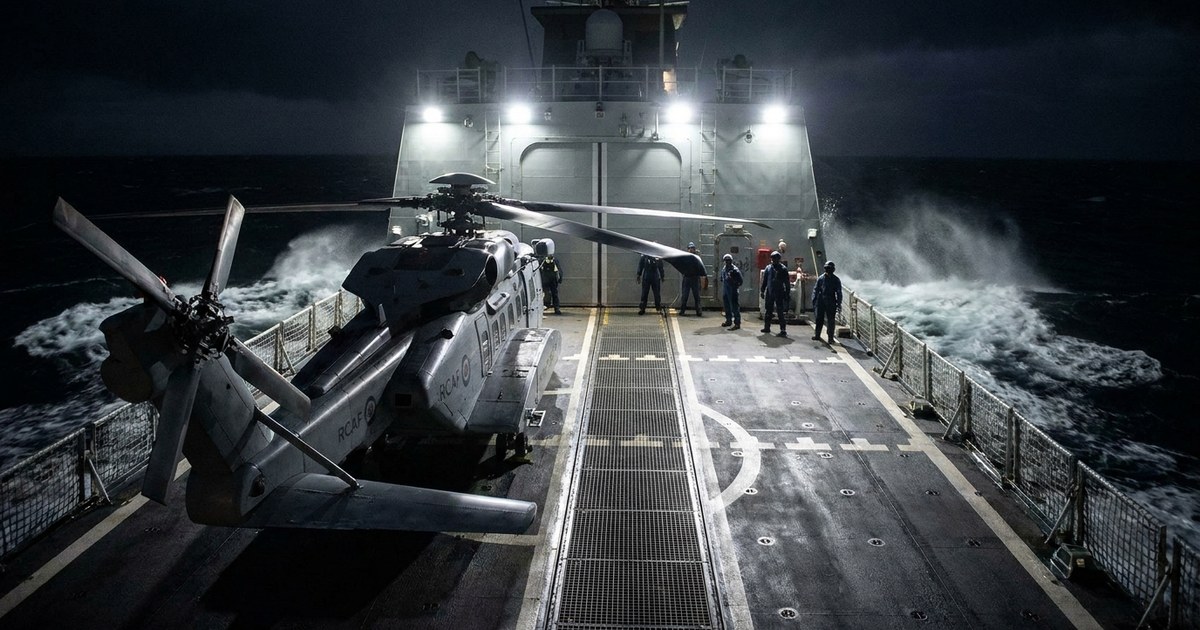
A Royal Canadian Air Force Cyclone helicopter suffered a rotor strike on its own tail as it landed at night on a Canadian warship in the Norwegian Sea, an initial safety report says. The four crew members weren’t hurt, but the helicopter was very seriously damaged.
The accident happened Oct. 6 on HMCS Ville de Québec, a frigate of the Royal Canadian Navy. The RCAF released the report last week.
It’s an early report, and it doesn’t name a cause. A final report will follow when the investigation ends.
What the report says about the Cyclone helicopter rotor strike
The helicopter, callsign AVALANCHE, was on a night flight from the ship. The flight had several phases. The accident came during the final landing sequence.
The report also looked at how the ship was moving. “At the time of landing, the ship’s flight deck motion was within established helicopter night landing limits,” it says.
The helicopter landed in the ship’s Beartrap and was secured to the deck. The Beartrap, formally the Helicopter Hauldown and Rapid Securing Device, is a deck system that secures a helicopter to the ship.
Then the main blades hit the helicopter’s tail. “During touchdown, two main rotor blades struck the tail boom, severing multiple components, including the section 5 tail rotor drive shaft,” the report says.
That shaft carries power to the tail rotor, the small rotor at the back. The crew made an emergency engine shutdown and got out. “There were no injuries to the crew members, however the helicopter sustained very serious damage,” the report says.
The ship and its NATO mission
Ville de Québec left its home port of Halifax in July, the National Post reported. On July 15, it deployed as flagship of Standing NATO Maritime Group One. The group sails in the North Atlantic, North and Baltic seas.
The ship is part of Operation REASSURANCE. It’s the Canadian Armed Forces’ largest overseas mission. It adds to NATO deterrence and defense in the Euro-Atlantic region.
More than 3,000 Canadian Armed Forces members deploy on the mission through the year. Global News, citing The Canadian Press, said the mission is meant to deter Russian aggression in eastern Europe.
A fleet under scrutiny, and what comes next
The Cyclone fleet has faced other recent trouble. Canada’s military briefly halted flights for its 26 CH-148 Cyclones after one lost power on takeoff Oct. 26, the National Post reported. That helicopter landed safely, and the fleet was grounded until Oct. 29.
The fleet’s worst accident came in 2020. On April 29 that year, a Cyclone with callsign Stalker 22 crashed in the Ionian Sea while flying from HMCS Fredericton. Six Canadian Armed Forces members were killed.
An investigation later tied that crash to how the flight-control system responded in a specific low-level turn. The new report makes no link between that crash and this landing.
For now, investigators are still at work. “While no technical issues have been identified to date, the investigation remains ongoing and continues to focus on materiel & systems, environmental and human factors,” the report says.
When main blades hit a tail boom, broken parts can end up as loose debris on a small flight deck. The report doesn’t say whether any debris was found.
Other rotorcraft have faced sudden hazards as well, including an RAF Chinook forced into a field landing after a bird strike near Chippenham.
Subscribe to FODNews for continuing coverage of FOD incidents and prevention worldwide.
Sources
- Royal Canadian Air Force — “CH148813 Cyclone – From the Investigator” (Oct. 2026)
- Global News / The Canadian Press — “No one injured after military chopper damaged in landing on Canadian ship” (Nov. 3, 2026)
- National Post — “Military chopper chops itself, taking serious damage, during night landing on Canadian warship” (Nov. 2, 2026)
- Department of National Defence — “Flight Safety Investigation Report for Stalker 22 Accident” (June 28, 2021)