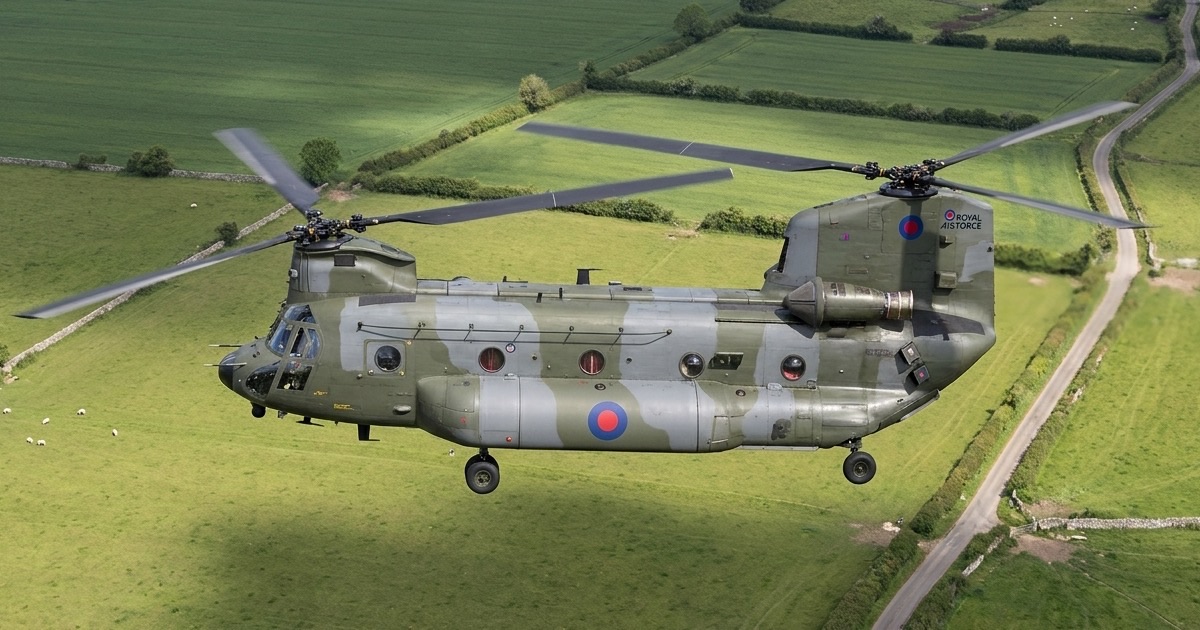
An RAF Chinook bird strike forced an unscheduled landing in a field near Chippenham, Wiltshire, on Thursday afternoon. The crew had struck a bird during a routine training flight, the Royal Air Force confirmed.
The CH-47 Chinook had departed RAF Odiham in Hampshire. The crew reported the strike and brought the twin-rotor helicopter down in an open field off the A4 in Pewsham, on the edge of Chippenham, at around 10:10 a.m. Moments later, it touched down roughly 30 meters from the busy road. Drivers slowed or pulled over to look.
“A Chinook helicopter from RAF Odiham suffered a birdstrike during a routine training flight,” an RAF spokesperson said. “As a precautionary measure the aircraft landed. The crew are uninjured. An engineering team were dispatched from RAF Odiham to assess the damage to the aircraft. We would like to thank the landowners for their patience and assistance whilst we look to rectify the aircraft.”
No injuries were reported among the crew. Meanwhile, the helicopter remained grounded in the field into the afternoon. Engineers traveled from Odiham to inspect the damage. They needed to determine whether it could fly out under its own power, or whether it would need to be partially disassembled and trucked back to base.
RAF Chinook Bird Strike: A Precaution, Not a Crash
The RAF was careful to frame the landing as precautionary, not an emergency in the strict sense. Standard procedure after any bird strike is to get the aircraft on the ground and inspected before continuing flight. Indeed, even a strike that feels minor in the cockpit can hide compressor or rotor-blade damage. That damage often only shows up under load. The Chinook’s twin turboshaft engines and exposed rotor system make it especially vulnerable to birds ingested at low altitude. That is the regime most training flights operate in.
Bird strikes are one of the most common foreign-object hazards in military and civil aviation alike. Heavy-lift helicopters like the Chinook fly low-level routes. As a result, that puts them in the path of birds far more often than fixed-wing traffic cruising at altitude. The UK’s Military Aviation Authority requires crews to report any suspected bird strike. Regulators then ground the airframe pending an engineering check, regardless of how the aircraft is handling.
The incident is the second UK military bird strike to force a precautionary landing in as many days. A French Navy Rafale diverted into Exeter Airport a day earlier following a strike on approach. Notably, bird strikes involving helicopters can carry outsized risk compared with fixed-wing aircraft. A 2026 NTSB investigation into a fatal Hudson River helicopter crash confirmed Canada geese as the cause. It’s a reminder of how quickly a single strike can escalate in a rotorcraft.
The RAF has not said how long the Chinook will remain in the field, or whether it required a full recovery operation. Meanwhile, training flights from RAF Odiham continue routinely across the southern England countryside. The base is home to the UK’s Chinook and Puma helicopter fleets.