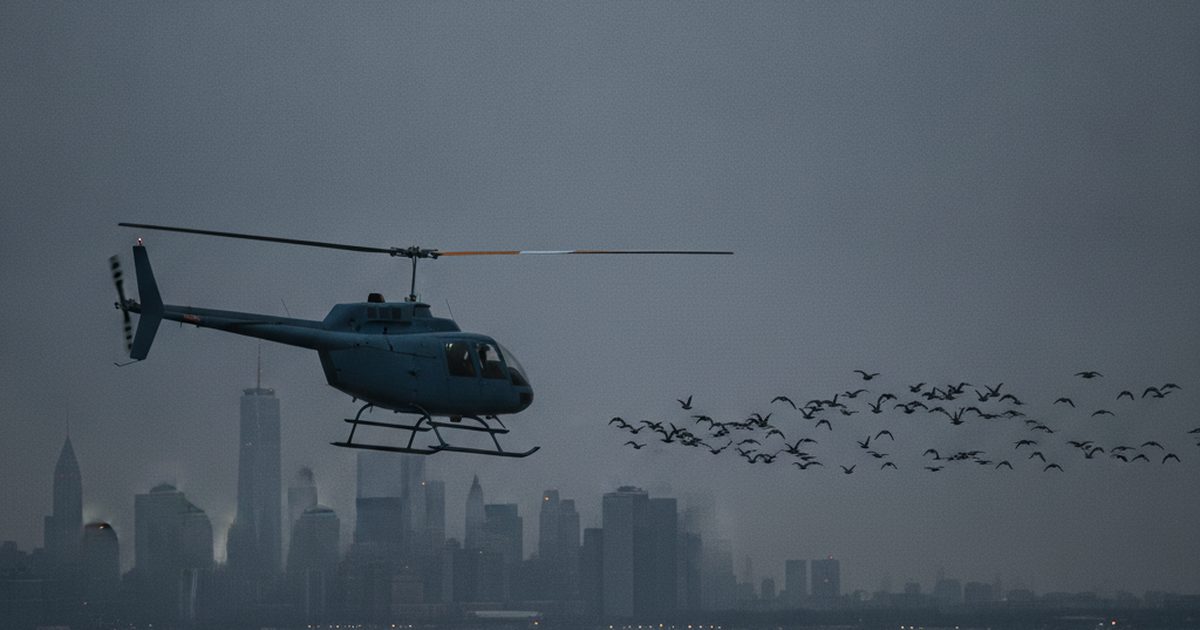
NEW YORK — A flock of Canada geese most likely caused the catastrophic in-flight breakup of a sightseeing helicopter over the Hudson River last year, the National Transportation Safety Board said July 16, 2026, releasing new investigative materials that point to a helicopter bird strike as the probable trigger of the crash that killed all six people on board.
The Bell 206L-4 helicopter, registration N216MH, operated by New York Helicopters, broke apart in flight on April 10, 2025, near Jersey City, New Jersey, and plunged into the river at approximately 3:15 p.m. EDT. The aircraft had departed Downtown Manhattan/Wall Street Heliport minutes earlier on an air tour flight.
NTSB Validates Bird Strike Evidence
Investigators said bird remains were recovered from the wreckage and surrounding area, including material embedded in the main rotor blades and the left horizontal stabilizer. The Smithsonian Institution’s Feather Identification Lab analyzed the samples and identified remains from multiple goose species, including female Canada geese.
Physical evidence extended well beyond the main wreckage site. A severed bird wing and a fragment of a main rotor blade were found on the ground and on building rooftops approximately 2,000 feet from where the fuselage was recovered — consistent with an in-flight rotor strike that caused catastrophic structural failure before impact.
The NTSB noted the July 2026 release is an investigative update, not a final probable-cause determination. The agency has not yet issued formal safety recommendations specific to this accident.
Six Killed, Including Spanish Family of Five
All six occupants — the pilot and five passengers — were fatally injured. The passengers were a family of five Spanish tourists. The flight was the eighth air tour operation the helicopter had flown that day.
At the moment of failure, the aircraft was in cruise at 110 mph at an altitude of 625 to 650 feet, climbing briefly to 675 feet before entering a sudden rapid descent. Surveillance video and ADS-B data showed the helicopter’s tail boom failing simultaneously with a severe yaw of the fuselage. The aircraft separated into three main sections — the fuselage, the main rotor and transmission assembly, and the tail boom — and struck the water in seven seconds, dropping more than 550 feet.
The Bell 206L-4 carried no flight data recorder or cockpit voice recorder.
Witness Accounts Describe Geese Flock Before the Bang
Multiple witnesses on the ground reported hearing loud bangs and pops in the seconds before the helicopter came apart. One witness described seeing a flock of approximately 20 geese take flight from the river and fly toward the helicopter’s path shortly before the sound of impact.
Canada geese are among the heaviest birds routinely encountered by low-altitude aviation in the northeastern United States, with adult birds typically weighing six to eight pounds. At cruise speed, a strike from even a single bird of that size can generate forces far exceeding the structural limits of rotor blades and tail components.
FODNews previously reported on a similar hazard when Canada geese were identified in a bird strike involving an Alaska Air Cargo A330 at Cincinnati, underscoring the species’ persistent presence across U.S. airspace.
Urban Wildlife Corridors Pose Elevated Risk for Low-Altitude Tours
The Hudson River corridor is a well-documented migratory and residential habitat for Canada geese, whose populations have grown substantially in the New York metro area. Helicopter tour routes that follow the river at low altitudes routinely share airspace with geese using the water’s surface for takeoff and landing.
Low-altitude helicopter operations over urban wildlife corridors have long been flagged as a gap in bird-strike risk management. Unlike commercial airports with active wildlife control programs, heliports and tour routes crossing urban waterways have fewer standardized mitigation tools. The FAA’s wildlife strike mitigation guidance provides a framework, but its application to sightseeing routes remains inconsistent.
The NTSB is expected to address airworthiness guidance for low-altitude urban tour operations in its final probable-cause report, though no timeline has been announced.
Investigation Ongoing; Final Report Pending
The crash is logged under NTSB accident number ERA25MA171. Investigators have examined operator records, maintenance history, and exemplar Bell 206L-4 aircraft for comparison. The investigation remains active; the July 2026 materials are the most detailed public accounting to date.
New York Helicopters has not issued a public statement since the initial days following the crash.
Subscribe to FODNews for continuing coverage of aviation safety and FOD incident reporting worldwide.
Sources
- NTSB Investigation Page: ERA25MA171 — Bell 206L-4 Hudson River Accident
- CNN: Tourist helicopter hit flock of birds before crashing into the Hudson River, NTSB says (July 16, 2026)
- Boston Globe: NYC helicopter that crashed and killed 6 last year shows signs of bird strike, safety board says (July 16, 2026)
- Reuters: NTSB finds evidence of bird strike before fatal New York helicopter crash (July 16, 2026)