
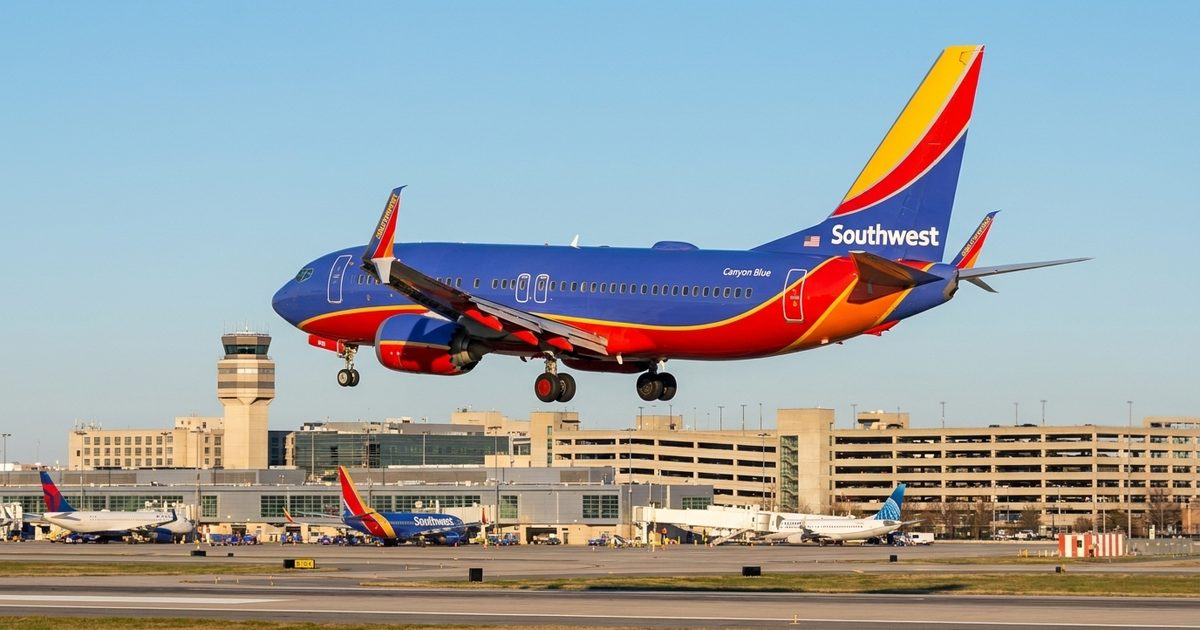
A Southwest Airlines Boeing 737 MAX 8 bound for Houston diverted to Baltimore on Tuesday after a Southwest bird strike occurred moments after takeoff from Ronald Reagan Washington National Airport (DCA). The airline and the Federal Aviation Administration confirmed the jet diverted to BWI following the strike.
Flight 1379 landed without incident at Baltimore/Washington International Thurgood Marshall Airport (BWI) roughly 90 minutes after departing DCA. No injuries were reported, and neither Southwest nor the FAA has disclosed any damage to the aircraft.
How the Southwest Bird Strike Unfolded
According to flight-tracking data reviewed by local outlets, the jet departed DCA at approximately 1:54 p.m. Eastern time. The crew reported striking a bird during the climbout. The flight then circled over Southern Maryland before turning toward BWI rather than Houston’s William P. Hobby Airport (HOU).
The aircraft touched down safely at BWI around 3:15 p.m. Southwest said in a statement that “the pilots followed procedures and the flight landed uneventfully.”
A BWI spokesperson, Jonathan Dean, said the plane landed without incident. The diversion did not disrupt other airport operations that evening, though the arrival briefly triggered a ground stop.
Passengers Rebooked, FAA Opens Inquiry
Southwest moved the diverted flight’s passengers to a different aircraft at BWI. That replacement flight departed for Houston at 5:05 p.m., roughly three hours behind the original schedule.
“Nothing is more important to Southwest than the safety of its customers and employees,” the airline said.
The FAA confirmed it is investigating what caused the collision. Such inquiries are standard procedure after any reported wildlife strike involving a commercial aircraft, whether or not damage is found.
A Recurring Hazard for Airline Fleets
Bird strikes are common in U.S. aviation and rarely cause serious harm. However, they remain one of the most persistent foreign object hazards airlines face on departure and approach. An FAA wildlife strike report published in August covered incidents from 1990 to 2025. It found that wildlife strikes killed 89 people and destroyed 128 civil and military aircraft nationwide.
Southwest’s own fleet has logged prior bird-related engine damage. In a 2023 incident, a 737-8 departing New Orleans ingested a bird into its left engine. Smoke entered the cockpit, and the crew made an uneventful return landing. Tuesday’s DCA incident produced no comparable indication of engine or airframe damage.
The diversion adds to a busy year of bird-strike-related diversions across the industry. In April, a Jet2 737-800 diverted to Manchester after striking birds departing Leeds Bradford. In August, an Air India flight was involved in the second of two bird strikes at Patna Airport within a week. Both cases, like Tuesday’s Southwest diversion, ended with safe landings and no injuries.
Reagan National sits along the Potomac River near tidal wetlands that attract waterfowl. That geography has made bird activity a recurring operational consideration for airlines using the airport. Neither Southwest nor DCA has announced any change to wildlife-mitigation procedures following Tuesday’s strike.
Sources
- WTOP News — “Houston-bound Southwest flight from Reagan National lands at BWI after bird strike”
- CBS News Baltimore — “Southwest flight diverts to BWI after striking bird while departing DCA”
- The Baltimore Banner — “Southwest flight from DC to Houston makes emergency landing at BWI”
- WBAL-TV — “Southwest flight diverted to BWI after bird strike”
Subscribe to FODNews for daily coverage of bird strikes and other FOD incidents worldwide.


