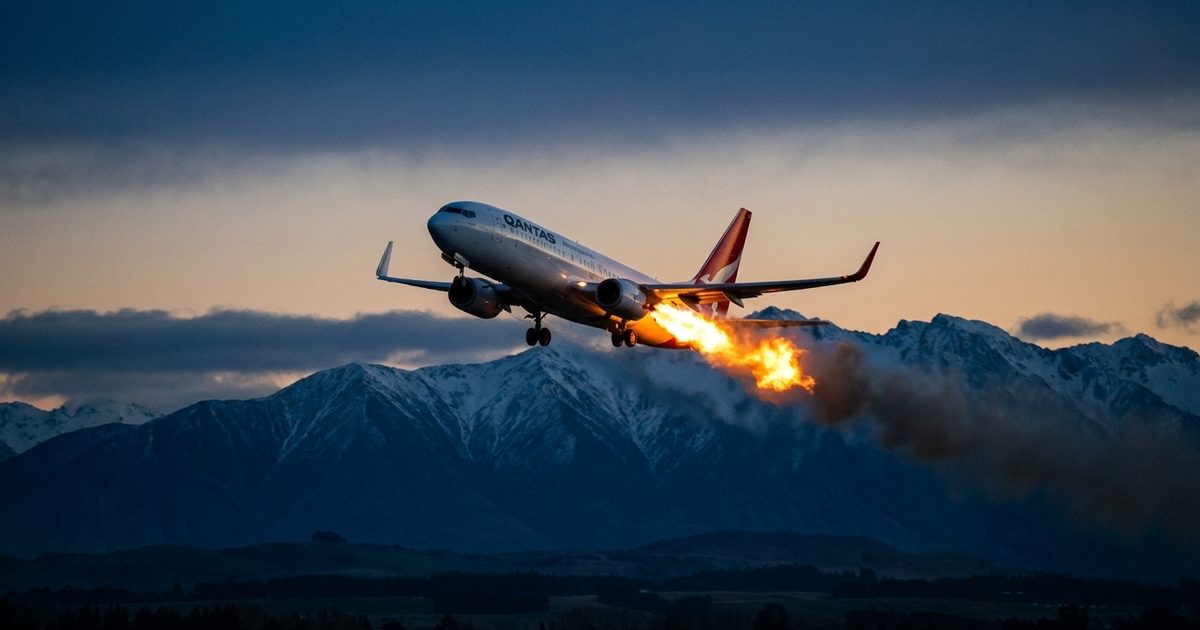
A suspected Qantas bird strike sent flames and loud bangs shooting from a Boeing 737’s left engine shortly after departure from Queenstown, New Zealand. The aircraft diverted to Christchurch on Saturday, Sept. 5.
Flight QF122 was climbing out over the South Island’s mountain ranges, bound for Sydney, when a bang shook the cabin. Passengers seated near the left wing watched flames burst from the engine in a series of rapid flashes. The moment was captured in footage shared with the Guardian. Cabin lights flickered as several passengers screamed.
FlightAware data showed the jet landed in Christchurch about 52 minutes after takeoff. Qantas said both engines kept running and that the landing was not an emergency. Fire crews met the plane on the tarmac as a precaution.
The airline grounded the aircraft in Christchurch and sent engineers to inspect it. As of Sept. 7, the cause had not been confirmed. Aviation experts pointed to a probable engine “surge and stall” — and a bird strike is among the leading suspects.
What Is a Compressor Surge and Stall?
A jet engine pulls in a steady stream of air, compresses it, and mixes it with fuel to generate thrust. When that airflow is disrupted, the compressor blades can no longer move air smoothly. Pressure backs up and reverses direction inside the engine — that’s a surge and stall. In plain terms, air that should flow forward suddenly reverses. That reversal is what can push flame and noise back out through the engine.
Former Qantas captain David Evans described what he saw. He told the Sydney Morning Herald that the flames and popping sounds “indicate disrupted airflow through the jet engine.” Fuel trapped in the turbine can ignite. Pressure then forces air back out the front of the engine instead of through it — producing the flashes passengers filmed.
Aviation consultant Keith Tonkin offered a simpler comparison: “It’s kind of like when a car backfires.”
Why a Qantas Bird Strike Is the Leading Theory
Evans said a surge and stall can be triggered by several things. But “bird strike of the turbine” tops his list of likely causes. A bird ingested into the intake disrupts the smooth column of air the compressor depends on. Even a single bird can trigger the stall.
Other theories remain on the table. Tonkin said the cause could also be “mechanical damage/failure of a part of the engine or nacelle.” A former pilot cited by the Herald raised other possibilities: a worn compressor, a fuel control fault, a failed blade, or ingested runway debris. Aviation consultant Neil Hansford told the ABC a detached engine blade striking a fuel line was also plausible.
No investigative body has confirmed a cause, and Qantas says the review continues. But wildlife ingestion is the theory investigators keep returning to first. Bird encounters are common during low-altitude climb-out — the exact phase QF122 was in when the bang occurred.
Queenstown’s History With Bird Strikes
Queenstown Airport sits in a mountain valley beside wetlands and open pasture that attract wildlife. The airport has said publicly that bird strikes are “a known risk to aviation” there. New Zealand’s Civil Aviation Authority rates the airport’s bird-incident rate as low, but not zero. Its wildlife team runs daily inspections. It uses mowing, gas cannons and pyrotechnics to keep oyster catchers, plovers and starlings off the runway.
The airport isn’t a stranger to this scenario. A Virgin Australia 737 departing Queenstown for Melbourne previously diverted to Invercargill after flames appeared from an engine. The airport attributed the diversion to a likely bird strike, according to Radio New Zealand. That incident, like QF122, shows how a single bird ingested during climb-out can produce the same flames and bangs.
The pattern isn’t unique to New Zealand. A Jet2 737-800 out of Leeds Bradford made a similar diversion after a suspected bird strike this year. The pattern underscores that wildlife ingestion on climb-out is a recurring, global hazard.
What Happens Next
The Qantas 737 remains grounded in Christchurch while engineers complete a full inspection. Qantas has not said when it will return to service or confirmed a cause. Australian and International Pilots Association president Andrew Marshall praised the crew. He said they “demonstrated exceptional professionalism, composure and skill in ensuring everyone landed safely.”
Until Qantas or the Civil Aviation Authority release findings, the bird-strike theory remains leading but unconfirmed. It’s one more reminder: a single animal on a runway or in the flight path can ground an aircraft.
Subscribe to FODNews for continuing coverage of aviation FOD and wildlife-hazard incidents.
Sources
- The Guardian: “‘The engine’s on fire’: Qantas flight from Queenstown to Sydney reroutes after flames seen by passengers”
- Sydney Morning Herald: “‘Surge and stall’: What pilots think caused Qantas jet to shoot out flames”
- ABC News: “Qantas passengers on Sydney-bound flight recount panic after seeing flames spit from engine”
- RNZ: “Queenstown plane emergency: Tears, vomit and panic”