Thermal relief plugs melted inside the left main landing gear wheels of an American Airlines Boeing 737-8. The failure let tire pressure escape and triggered a high-speed rejected takeoff at Denver International Airport. The National Transportation Safety Board detailed the sequence in a final report released Aug. 26.
The report closes the investigation into Flight 3023. The flight was accelerating down Runway 34L for a Miami departure on July 26, 2025. The left main landing gear tires and wheels failed on the roll.
A Long Wait Before a Short Roll
Flight 3023’s trouble started before the airplane ever reached a runway. Denver’s tower initially favored Runway 08. The crew taxied there and was cleared to enter. Controllers then reported a tailwind component they couldn’t accept, and the crew backed out, according to the NTSB.
The airport was mid-transition between runway configurations amid shifting winds. Those winds included windshear reports and had already forced another airplane to go around. The crew then taxied to Runway 17L, where the same tailwind problem turned up again. Performance data for a third option, Runway 35R, wasn’t available. As a result, the crew coordinated with air traffic control and settled on 34L instead.
The crew had started both engines early “in anticipation of a short taxi and prompt departure,” the NTSB wrote. Instead, the 737-8 sat holding at Runway 34L for about 25 minutes in 35-degree Celsius (95-degree Fahrenheit) heat. The crew watched a dust devil kick up west of the airport. They also told American Airlines dispatch they were nearing duty-time and minimum-fuel limits.
What Thermal Relief Plugs Actually Do
Each of the 737’s main landing gear wheels carries four thermal relief plugs. These are small fittings built with a center section designed to melt at high temperatures. Their job is to vent tire pressure before heat buildup can rupture the tire or wheel outright. The NTSB report frames that as the core safety function of thermal relief plugs.
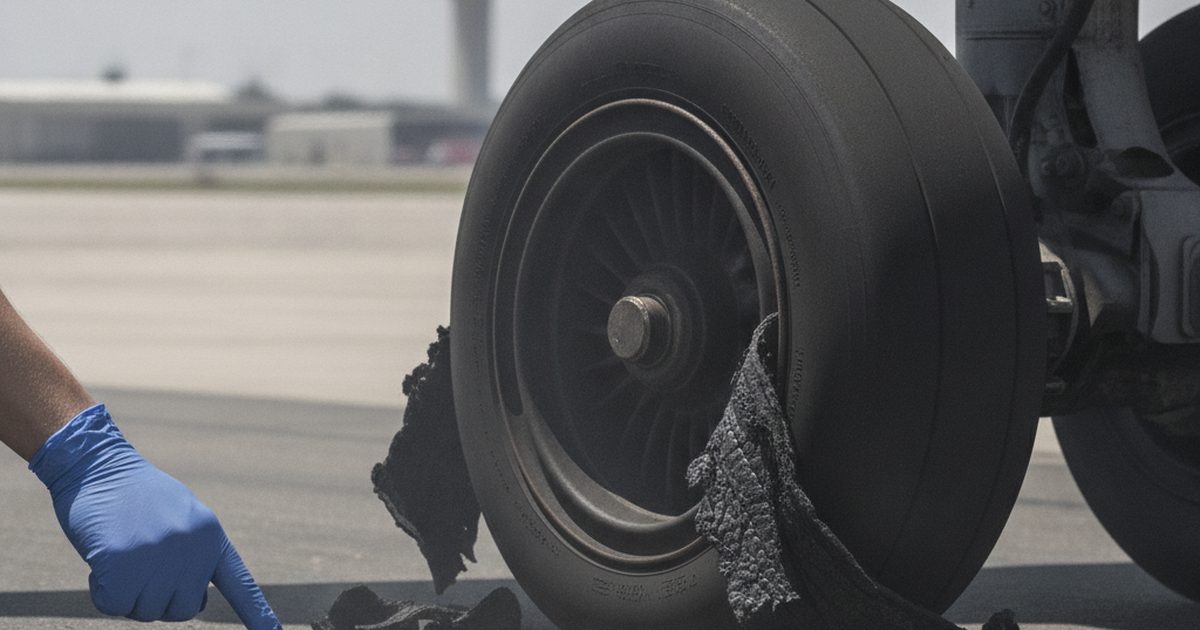
That’s exactly what happened, just not where it was supposed to. Investigators found no remaining plug material in three of four plugs checked on one wheel. Two of four plugs checked on the other wheel showed the same result. A thermal relief plug recovered from the runway confirmed it: the meltable center was gone.
The report doesn’t cite a specific trigger temperature or brake-temperature data. Still, the sequence it lays out points squarely at conditions thermal relief plugs exist to guard against. The airplane made an unusually long ground taxi. It then held for 25 minutes with both engines running in high ambient heat. It was also a heavy airplane sitting at Denver’s roughly 5,327-foot runway elevation.
The Takeoff Roll and Rejected Departure
The crew got the standard 80-knot callout without incident. Between 90 and 100 knots indicated airspeed, the captain heard a loud pop and felt a bump. The airplane immediately tilted left. The first officer called for an abort, and the captain took control. The crew rejected the takeoff above 80 knots, using differential braking and rudder to hold the centerline. Reversers stayed stowed because the crew worried deploying them would worsen the airplane’s controllability, the NTSB said.
Tower controllers spotted smoke and fire beneath the left wing. About 30 to 45 seconds after telling passengers to stay seated, the crew ordered an evacuation. All 175 people aboard got out with no injuries. The NTSB did note a complication, though. Some passengers grabbed carry-on bags on the way out, slowing the exit despite repeated commands to leave belongings behind.
Wheel Debris Dented the Wing
As the tires disintegrated, the wheels themselves absorbed the abuse. One wheel rolled on its bare rims before seizing; the other fractured into pieces. Once the wheels wore away, the landing gear strut dragged along the runway. So did the left engine’s thrust reverser and fan cowl doors.
Fractured wheel debris also struck the airplane’s own wing. The impact left two dents and seven gouges in the left wing’s lower skin. The largest dent measured about 3 inches across and a quarter-inch deep, with a crack on the inner surface. Several gouges exceeded structural repair-manual limits. That skin panel runs from wing root to tip as a single piece. As a result, American Airlines had to replace the entire section. The NTSB classified the damage as substantial.
It’s a tidy illustration of how one mechanical failure creates a debris hazard twice over. The fractured wheel pieces landed on the runway itself. Then that same debris struck the airplane, doing damage a second time. Denver has seen the runway side of that equation before. A WestJet 737 shed both left-main tires on takeoff there in June, closing the runway for a debris sweep. It’s also the same basic failure mode behind a tire-failure cluster investigators are still untangling at Chicago O’Hare.
Subscribe to FODNews for daily coverage of FOD incidents and prevention worldwide.