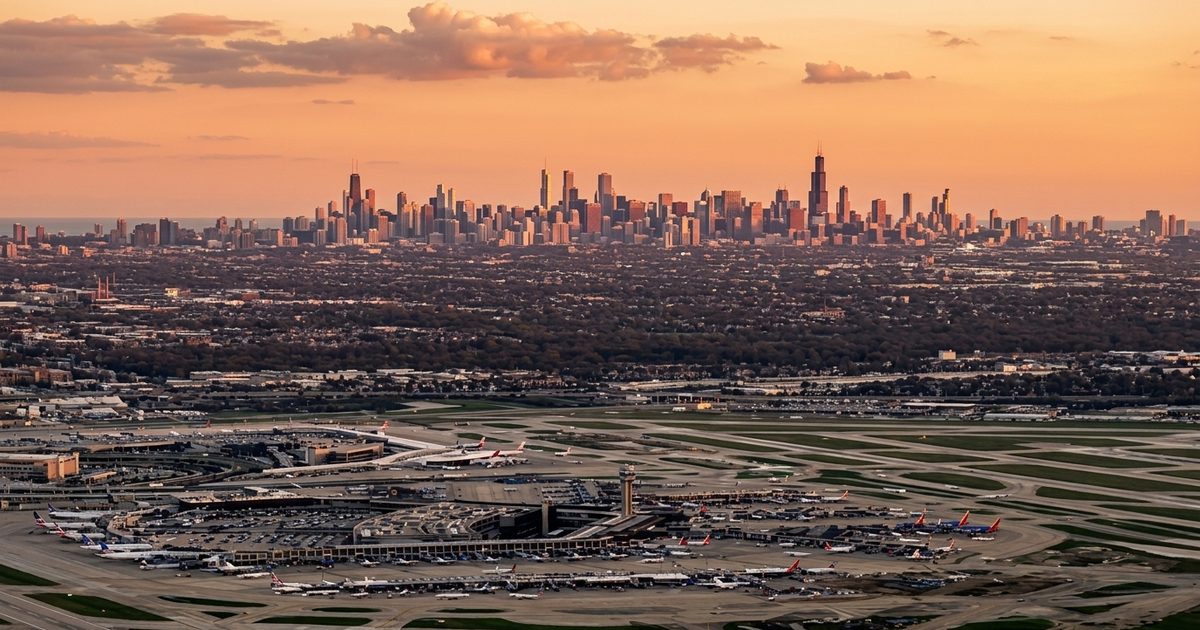
CHICAGO — An American Airlines Boeing 737 blew two tires while taxiing for departure at O’Hare International Airport on August 26. It was the fifth in a cluster of O’Hare tire failures in two weeks. The incident prompted the Federal Aviation Administration to widen its investigation into whether the events share a common cause.
Flight 3280, bound for Charlotte, was taxiing after pushing back from the gate when both tires on its right main landing gear blew, according to American Airlines. Air traffic control audio captured the crew of a following aircraft spotting the debris first. “I see two right tires your main, you guys going to deplane out, is that correct?” a controller asked. The pilot confirmed. Passengers deplaned via airstairs and were bused to the terminal. No injuries were reported. American arranged a replacement aircraft. The flight arrived in Charlotte roughly four hours late.
A Fifth Incident in a Growing List of O’Hare Tire Failures
The August 26 blowout extends a cluster FODNews has been tracking since mid-August. A United Airlines 737-900 aborted takeoff after a tire blew on August 13. Then American Flight 386 and United Flight 739 suffered separate tire failures hours apart on August 17. A fourth event followed on August 21, when another American 737 burst a tire while taxiing in from Phoenix.
The Chicago Department of Aviation says each incident occurred on a different part of the airfield. Each happened across separate runways and taxiways. So far, it has found no confirmed link between them. Debris sweeps conducted after the August 17 failures turned up nothing. Both American and United have since increased landing-gear inspections across their O’Hare-based fleets.
What Investigators Are Looking At
The FAA confirmed it will investigate the August 26 event, adding to open reviews of the prior incidents. Investigators are examining runway and taxiway surface conditions, foreign-object debris, and tire maintenance and inflation records. They are also looking at hot-brake stress from repeated cycles. These are the standard suspects in unexplained tire failures at a high-traffic hub. O’Hare’s volume is so high that its runways accumulate rubber buildup faster than most airports. Debris shed by one aircraft’s tires can also become a hazard for the next arrival or departure.
The cluster comes during a period of tighter operating constraints at O’Hare. An FAA-imposed summer flight cap tied to ongoing construction limits the airport to 2,708 daily operations through October 24. Officials say the cap is unrelated to the tire failures. Still, it has intensified scrutiny of any operational irregularity at the airport this season.
No cause has been confirmed for any of the five events. Aviation experts note that tire failures remain rare relative to the thousands of daily operations at O’Hare. Still, five incidents in two weeks is enough to treat them as a pattern until investigators can rule one out.
Subscribe to FODNews for daily coverage of FOD incidents and prevention worldwide.
Sources
- CNN. “American Airlines plane blows 2 tires at Chicago O’Hare airport before takeoff, FAA says” (Aug 26, 2026).
- Fox Business. “American Airlines flight suffers tire blowouts at O’Hare, marking 5th tire report” (Aug 27, 2026).
- Simple Flying. “5 Tire Incidents In 2 Weeks At Chicago O’Hare As American Airlines 737 Suffers Double Blowout.”
- FODNews. “Second O’Hare Tire Failure in Five Days” (Aug 24, 2026).