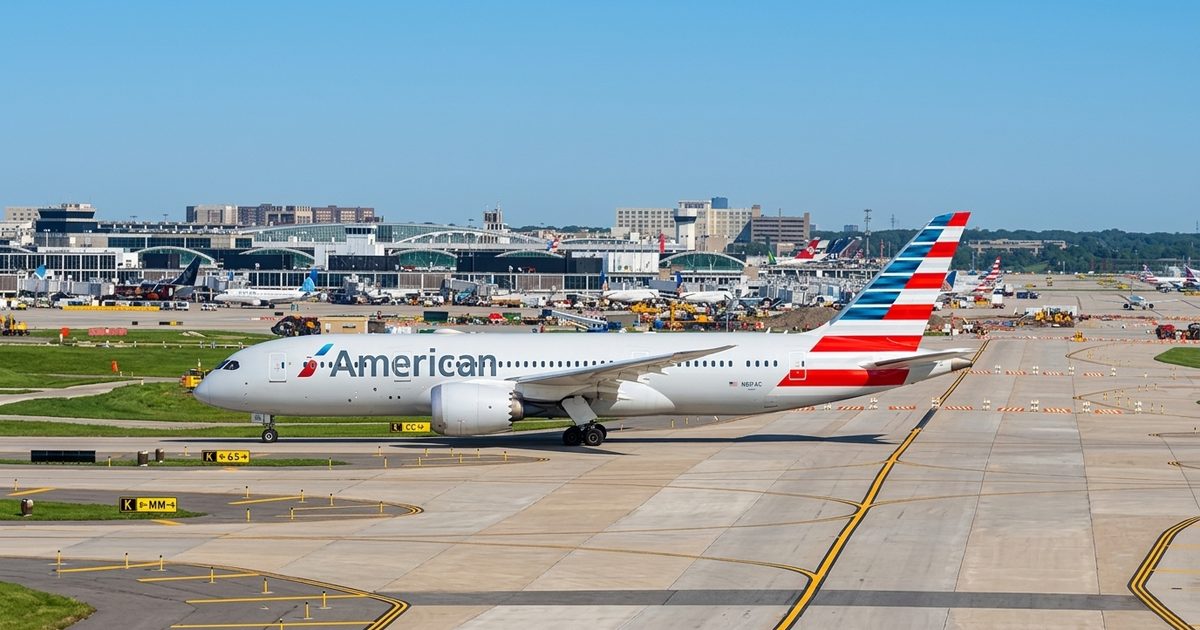
CHICAGO — American Airlines Flight 386 landed safely at Chicago O’Hare International Airport on Monday, Aug. 17, with two blown tires. The landing triggered a temporary runway closure. It also marked the second O’Hare tire failure in a matter of hours that day — and the third across a five-day span in mid-August.
The Boeing 737-800 was arriving from LaGuardia Airport with roughly 180 passengers aboard. It blew the tires on or shortly after touchdown around 2 p.m. local time on Aug. 17. There were no injuries. Fire trucks and police units met the aircraft on the taxiway per standard procedure. Passengers deplaned using airstairs and were bused to the terminal, according to the Federal Aviation Administration and American Airlines.
Air traffic control audio captured the moment controllers realized what had happened. “American 386, you require any assistance? I heard you just blew a tire,” a controller asked. “No injuries and no one’s panicking,” the pilot replied. “Everyone remains seated.”
American said the aircraft was pulled from service for inspection. “We apologize to our customers for their experience,” the airline said in a statement. The FAA confirmed it is investigating.
A Second O’Hare Tire Failure Hours Later
About three hours after Flight 386 landed, a second aircraft suffered a nearly identical failure at the same airport that afternoon. United Airlines Flight 739, an Airbus A320 arriving from Omaha, was exiting the runway after landing around 5:30 p.m. when it blew its main left tire.
“After arriving at Chicago O’Hare, United Flight 739 sustained tire damage,” a United spokesperson said. “Customers deplaned via airstairs and buses took them back to the terminal.” No injuries were reported. The FAA is investigating that incident as well.
Officials say there is no indication the two Aug. 17 tire failures are connected. The two aircraft blew tires in different parts of the airport. They were different aircraft types, arriving from different cities.
Third O’Hare Tire Failure in Five Days
The Aug. 17 pair of incidents followed a separate tire failure four days earlier. On Thursday, Aug. 13, a United Airlines Boeing 737 bound for Phoenix blew two tires on its right main landing gear. The crew aborted its takeoff at O’Hare, a story FODNews reported at the time. That crew rejected the takeoff roll after tire fragments scattered across the runway. A nearby pilot described seeing “lots of chunks of tire going down the runway.”
Taken together, the three events mean O’Hare recorded tire failures on three separate flights within a five-day span in mid-August. Two aircraft landed with blown tires and one aborted a takeoff. All three forced runway closures or diversions while crews cleared debris, and all three remain under FAA investigation.
The FOD Angle: Rubber on the Runway
Every one of these failures left the same operational hazard behind: shredded rubber and, in some cases, wire and metal fragments scattered across an active runway. Loose tire debris is a textbook foreign object debris risk. An engine can ingest it, or a later arrival or departure can strike it, if it isn’t swept up first.
That is why O’Hare’s runway closed temporarily after the American 386 landing. A few inbound flights had to go around while ground crews inspected and cleared the pavement.
Coincidence or Pattern? An Open Question
Three tire failures at one of the country’s busiest airports within a single five-day stretch is unusual. Is it a coincidence, or does it point to something shared — runway surface conditions, tire wear, or debris already on the airfield?
Neither the FAA nor the airlines involved have offered an answer. Investigators have not said which specific tires failed or how far either aircraft rolled after the blowouts. It also remains unclear whether existing runway debris caused the American 386 failure or resulted from it. American, United and the FAA all confirmed only that reviews are underway.
For now, the three incidents sit alongside each other as an open question rather than a confirmed pattern. The FAA has not linked any of the events, and officials specifically ruled out a connection between the two Monday blowouts. Whether the Thursday abort shares a cause with either Monday incident is, at this point, unknown.
Subscribe to FODNews for continuing coverage as the FAA’s investigations into all three O’Hare tire failures develop.
Sources
- ABC News — “American Airlines flight blows 2 tires upon landing at Chicago O’Hare: FAA”
- ABC7 New York — “American Airlines plane from LaGuardia blows tires landing at Chicago’s O’Hare Airport: FAA”
- New York Post — “Two Chicago-bound planes suffer tire blowouts three hours apart after landing at O’Hare airport”
- WGN — “American Airlines flight blows 2 tires during landing at O’Hare”
- FODNews — “United 737-900 Blows Two Tires, Aborts Takeoff at Chicago O’Hare”