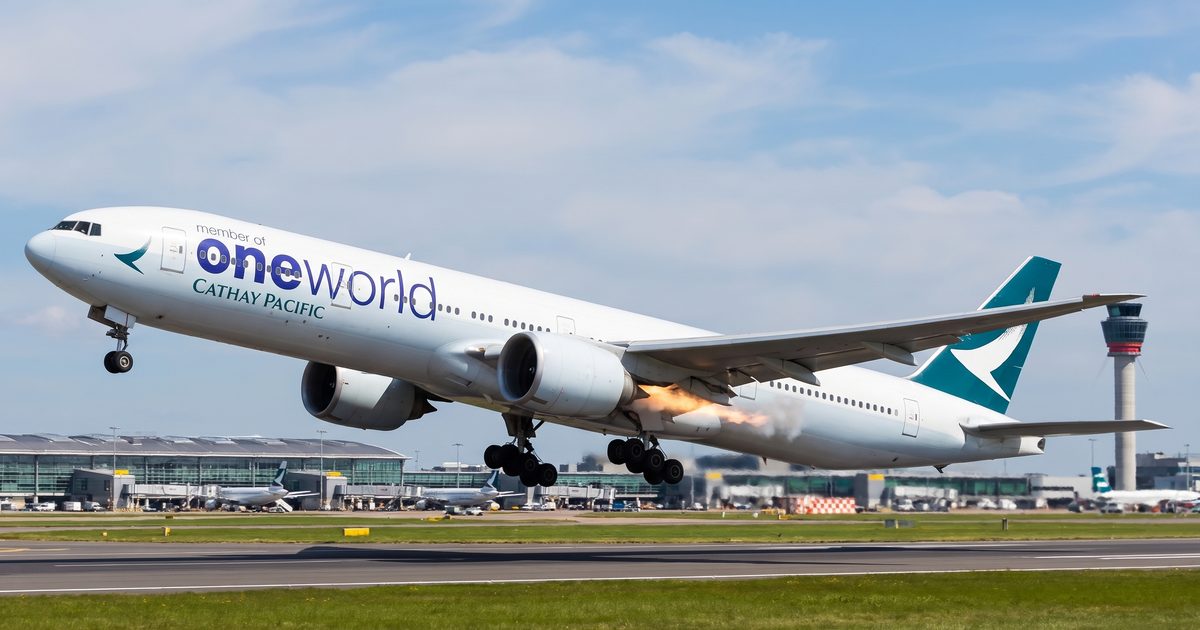
LONDON — The nose of the big jet was just lifting off runway 09R at Heathrow Airport on Tuesday, Nov. 10, when a loud bang rang out and a large streak of flame shot from the right-hand engine. The Cathay bird strike came at rotation, one of the most demanding moments of any flight, with Hong Kong still a long way off.
The nose came briefly back down, a passenger reported, according to The Aviation Herald. Then the aircraft rotated a second time and climbed away. The captain later told the cabin they had hit a bird.
Flight CX252 did not turn around at once. It flew on, all the way to Germany, before vibration in that engine brought it home.
A bang, a flame and a second rotation
The aircraft was a Cathay Pacific Boeing 777-300, registration B-KPD, bound from London to Hong Kong. The bird went into its right-hand GE90 engine as the jet left the runway, The Aviation Herald reported.
The flight was already running a little late. It was due to leave at 11 a.m. and took off at 11:25 a.m., according to a Southern Metropolis Daily report carried by Sina Hong Kong. Passengers expected to land in Hong Kong at 7:30 a.m. the next day.
Instead, seconds into the trip, a large streak of flame came from the right-hand engine. For a moment the jet settled. Then it lifted again and kept climbing.
Why the crew kept going, then turned back
The engine kept running. Messages sent from the aircraft suggested it was showing higher than normal vibration and a higher than normal exhaust gas temperature, yet both were still normal, The Aviation Herald reported.
So the crew pressed on and climbed to 31,000 feet. The captain intended to continue and make a final call when the jet was about to enter Turkey, unless the airline’s operations team advised otherwise.
That decision point never came. Near Nuremberg, Germany, with Czech airspace just ahead, the crew chose to return to London because of the vibrations in the right-hand engine.
The 777 held 31,000 feet on the way back. It landed safely on Heathrow’s runway 09L about three hours after it had left, and the flight was cancelled. The cabin account, the engine data and the details of the turn come from The Aviation Herald alone.
What the airline said after the Cathay bird strike
Cathay Pacific confirmed the outline three days later. On Nov. 13, an airline official told Southern Metropolis Daily that CX252 was suspected of a bird strike after takeoff. The flight returned under established safety procedures, the official said, and landed safely at Heathrow at 2:23 p.m. local time.
Affected passengers were moved to other flights, according to the report. The airline’s engineering team would carefully inspect the aircraft and carry out any needed repairs before it returned to service.
The airline said the safety of passengers and crew came first. It also apologized for the inconvenience.
A bird is debris in the most unforgiving place
Most foreign object debris sits on the pavement, where a sweep or an inspection can find it. A bird at rotation is different. It arrives without warning, and it ends up inside a running engine at the very moment the aircraft needs that engine most.
This flight shows the second half of the problem, too. The engine stayed within its limits, so the danger did not end with a shutdown or an immediate return. It became a judgment call instead: whether to carry a shaken engine across a continent and on toward Hong Kong.
Other crews have faced the same choice. FODNews has reported on a Delta 757 that continued to Atlanta after a dual-engine bird ingestion on takeoff from Orlando and a Turkish cargo 777F that turned back to Maastricht after a bird strike.
Here, the crew gave the engine time, watched it, and then turned around while London was still close. The Cathay bird strike lasted an instant at the runway’s edge. Its consequences took three hours, and a cancelled long-haul flight, to play out.
Subscribe to FODNews for continuing coverage of FOD incidents and prevention worldwide.