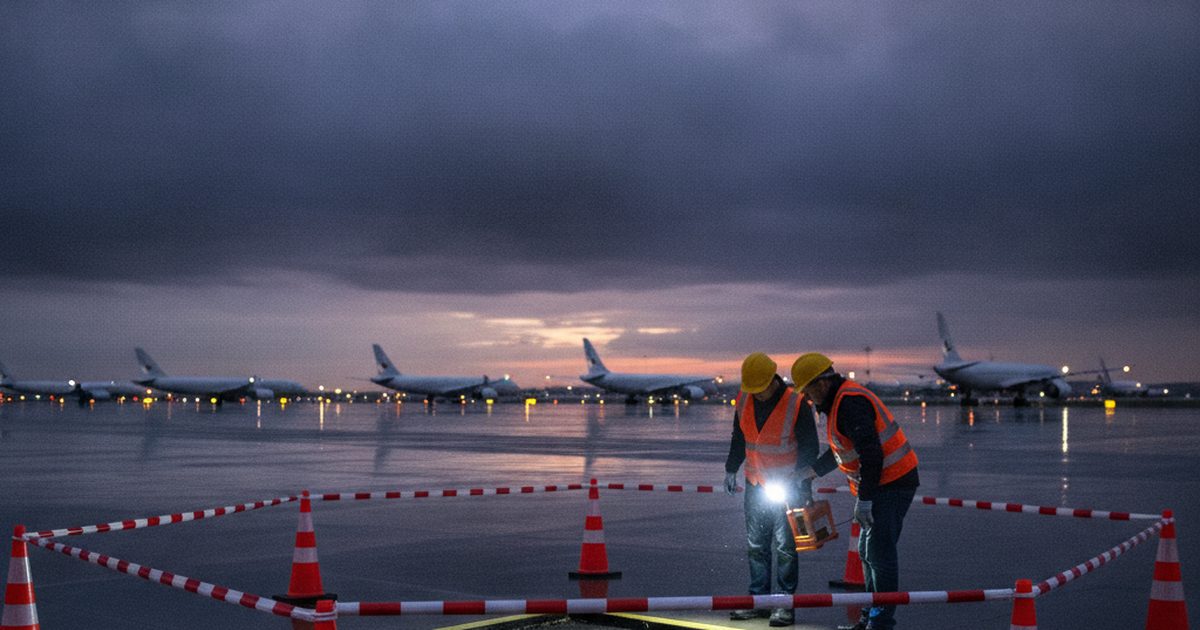
A Manchester Airport runway hole triggered a two-hour closure on the evening of Saturday, Sept. 19, 2026. Air traffic controllers grounded departures, diverted three inbound flights, and watched delays ripple through the schedule into the night. It was the second reported runway-surface hole at the airport in under three weeks.
Controllers pulled Manchester Airport‘s Runway 05L/23R, its primary runway, out of service after spotting the defect. As a result, controllers metered arrivals and departures at reduced capacity while crews worked the pavement. Aviation News UK reported on X that controllers were regulating arrivals specifically “due to a hole in Runway 23R/05L.” Meanwhile, travel-data service Inrix logged average departure delays of roughly 50 minutes during the disruption window, according to The Independent.
At least three inbound flights — arriving from Antalya, Pisa, and Rhodes — diverted to Liverpool while the runway was out of action. Additionally, a Pegasus Airlines flight from Istanbul’s Sabiha Gökçen Airport diverted to London Stansted instead. The carrier told stranded passengers it was working to limit the delay’s effects and would schedule a new onward flight.
A Manchester Airport spokesperson confirmed only that “one of our runways closed for a short period today to allow routine maintenance to take place.” The spokesperson declined to publicly characterize the issue as a hole. However, the runway reopened the same evening. Knock-on delays continued afterward as crews repositioned aircraft.
Second Manchester Airport Runway Hole in Three Weeks
Saturday’s closure was not an isolated event. Manchester’s “Delta Zulu” runway crossing point suffered a separate hole on Aug. 31, 2026, closing that section of the airfield for hours over a bank-holiday weekend and causing similarly heavy disruption. Two unexplained pavement failures have now struck the same runway system inside a three-week span. Overall, that pattern points to a maintenance or repair-material question the airport has not addressed on the record.
A Runway Hole Is a Foreign Object Debris Problem, Not Just a Delay Problem
Framed only as a scheduling headache, Saturday’s closure understates the real hazard. A hole or spalled section of runway pavement is itself a foreign object debris source. Jet blast or aircraft tires can pick up loose asphalt, concrete, or sealant fragments dislodged from a failing surface. From there, a following aircraft can ingest the debris into an engine or take a hit to the fuselage. In fact, that is the same mechanism behind an Aeroitalia 737’s tire blowout at Cagliari-Elmas Airport last month. Debris already lying on the runway surface punctured a tire moments after takeoff. Closing a runway the moment crews spot a defect is the right call. Still, it only prevents an incident if the underlying pavement failure gets fixed rather than patched and revisited weeks later.
Manchester is not the only major hub wrestling with a recurring runway-surface pattern this year. For example, Chicago O’Hare logged five tire failures in two weeks before the FAA opened a runway-debris investigation there. Repeat incidents at the same location are usually the tell. They separate a one-off FOD event from a systemic pavement or housekeeping problem. Manchester’s back-to-back holes fit that pattern.
The airport has not said what caused either the Aug. 31 or Sept. 19 defect, or whether the two are connected. Additionally, The Mirror and the Manchester Evening News corroborate the account above. Both outlets cite Aviation News UK and Inrix data consistent with the airport’s own maintenance-closure statement.
Stay informed — subscribe to FODNews for daily coverage of FOD incidents and prevention worldwide.