A Munich Airport vehicle collision left a 32-year-old cleaning company employee fighting for his life. His car slammed into a parked passenger jet’s engine, then a mobile boarding staircase, in the pre-dawn hours of Sept. 19. German prosecutors have since opened a criminal investigation. They’re calling it a case of “dangerous interference with air traffic” — a charge normally reserved for far more deliberate acts.
Munich Airport Vehicle Collision Unfolds During Curfew Hours
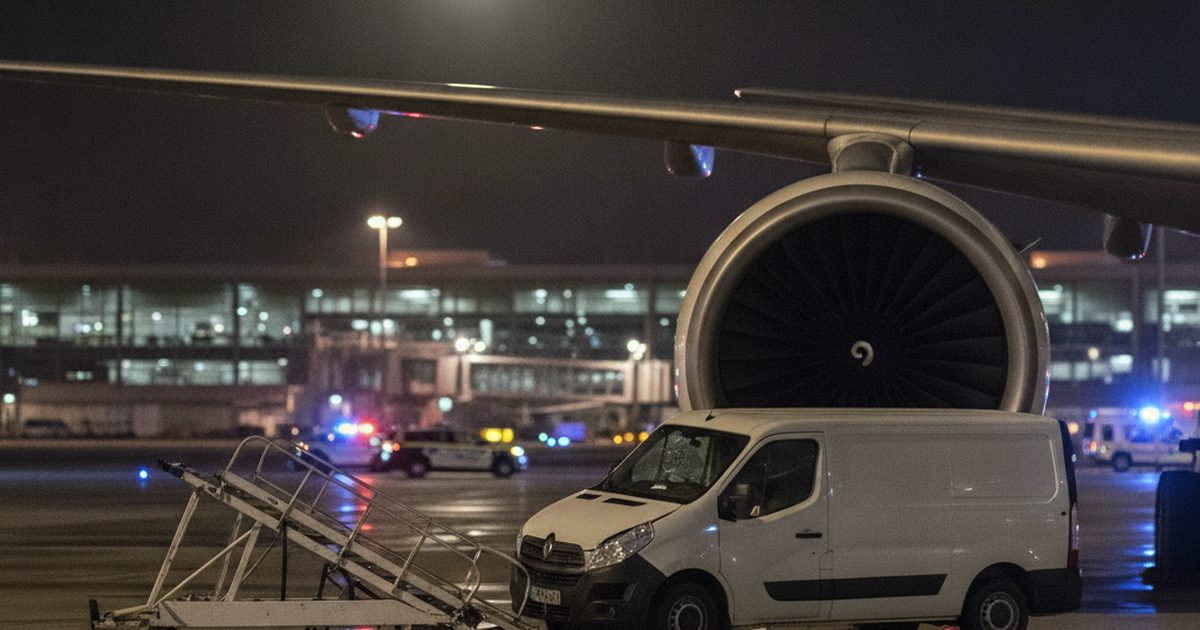
The crash unfolded around 3 a.m. local time on a remote apron at Munich Airport, during the mandatory midnight-to-5-a.m. curfew when no scheduled flights operate. The aircraft, an empty widebody jet from a Lufthansa-family carrier, sat parked away from the terminal with nobody aboard. According to Deutsche Welle, the driver’s car struck one of the jet’s engines first. It then careened into an unmanned passenger staircase nearby. Police say the driver may have suffered a medical impairment before losing control. Even so, the exact cause is still under investigation.
The man was airlifted by rescue helicopter to a Munich hospital. His condition remains “critical and life-threatening,” a police spokeswoman said. Still, no passengers or crew were aboard the aircraft. Airport officials confirmed flight operations were unaffected. Curfew hours meant a driver could travel well off any designated ground route without immediately encountering other traffic.
Multi-Million-Euro Damage, a Serious Charge
Police estimate damage to the engine and staircase at several million euros. Meanwhile, Munich prosecutors have ordered an accident-reconstruction report. They’ve also opened a formal investigation for “dangerous interference with air traffic” (gefaehrlicher Eingriff in den Luftverkehr). Notably, the charge signals authorities are treating the incident as more than a routine traffic accident. Still, there’s no indication yet of intent.
For FOD professionals, the case is a reminder. A ground vehicle can inflict engine damage just as severe as a bird strike or a stray tool. The mechanism differs; the consequence doesn’t. In fact, it fits a familiar pattern. Ground equipment striking parked aircraft engines has become one of the more persistent FOD-adjacent hazards on ramps worldwide. At Belgrade, ground handling equipment struck an Air Serbia ATR 72 badly enough to ground the aircraft for three months. Similarly, at Lagos, a ground-service truck tore into an Air Peace A320’s engine. The airline called it sabotage. None of the three cases involved debris in the traditional sense — no bolt, no bird, no tire fragment. Each put a vehicle in direct contact with an engine intake. That’s the same failure point every FOD program is built to protect.
Curfew Hours, Unmanned Equipment, and Medical Fitness
Munich’s overnight curfew protects the ramp from flight traffic. Yet it did nothing to stop a ground vehicle from reaching a parked aircraft unsupervised. That gap is exactly what ramp-safety protocols are meant to close: unmanned equipment and unattended aircraft sitting exposed during low-traffic hours. Vehicle-access restrictions near parked aircraft are one obvious lever. So are stricter curfew-hours patrols and medical-fitness screening for ground staff operating near flight-critical hardware. So far, investigators have not said whether Munich Airport had specific restrictions on cleaning-company vehicle routes near remote parking positions.
The driver’s condition and the criminal investigation’s findings remain pending. FODNews will follow the case as German authorities release further detail.
Sources
- Deutsche Welle — “Driver seriously injured in collision with plane at Munich Airport” (Sept. 19, 2026)
- tz.de — “Schwerer Crash am Flughafen München: Reinigungsauto rammt Passagierjet” (updated Sept. 21, 2026)
- Passauer Neue Presse — “Fahrer schwebt nach Autounfall mit Flugzeug in Lebensgefahr” (Sept. 21, 2026)
Stay informed — subscribe to FODNews for daily coverage of FOD incidents and prevention worldwide.